Elmhurst Epoxy Flooring has installed epoxy flooring in Worth and the surrounding suburbs for more than 20 years, and the detail we check first on any garage job is one most buyers never read: the category printed on the product label. In Illinois that category sets a legal ceiling on the solvent a coating may contain. The ceiling binds the crew applying the product as well as the store that sold it, so we treat it as our responsibility rather than the supplier’s.
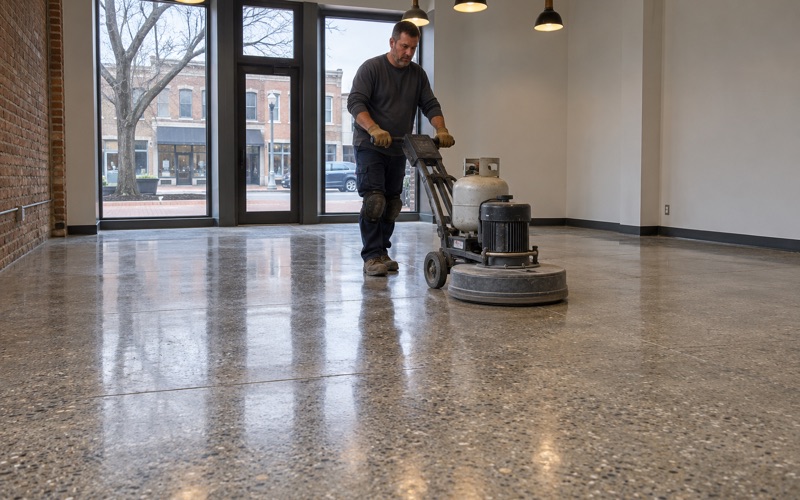
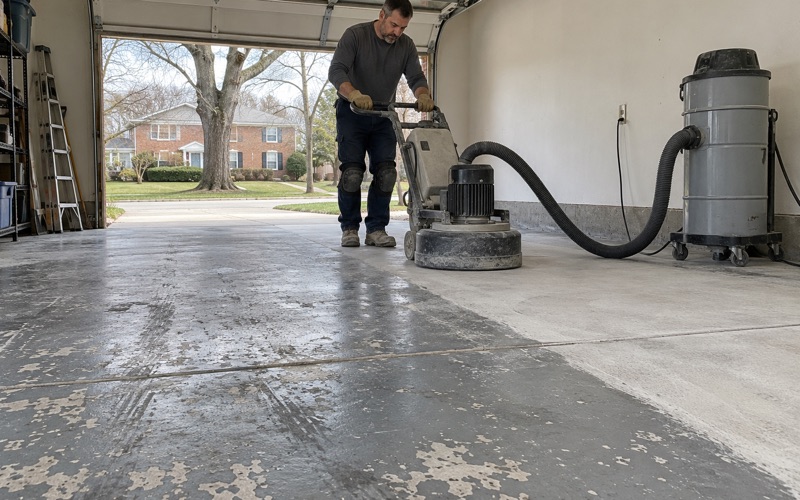
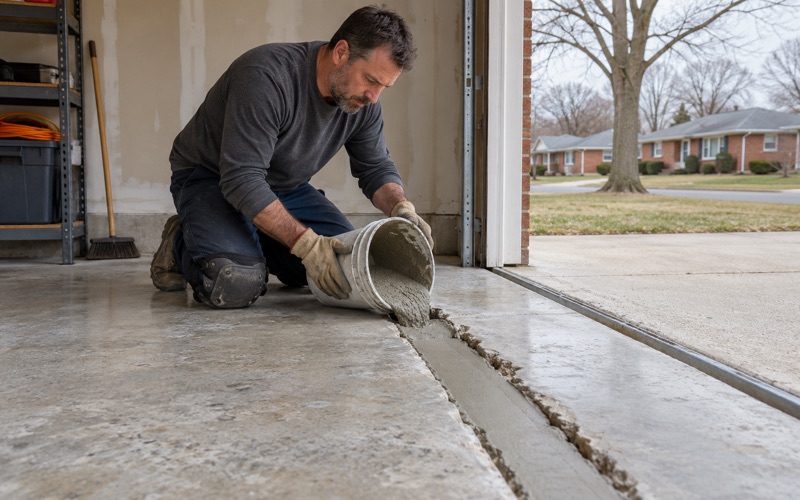
The concrete comes next. We open every slab with a diamond grinder or a shot blaster instead of an acid etch, which leaves a real surface profile for the primer to bite into. Before a price is final we map cracks, spalls and any old coating, and a moisture test goes into the written scope whether the slab sits under a garage or a basement.
Our proposals name the product line, the number of coats and the finished thickness. That gives you a way to check the finished floor against the quote, and it shows which VOC category each product carries. If a slab needs repair or replacement before it should be coated at all, the proposal says that too.
A Public Works Garage on Neenah Avenue
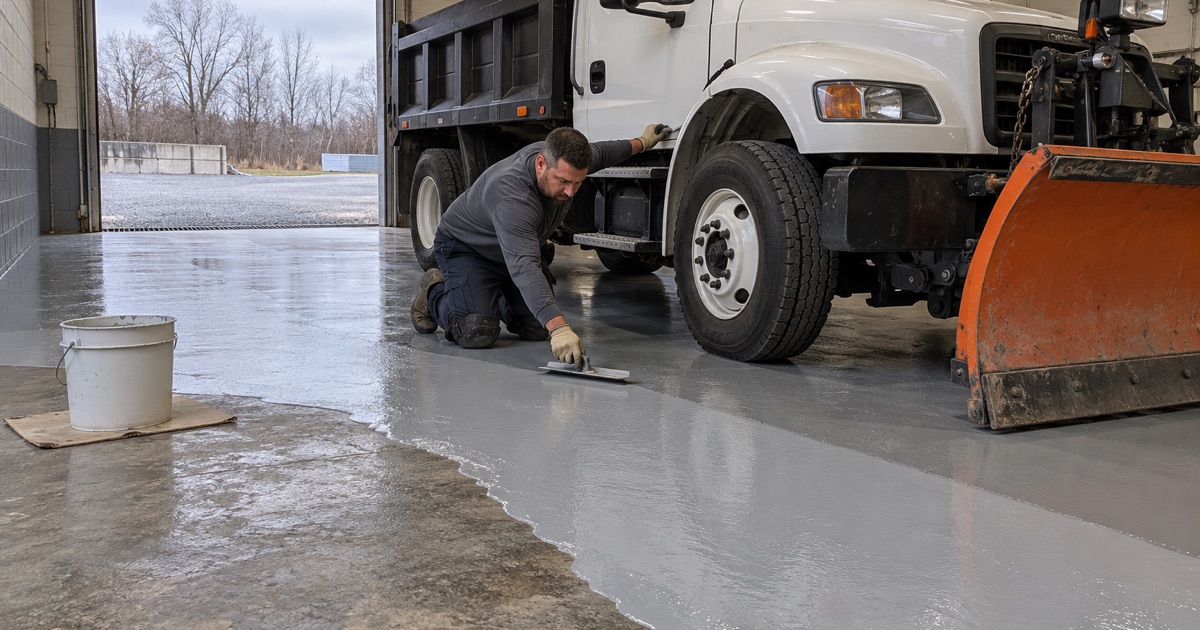
The Village of Worth’s capital improvement plan for fiscal years 2027 through 2031 lists the Public Works Yard at 10934 South Neenah Avenue among the buildings the village owns and maintains. One row budgets $25,000 a year from fiscal 2027 through 2030 for garage maintenance, described as including painting, HVAC and indoor construction. The plan itself notes that adopting it is a statement of intent and not an appropriation of funds.
The same plan lists other work at the yard, including brick wall tuckpointing at $15,000, north lot asphalt at $60,000 and south lot asphalt and concrete at $500,000. It also lists the purchase of 10932 Neenah Avenue for a new Public Works and Police building. None of those rows names a floor coating, a sealer or a product.
Why a fleet garage makes a useful example
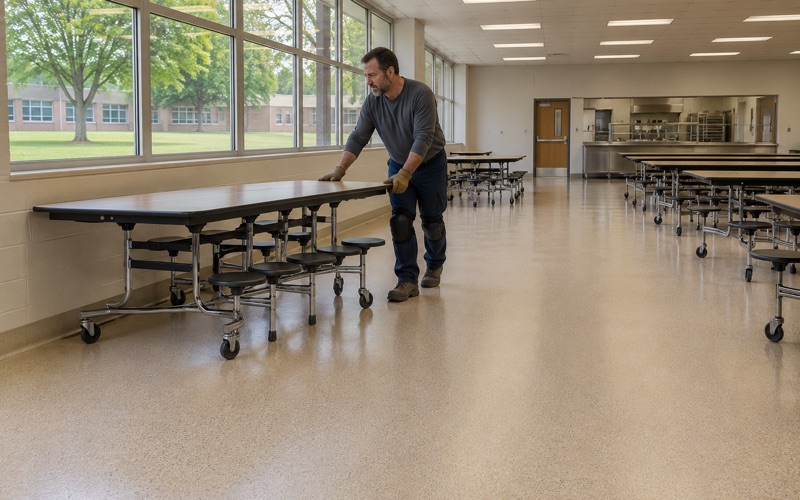
We have not read the village’s specifications, its product choices or the condition of that garage floor, and the village is not our customer. We use the yard here because a municipal fleet garage is the kind of floor where both Illinois labels are plausible. A shop floor that sees frequent heavy scrubbing with strong cleaners, or chemicals beyond ordinary foot and tire traffic, sits right on the line between the two categories this page explains.
The same question in a house garage
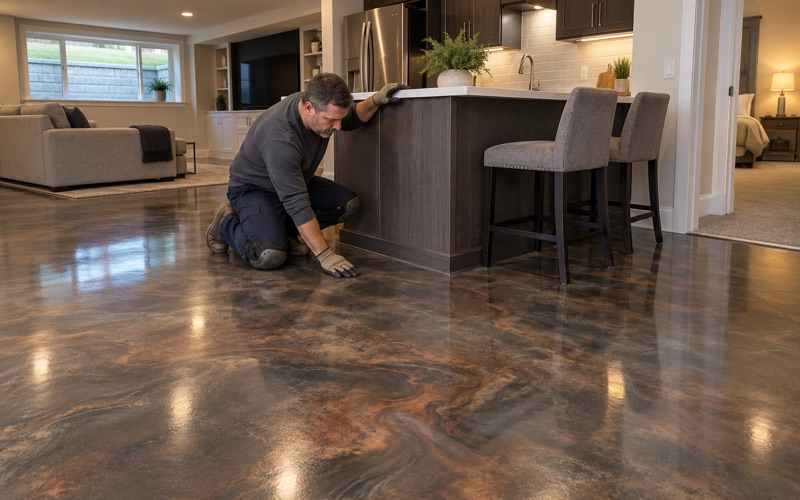
Worth’s housing turns the label question into a retrofit question. About three-quarters of the village’s homes were built between 1950 and 1979, so nearly every garage or basement floor we would coat here is a slab several decades old. A homeowner’s two-car garage rarely needs an industrial maintenance product, but the choice should still be made on purpose and written down.
Condominium and association buildings
The village also has a large layer of mid-size apartment and condominium buildings, with 1,060 units in buildings of 10 to 19 units. In those buildings a common garage, storage room or laundry floor is decided by the association or owner, not the person living in a unit. We write the proposal to whoever holds that decision, so the coating category and scope are approved by the right party.
Looking for epoxy-flooring closer to Evergreen Park? See Epoxy-Flooring in Evergreen Park.
Illinois VOC Limits Reach the Applicator, Not Just the Store
The rule that governs this sits in Title 35 of the Illinois Administrative Code, Part 223, Subpart C, which covers architectural and industrial maintenance coatings. Section 223.305 applies it to anyone who supplies, sells, offers for sale or manufactures such a coating for use in Illinois. It also applies it to any person who applies or solicits the application of one anywhere in the state.
What that means for a contractor
That second clause is the one that matters to you as a buyer. A contractor cannot point at the distributor if the wrong product goes down on your floor, because the person rolling it out is covered by the same section as the person who sold it. We select products inside the limits for floor and industrial coatings for exactly that reason, and the product line in our proposal lets you look the category up yourself.
The rule does not ask you to become an expert in coatings chemistry. It asks the person doing the work to know which category a product falls in and to keep it there from the pail to the floor.
What sits outside the rule
The subpart excludes coatings sold or made for use outside Illinois, aerosol products, and containers of one liter or less, which is a little over a quart. A spray can of touch-up paint or a small tin for a threshold repair is not held to these limits. A full garage floor never comes in containers that small, so the limits apply to every system we would put down on one.
Neighboring categories with their own numbers
Section 223.310 lists limits for coatings manufactured on or after July 1, 2009, and several of them touch concrete work. Primers, sealers and undercoaters are capped at 200 grams per liter, concrete curing compounds at 350 and waterproofing concrete and masonry sealers at 400. A multi-coat floor can involve more than one category, so we check each product in the system against its own line rather than the topcoat alone.
Floor Coating or Industrial Maintenance: The Label Decides
Two categories cover nearly every garage floor product, and the difference between them is 90 grams per liter. A product labeled as a floor coating is held to 250 grams per liter. A product labeled as an industrial maintenance coating is held to 340 grams per liter. Both numbers are ceilings rather than targets, so a product may sit well below either one.
Floor coatings
Section 223.307 defines a floor coating as an opaque coating labeled and formulated for application to flooring, including decks, porches, steps and other horizontal surfaces that may see foot traffic. Most residential garage systems fall here. The definition turns on both the formulation and the label, so a product does not drift into the category just because someone rolled it onto a floor.
Industrial maintenance coatings
The industrial maintenance category is narrower than its name suggests. It covers high-performance coatings formulated for substrates exposed to one or more extreme conditions and labeled for that service. The listed conditions include immersion in water, wastewater or chemical solutions, exposure to corrosive, caustic or acidic agents, repeated exposure above 250 degrees Fahrenheit, frequent heavy abrasion including repeated scrubbing with industrial solvents or scouring agents, and exterior exposure of metal structures.
How we choose between them
We start from what the floor will actually face, not from which number allows more solvent. A home garage that sees cars, foot traffic and ordinary cleaning is a floor coating job, and we price it with a floor coating product. Where a floor genuinely meets the conditions in the industrial definition, a product labeled for that service is the legal choice, and the proposal names it so nobody has to guess later.
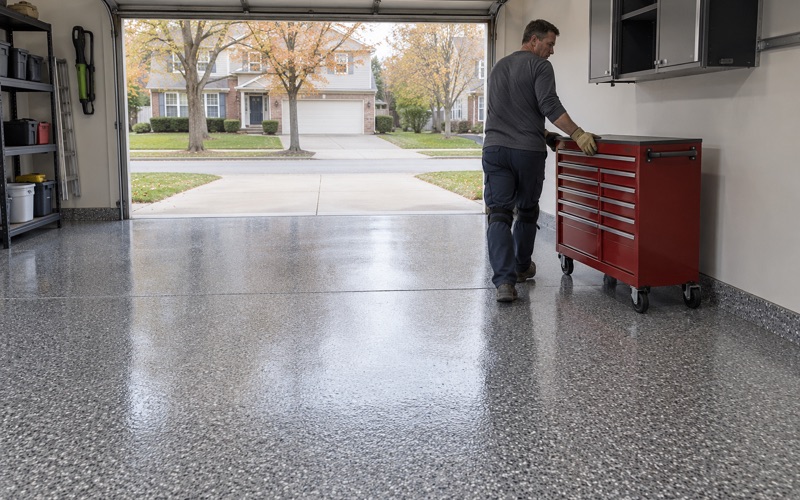
A common garage system pairs a 100% solids epoxy base with a polyaspartic or polyurea topcoat and a vinyl flake or quartz aggregate broadcast. We specify slip resistance by the broadcast and topcoat used, rather than promising it as a slogan. Whatever the system, each product’s data sheet should state its own VOC content, and we check that figure against the category on its label.
Cold Garages, Thinning and What a VOC Number Tells You
Section 223.310(e) closes the loophole a cold garage invites. No person who applies or solicits the application of an architectural coating may apply one that has been thinned to exceed its applicable limit. A compliant product stays compliant only as long as nobody pours extra solvent into the pail.
Why a cold slab is no excuse
Resin thickens as it cools, and on a cold slab the temptation is to thin it so it rolls out and levels. Thinning a product past its limit turns a legal coating into an illegal one, and it also changes the film the maker designed. We schedule cure by slab temperature and the dew point spread at the surface instead of the calendar, and an unheated garage in deep winter is told to wait.
If you are comparing quotes, ask each contractor which category every product carries and whether any of it will be thinned on site. A straight answer to both questions is a fair test of whether the rest of the proposal has been thought through.
What the number does not tell you
A VOC limit describes what is in the product, not how it smells during cure, how a room feels while it cures or whether the coating suits that room. A product inside its limit can still fail on a damp slab, which is why moisture testing such as ASTM F1869 calcium chloride or ASTM F2170 relative humidity probes belongs in the scope. We explain what a coating warranty leaves out before the job is sold, and moisture is the first exclusion we name.
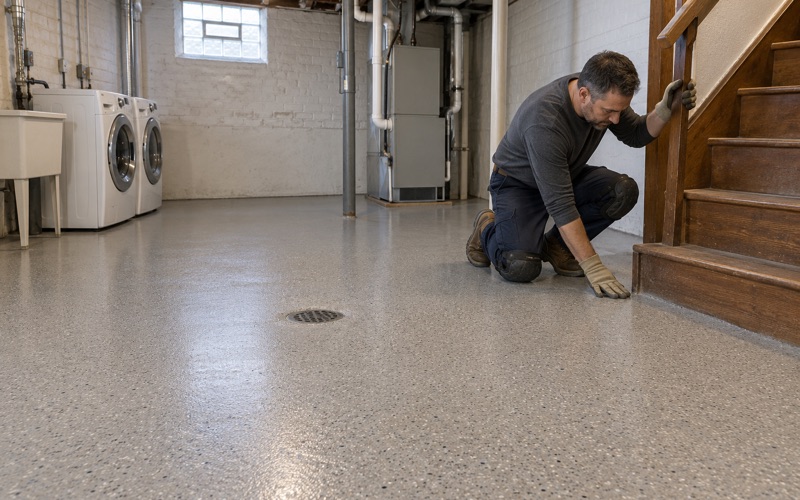
On a basement floor we read the slab for past water first, because no coating stops seepage, a sewer backup or a sump that cannot keep up. That check costs little and saves a floor that was never going to hold.
Before work starts in Worth
Worth requires contractors working in the village to register, with a $110 fee ($55 after June 30), a certificate of insurance naming the village and a $10,000 surety bond. The building department’s permit list names many remodeling projects but does not name flooring either way, so we ask before starting rather than assume. Home jobs over the state threshold get a written contract and the Home Repair: Know Your Consumer Rights pamphlet before any grinding, and grinding dust is captured at the machine by vacuum instead of being washed toward a drain.
- 20+ Years on Concrete
- Moisture Testing in Every Scope
- Ground, Never Acid-Etched