Elmhurst Epoxy Flooring has spent more than 20 years putting down epoxy flooring in Wood Dale garages, shop bays and commercial rooms, and every job starts the same way: we read the slab before we price the coating. Cracks, spalls and any old coating are mapped first, and if the concrete needs repair or replacement before it should be coated, we say so instead of selling over the problem.
Your proposal names the product line, the number of coats and the finished thickness, so the floor that goes down can be checked against the paper. A moisture test is written into that scope before the price is final, on a garage slab and a basement slab alike. What the warranty leaves out is explained before you sign, and moisture is the first exclusion we name.
This page looks at one job a sealed floor makes easier but never makes unnecessary: cleaning up spilled coolant. It happens in fleet bays and family garages alike, and it is worth thinking through before you choose a color.
An Antifreeze Branch on Beinoris Drive
Crystal Clean runs its Chicago Antifreeze branch from 298 Beinoris Drive in Wood Dale. The company’s branch page says the location specializes in antifreeze services and serves the greater Chicagoland area and northern Illinois. We have no connection to the company and have not been inside the building; what matters for a floor is the safety data sheet published for its coolant.
The branch page does not say whether collection, recycling or storage happens on Beinoris Drive, and we do not guess. The useful point for anyone with a garage is simpler: a company whose listed service is antifreeze publishes a cleanup procedure for its coolant, and that procedure is worth following.
What the Coolant’s Data Sheet Says It Is
Crystal Clean’s safety data sheet for its Heavy-Duty OAT Extended Life Antifreeze/Coolant Premix, issued January 21, 2026, lists the premix as at least 45 percent ethylene glycol, with diethylene glycol up to 5 percent. It labels the product harmful if swallowed and states that the single lethal dose for humans is about 100 ml. The same sheet gives the color as clear and describes the coolant as completely soluble in water.
Those last two lines are the ones a floor contractor should notice. A liquid with no color that vanishes into water behaves very differently on bare concrete than on a sealed surface, and the cleanup instructions on the same sheet assume you can see what you are cleaning.
What the Sheet Says About a Spill
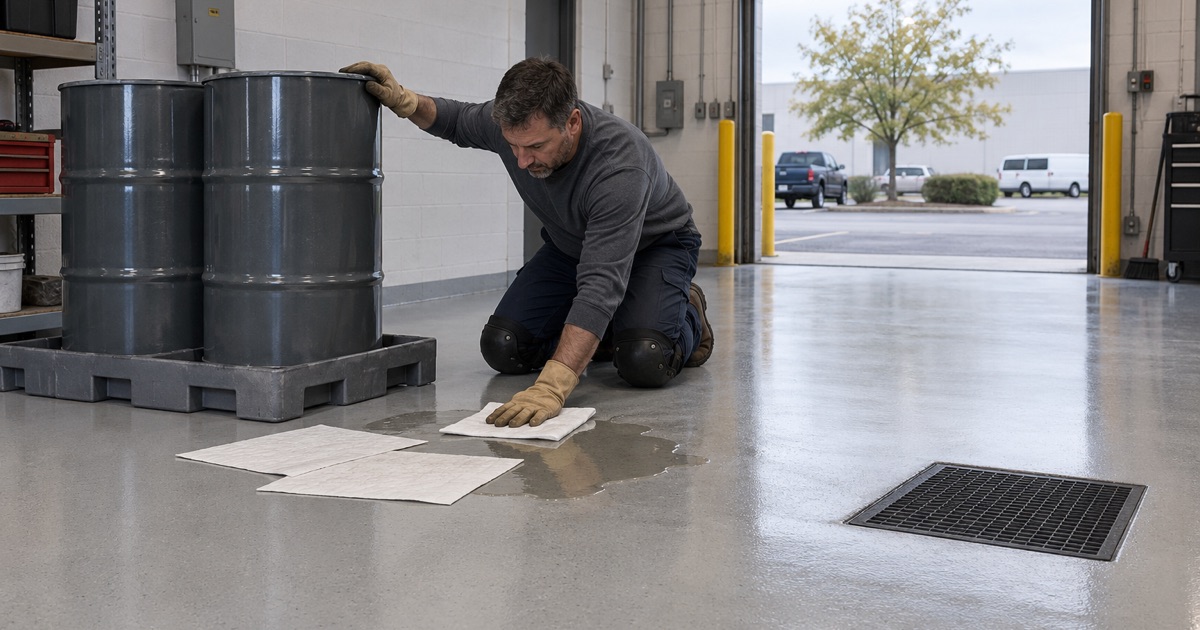
For a small spill, the sheet says to absorb the spillage with suitable absorbent material and then clean the surface thoroughly to remove residual contamination. For a large one, it calls for diking the liquid, absorbing it in vermiculite, dry sand or earth, and placing it into containers. Spilled coolant is never to be returned to its original container for reuse.
Under environmental precautions, the sheet says to avoid discharge into drains, water courses or onto the ground. Its storage section adds a line worth reading in any garage that also holds pet food: keep the product away from food, drink and animal feedingstuffs.
Looking for epoxy-flooring closer to River Grove? See Epoxy-Flooring in River Grove.
Absorb and Wipe, Not Hose It to the Floor Drain
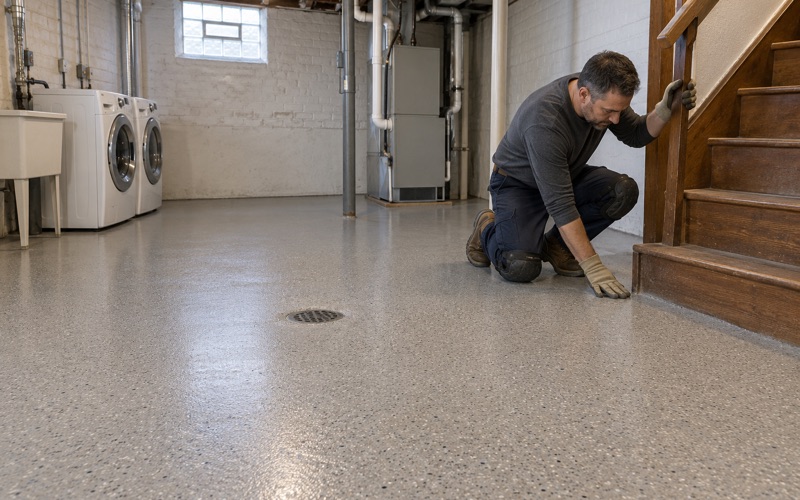
The old shop habit after a coolant change is to grab a hose and push whatever reached the floor toward the drain. The maker’s own sheet points the other way: soak it up, clean off what remains, and keep it out of drains. In a garage or service bay, the floor drain is exactly where a hosed spill ends up.
Why the Surface Decides Whether the Routine Works
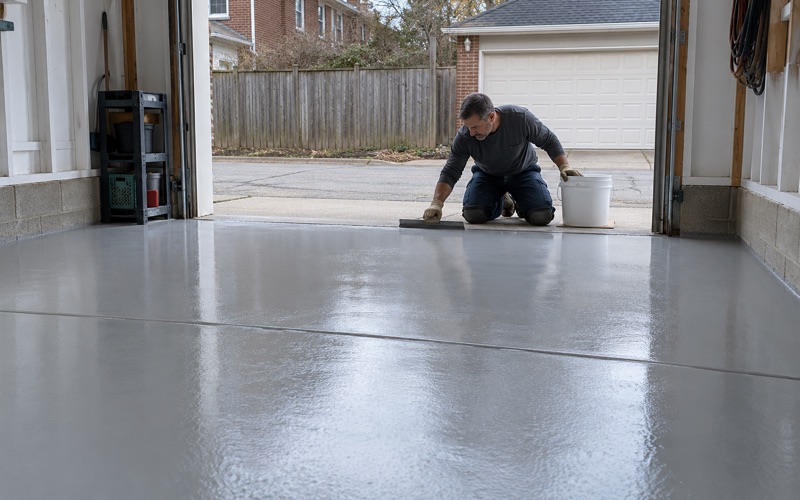
Absorb-then-clean only works if the liquid is still on top of the floor when the absorbent arrives. On bare, porous concrete, part of a glycol spill soaks into the slab, out of reach of a pad or a scoop of clay absorbent, and the residue the sheet wants removed stays in the surface. On a sealed floor the liquid sits where it landed, the absorbent takes up the bulk, and a damp wipe takes the rest.
Sealing has to mean a film on top, not just a harder surface. A lithium silicate densifier toughens bare concrete and cuts dusting, but it leaves the pores open enough that a glycol spill can still wick in, so it is the wrong answer if spill cleanup is the reason for the job.
A coating does not make antifreeze safe, and it does not replace the cleanup procedure. What it changes is whether that procedure can be carried through to the end. That is the honest version of the pitch, and it is the only one we give.
Building a Floor That Takes Repeated Wet Cleaning
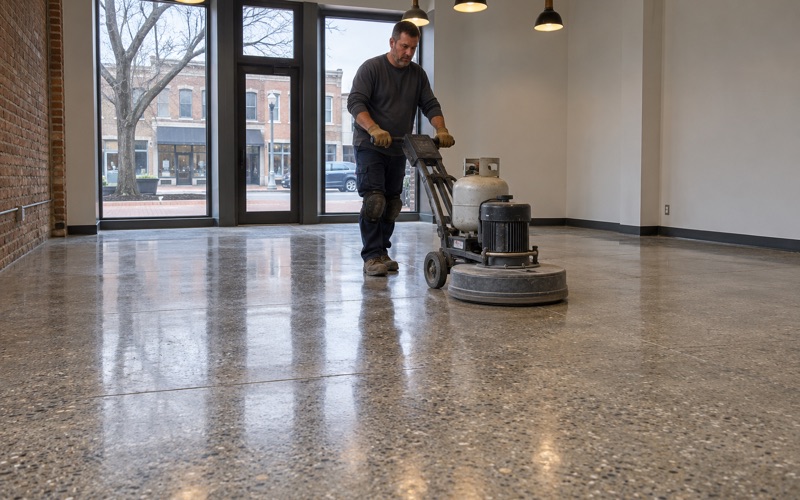
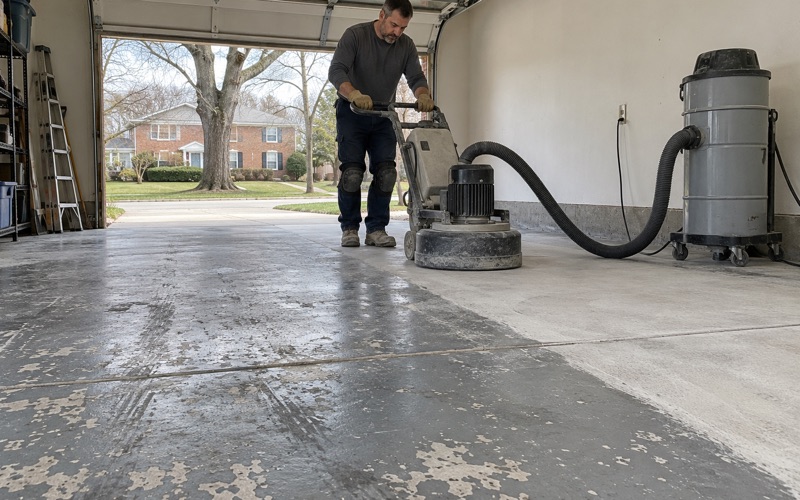
A floor that gets wiped and mopped often needs a coating that bonds hard and a topcoat that tolerates repeated cleaning. We open every slab with a diamond grinder or a shot blaster, never an acid etch, so the coating has a real profile to grip, the kind measured on the ICRI CSP scale. A 100% solids epoxy base under a polyaspartic or polyurea topcoat is a common garage build, and the proposal states which system you are getting.
Grinding makes its own fine dust, and we handle it the way the coolant sheet handles coolant. The dust is captured at the machine by a vacuum rather than rinsed toward a floor drain, a sump or a storm inlet.
Testing the Slab Before It Is Sealed
A coating that lets go of the slab can be worse than none for spill cleanup, because coolant can creep under a lifted edge where no wipe will reach. Moisture pushing up from below is a common reason a coating lifts, so the slab is tested before it is sealed. Depending on the slab, that means ASTM F2170 in-situ relative humidity probes or an ASTM F1869 calcium chloride test, with the ASTM D4263 plastic sheet test as a quick first screen.
Clear, Water-Soluble and Hard to See on Gray Concrete
Ordinary garage concrete is gray, a little uneven and marked by years of use. A puddle of clear coolant on it reads as a damp patch at best, and once some of it soaks in, the spot can look like nothing more than a freshly mopped floor. Because the premix mixes completely with water, meltwater dripping off a car dilutes it further instead of separating from it.
What a Light, Sealed Floor Shows You
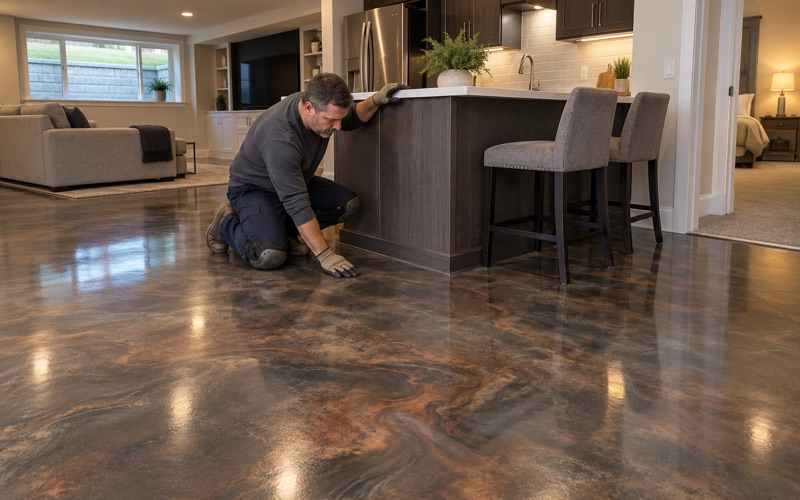
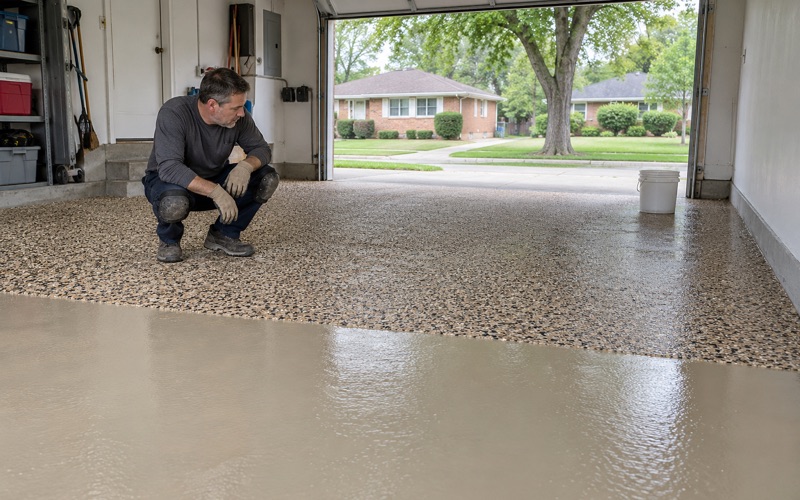
On a light-colored sealed floor, a wet patch catches the light and stays where it fell. You can see where the spill starts and stops, you can see when the absorbent has picked it up, and you can see whether the final wipe left anything behind. That is a practical reason to lean toward a lighter base color in a garage where coolant gets topped off.
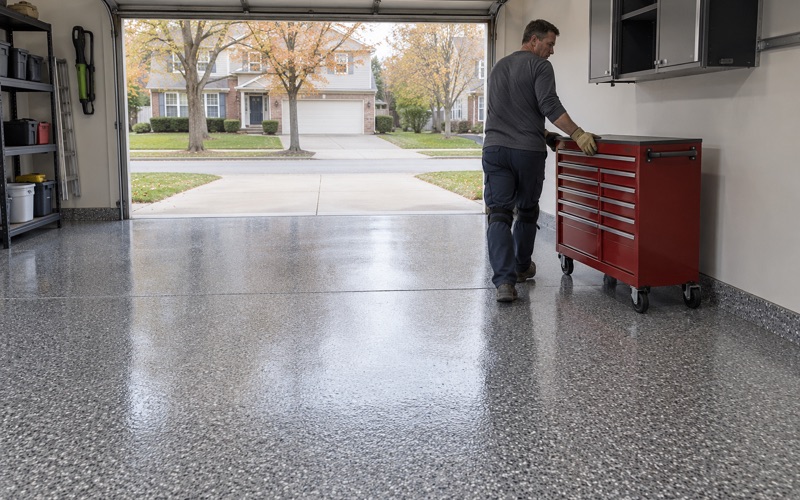
A vinyl flake broadcast hides dust and tire marks well, but a busy, dark blend can hide a drip about as well as bare concrete does. We lay out samples and talk through that tradeoff, so the choice rests on how the floor is used rather than on looks alone.
Winter Brine and Hot Tires on the Same Floor
Coolant is not the only liquid crossing a Wood Dale garage floor. Brine and rock salt ride in on tires all winter, so we choose garage systems that stand up to those deicers as well as to glycol and the scrubbing that follows both. Cure schedules follow slab temperature and the dew point spread at the surface, and an unheated garage in deep winter is told to wait rather than coated on a calendar date.
Hot tire pickup is the other garage test: tires warm from a drive can soften and lift a weak coating where they park. The topcoat and the finished thickness named in the proposal are chosen with that in mind, not fixed after the first peel.
Coolant Changes in Shop Bays and Home Garages With Pets
Wood Dale is a city in Addison Township, DuPage County, with 14,012 residents at the 2020 census. Census housing tables count 4,112 of its 5,342 occupied units as owner-occupied, or 77.0 percent. Owner-occupied single-family detached homes number 2,635, and a home garage is where a do-it-yourself coolant change usually happens.
Pets and Antifreeze Residue
Dogs and cats spend time on garage floors, and the human lethal-dose line on the coolant sheet is a plain reminder of what ethylene glycol is. We are not veterinarians and we do not quote figures for animals. What we can say is that a sealed, light floor makes a spill easier to find and the sheet’s cleanup easier to finish, and that the cleanup still has to happen every single time.
If a coolant change happens at home, it helps to do it on the sealed part of the floor rather than on a strip of bare concrete at the apron, and to keep the pets inside until the wipe is done. A drip you can see on a light floor is a drip you can deal with before anyone walks through it.
Fleet and Service Bays
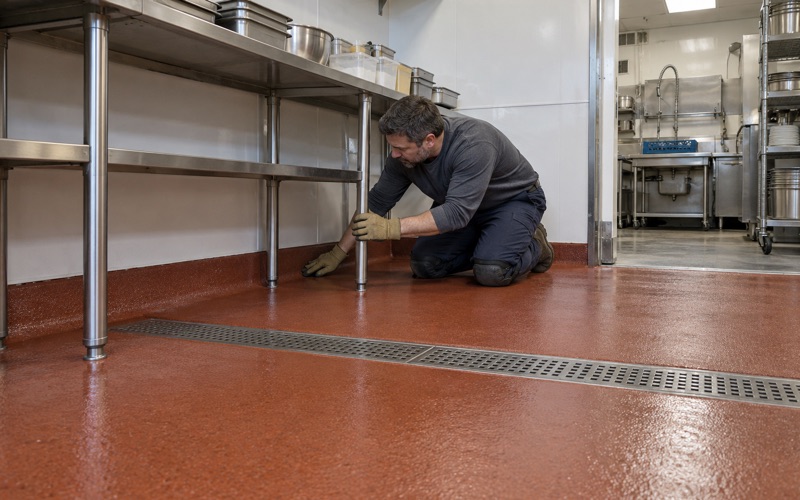
Commercial bays where vehicles are serviced see the same spill at a larger scale and more often. The floor needs a texture that stays walkable when wet, which we specify by the broadcast aggregate and topcoat used rather than promise as a slogan, and a finish that lets absorbent sweep up cleanly. The spill routine there still ends with used absorbent in a container, not in the drain.
A quartz aggregate broadcast locked under the topcoat is a common way to build that texture in a service bay. Coarser grit grips better but holds more residue, so the grade is chosen with the people who will be mopping it.
Before Work Starts in Wood Dale
The City of Wood Dale requires every contractor to register with its Community Development Department before a permit issues, with a certificate of insurance carrying $2,000,000 in public liability coverage that names the city. Homeowners doing non-licensed work on their own property do not register. Our residential jobs over the state threshold also get a written contract and the Illinois Home Repair: Know Your Consumer Rights pamphlet before any grinding starts. Registration has to be in place before the permit, so we settle it before a Wood Dale job goes on the calendar.
- 20+ Years on Concrete
- Moisture Testing in Every Scope
- Ground, Never Acid-Etched