Elmhurst Epoxy Flooring has spent more than 20 years installing epoxy flooring in Winnetka and the surrounding suburbs, and some of the floors that matter most never see a car. A chemical mixing bay, a sprayer wash pad or a pesticide storage room is held to a different standard than a garage, because what lands on it is regulated. We build resin floors for those rooms with the chemistry and the cleanup routine settled before a product is chosen.
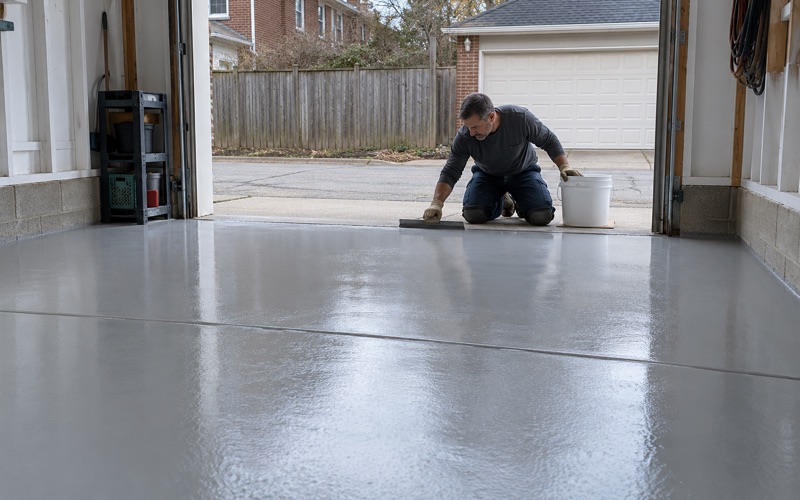
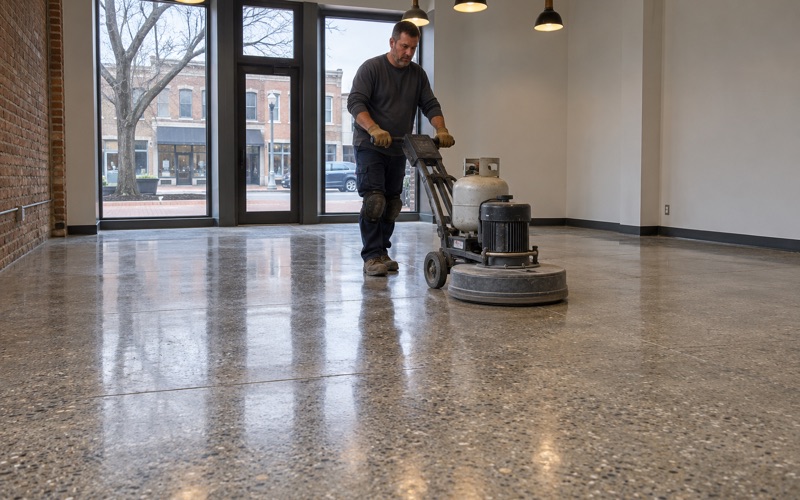
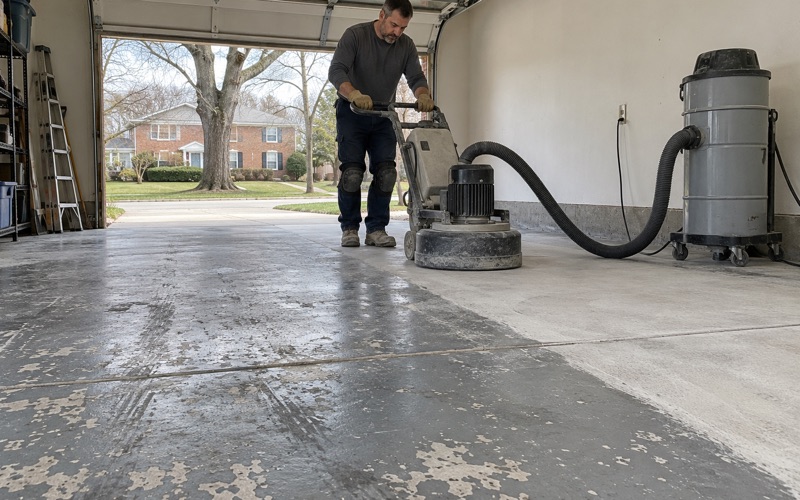
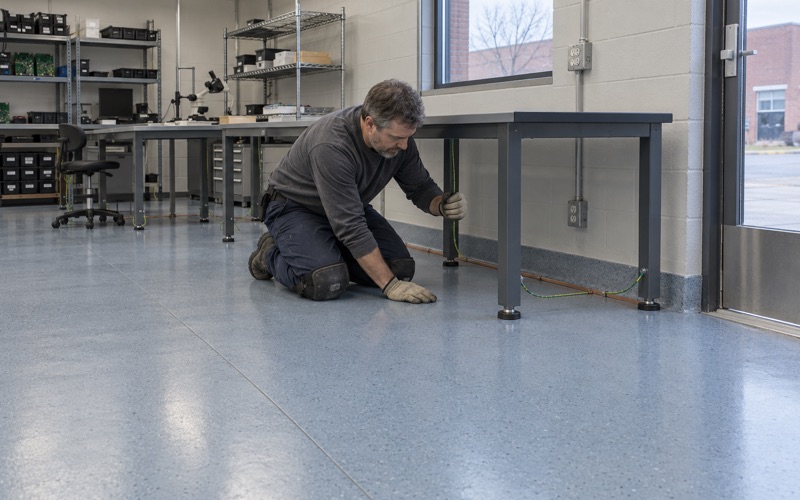
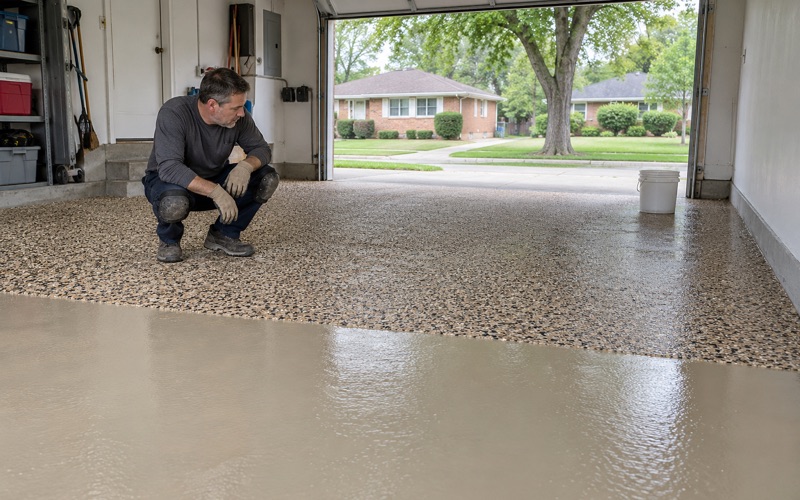
The work starts the same way on every slab. We map cracks, spalls and old coatings, open the concrete with a diamond grinder or a shot blaster rather than an acid etch, and test for moisture before the price is final. The written proposal names the product line, the coat count and the finished thickness, so whoever manages the building can hold the installed floor against the quote.
This page looks at one kind of building in particular: the turf maintenance shop, where the floor is part of how spills are contained and cleaned. It is not a pitch for a coating as a compliance shortcut. We say plainly where the floor’s job ends and the permit, the structure and the crew’s own routine take over.
A Golf Maintenance Building on a Floodplain Campus
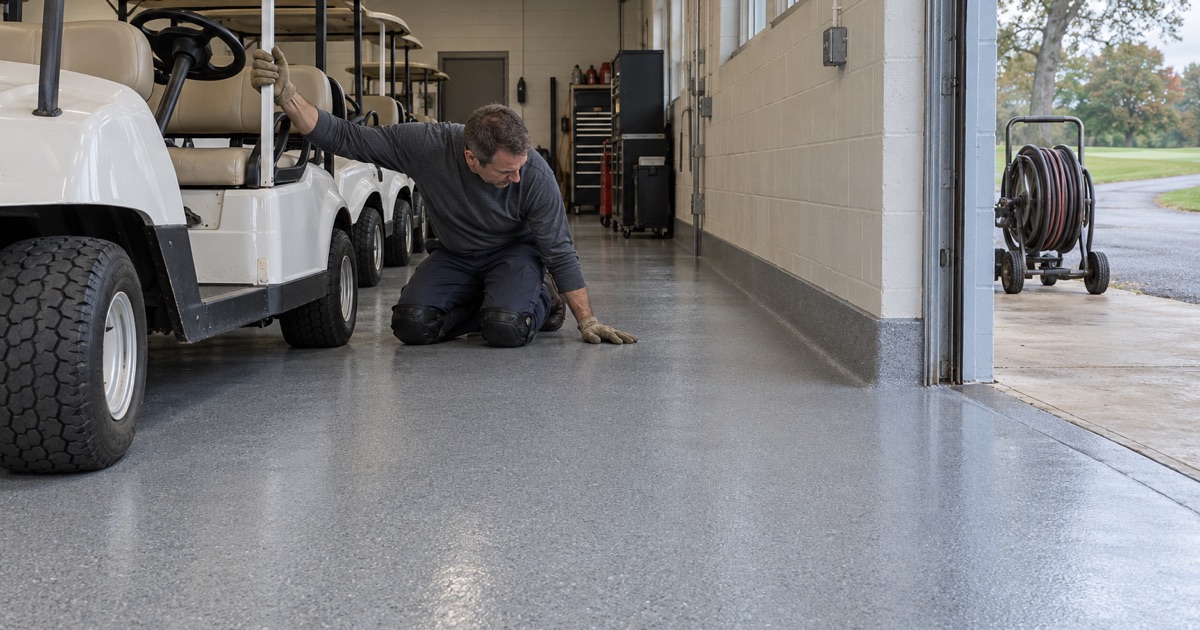
What the park district has on record
In June 2025 the Winnetka Park District presented an update to its Comprehensive Master Plan, and the facility evaluation by Williams Architects listed a Golf Maintenance Building among the buildings it reviewed. The same update carried a site note that the entire main campus lies within a floodplain, so any improvements would require a floodplain impact review and compliance measures. The plan goes on to recommend a master plan and feasibility study of that main campus.
Why this building is not a garage
Winnetka Golf Club on Oak Street runs an 18-hole par 71 course and a 9-hole par 27 course, with the first nine holes dating to 1914. The club was renovated from August 2022, with stormwater pumped to two water features and reused for irrigation. Keeping that much turf in play means a crew that mixes, loads and rinses sprayers as an ordinary part of the week. Wherever that mixing and rinsing happens, the floor stops being a finish and becomes a containment surface.
What we have and have not seen
We have not read the evaluation’s findings for the Golf Maintenance Building, and we do not know whether it has a mix-and-wash bay, what permit class it holds, where it sits on the campus or what its floors are made of. Neither the park district nor KemperSports, which was brought in to manage the club in November 2022, is a client of ours. What follows describes the kind of floor that work calls for, not a report on any particular room.
One point does carry over from the master plan. On a campus the park district describes as a floodplain, building work around a room like this goes through that floodplain review, and the floor gets chosen inside that process rather than ahead of it.
Looking for epoxy-flooring closer to Northlake? See Epoxy-Flooring in Northlake.
What Illinois’ Lawncare Rule Asks of a Sprayer Wash Floor
Containment built from impervious materials
Illinois governs lawncare spills, wash water and rinsate under Part 256 of Title 8 of the Illinois Administrative Code. Its general class permit section says the containment area shall be constructed of impervious materials as required by the Act, and that it shall be compatible with the materials applied by the application device. A Class C permit adds a minimum capacity of 120 gallons or 120 percent of the largest applicator tank, plus a sump, and Class B and C areas exposed to precipitation must hold the volume of a 6-inch rain storm.
The parts a floor does not supply
Capacity, the sump, a curb or a transfer tank belong to the permit and the structure, not to the coating. A resin floor does not hold a permit, does not by itself bring a facility into compliance with Part 256, and is not flood protection. A 1993 University of Illinois extension article suggested golf superintendents would probably want a general Class C permit with a permanent structure, and called one roofed building holding the pad, sump and pesticide storage advisable.
Impervious means cracks, joints and edges
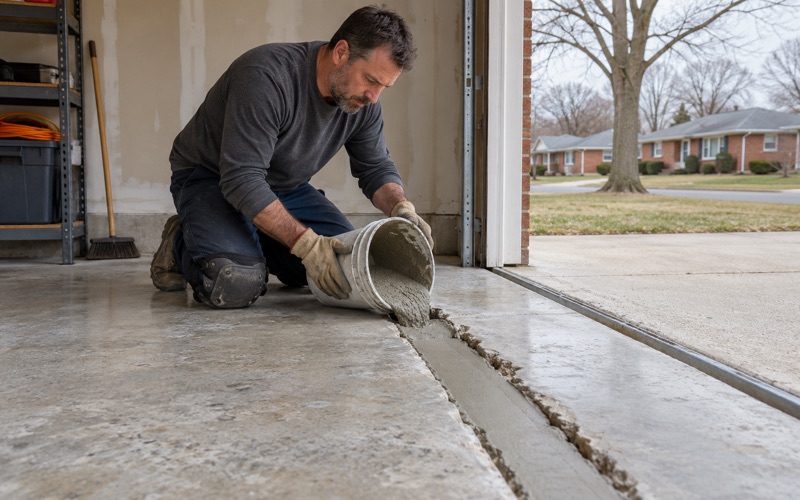
Bare concrete looks solid, but a shrinkage crack, an open saw-cut joint or a gap where the slab meets the wall is a path for rinsate to leave the area. We map every one of those before grinding, fill and seal them as part of the scope, and tell the owner when a slab is too broken to be worth coating. The finished system then runs continuously across the field with no open line in it.
The edge matters as much as the field. Where the containment area meets a wall or a curb, we carry an integral cove up the vertical surface so a spill cannot slip under a baseboard or into the cold joint at the base of the wall. A floor that is sealed in the middle and open at the perimeter is not impervious in any sense the rule would recognize.
Matching the Floor to the Chemicals the Crew Uses
Start with the product list
Compatibility in Part 256 is measured against the materials actually applied, so we ask for the list: the herbicides, fungicides, insecticides, fertilizers and adjuvants the crew mixes, along with their safety data sheets. We check the resin system against those products rather than assuming a generic rating covers them. If something on the list is a poor match, we choose a different system or tell the owner a coating is the wrong tool for that room.
Product lists change. A crew that adds a new fungicide program or switches fertilizer suppliers mid-season has changed what the floor sees, and the safety data sheets for the new products are worth a second look against the system that went down. That is why the product list belongs in the written proposal, where the comparison can be made later.
Building up the system
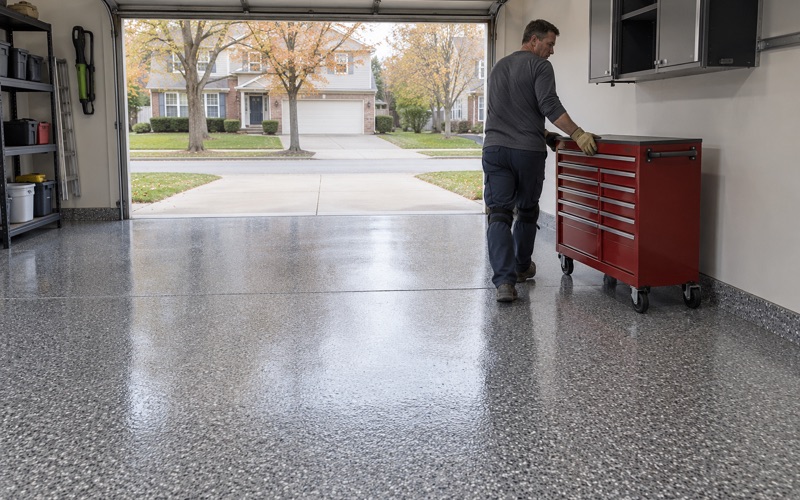
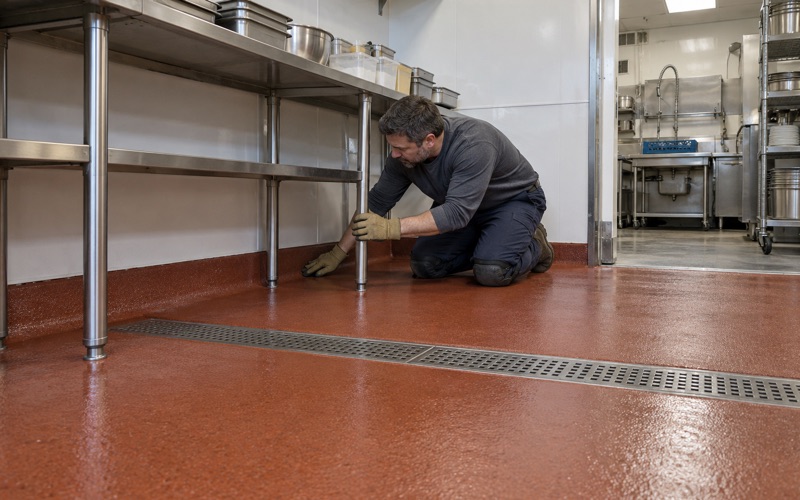
For a mix-and-wash bay we generally look at a 100% solids epoxy base over a ground profile in the ICRI CSP range the primer calls for. A quartz aggregate broadcast gives footing on a floor that is wet much of the day, and the topcoat is chosen for the chemistry it will see. Urethane cement is a candidate where hot water washdown or thermal shock is part of the routine.
Slip resistance comes from the broadcast and topcoat we specify, and both are written into the proposal rather than promised as a slogan. A smooth, glossy finish is easy to rinse and easy to fall on. The texture is a balance between footing and how cleanly the surface gives up residue during a washdown, and we set it with the person who runs the crew.
Storage rooms and slab moisture
A pesticide and fertilizer storage room sees fewer liquids but longer contact, from a leaking jug or a split bag left on the floor over a weekend. On any slab we test for moisture before pricing, using ASTM F2170 in-situ relative humidity probes or ASTM F1869 calcium chloride testing, because vapor pushing up from below can lift a coating however well it resists chemicals. Where readings run high, a moisture-mitigation primer goes into the scope, and moisture is the first exclusion we name when we explain the warranty.
Spill Recovery and Washdown on a Coated Containment Floor
What the rule asks after a spill
Section 256.70 says pesticide spills into containment areas shall be recovered promptly, and that proper cleaning includes removal, washing and rinsing of material from the area. Containment areas are washed with a biodegradable cleanser and then triple rinsed, with standing water removed. Spray vehicles and equipment that are not cleaned are to be parked in the containment area or otherwise protected from precipitation.
Why a sealed surface makes that routine work
On porous concrete a spill soaks into the paste and into every crack, and no amount of rinsing brings all of it back out. A continuous resin surface holds the liquid on top, where it can be squeegeed toward the sump, recovered and washed down. Each of the three rinses then moves residue toward collection instead of deeper into the slab.
The cleanser matters to the floor as well. Before we settle on a topcoat we ask what the crew washes with, and we check that the cleanser and the rinse routine will not dull or soften the finish over a season of daily use.
Keeping the floor impervious after year one
A containment floor stays impervious only if damage is repaired when it happens. A dropped tool, a dragged sprayer frame or a pallet set down hard can chip the coating, and that chip is bare concrete again. We recommend a short walk of the bay at the end of each season, and we pick a topcoat that can be patched and recoated without stripping the whole floor.
Wear concentrates where the sprayers turn and where hoses are dragged across the floor. Those lanes can get a heavier broadcast or an extra topcoat at installation, which costs less than recoating the whole bay early.
Scheduling the work around the crew
A maintenance shop rarely closes during the playing season, so we phase the floor around the crew, using off-season or weekend windows when a bay cannot come out of service. Cure times follow slab temperature and dew point rather than the calendar, which matters in an unheated building late in the year. Grinding dust is captured at the machine with a vacuum and never rinsed toward the sump or a storm inlet, which on a containment floor is the last place it belongs.
- 20+ Years on Concrete
- Moisture Testing in Every Scope
- Ground, Never Acid-Etched