Elmhurst Epoxy Flooring has spent more than 20 years on epoxy flooring in Winfield and across DuPage County, and the jobs that ask the most patience are the ones laid over an older floor. Before we grind anything, we need to know what the old floor is made of. A slab that once carried resilient tile and adhesive is not just concrete waiting for a coating, and treating it that way can put fibers into the air of a room people use every day.
So our sequence in any older office, classroom, hall or basement starts with questions rather than a grinder. We map cracks, spalls and old coatings, ask when the existing floor went down, and look for an inspection report if the building has one. When an answer is missing, the work waits until someone qualified has sampled the material.
We do not test or remove asbestos ourselves, and we hold no state abatement license. What we bring is the coating half of the job: a slab opened by diamond grinding or shot blasting, a moisture reading written into the scope, and a proposal that names the product line, the number of coats and the finished thickness. That half begins only once the other half is finished and documented.
An Office Closed for a Month on Church Street
The clearest recent example of the right order in Winfield sits on Church Street, near the Metra station. In its September 27, 2026 bulletin, St. John the Baptist parish at 0S233 Church Street told parishioners that the business office would close for October while asbestos was removed and the offices were renovated.
We have not seen the full bulletin or the rooms, and we have no role in that project. We do not know which materials hold the asbestos there, whether floor tile, mastic or something else. What the notice does show is the sequence: the office empties, the hazardous material comes out first, and the renovation follows.
Why a Whole Month
Closing an office for weeks is not overcaution. Abatement means containment, removal, cleanup and clearance before other trades come back in, and each of those steps runs on its own schedule. A parish, a church office or any older public building planning a floor upgrade should expect the same rhythm and plan its downtime around it.
A Campus Built in Stages
The parish campus shows how mixed an older site can be. The church was rebuilt in 1906, the school cornerstone dates to 1942, and the gymnasium followed in 1991. Rooms from different decades can carry different floors, adhesives and patches, so one test result never speaks for a whole building.
Looking for epoxy-flooring closer to Justice? See Justice Epoxy-Flooring.
What Sits Under Old Carpet and 9-Inch Tile
Pull back the carpet in an older office or classroom and there is often a second floor underneath: square resilient tile, commonly 9 inches on a side, set in black mastic. Federal workplace rules treat resilient flooring and its adhesive installed in 1980 or earlier as presumed asbestos-containing until testing shows otherwise. That presumption, in the OSHA construction asbestos standard, is the starting point for every old-floor job we price.
Why the Grinder Is the Problem
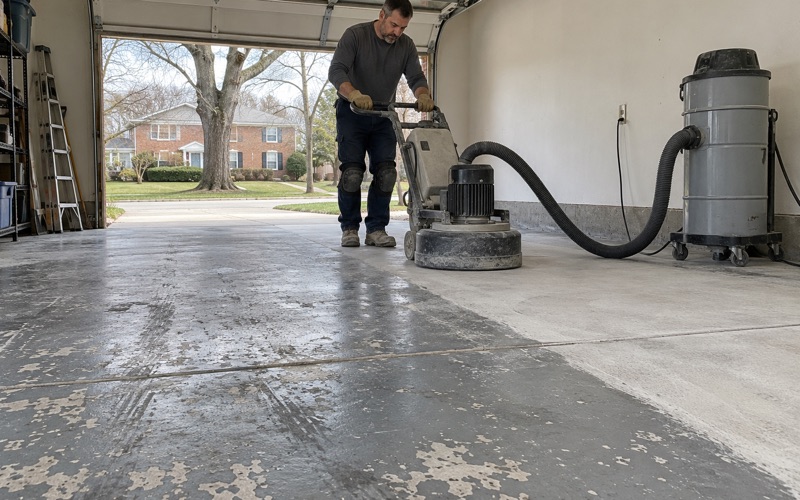
Our standard prep is aggressive by design. A diamond grinder or shot blaster removes the top of the slab to give a coating something to grip, which is exactly the wrong thing to run across tile or mastic of unknown content. Grinding, blasting or scarifying turns an intact material into dust, and a vacuum at the machine does not make that acceptable.
Why a Coating Is Not a Cover-Up
Some owners ask whether a coat of epoxy over the old tile would seal it in and save the removal. We do not sell that. A coating is not an approved way to deal with unknown flooring, it would still need prep that disturbs the tile, and it leaves the problem in place for whoever opens that floor next.
Where the Age Line Falls Here
About two-thirds of the 4,108 homes in Winfield were built in 1980 or later, so most of the housing sits on the younger side of that line. Still, 417 date from the 1970s, 584 from the 1960s and a few hundred more from earlier decades, and churches, offices and public buildings carry their own ages. The year a building went up is also not the year its floor went down, so we ask about both.
Illinois Notice and the Order of the Work
Illinois adds a step in front of abatement in commercial and public buildings. Under 77 Illinois Administrative Code 855.220, the contractor or the building owner must notify the Illinois Department of Public Health at least two working days before abatement activities begin. The rule reaches down to projects as small as 3 square feet or 3 linear feet, so a small patch in a hallway is not exempt because of its size.
Industrial buildings are excepted from that section. An emergency removal is reported by phone or fax the same business day, with a written follow-up. Neither exception turns a parish office, a library or a school hall into an industrial space.
Who Files and Who Waits
The notice belongs to the abatement contractor or the owner to file, never to us. For a coating schedule, it means two working days is the minimum lead time before removal can even start, and a weekend does not count toward it. Removal, cleanup and clearance follow, and our start date sits behind all of them.
Other questions have their own addresses. Permits run through the Village of Winfield building department at 27W465 Jewell Road, while fire code questions go to the Winfield Fire Protection District, a special district separate from the village.
Why the Coating Crew Comes After Clearance
We schedule the first grinding pass only after the abatement contractor has finished and the room has a clearance result on paper. That report tells us the old material is gone and the space is ready for other trades. From there the slab is ours to judge on its own merits.
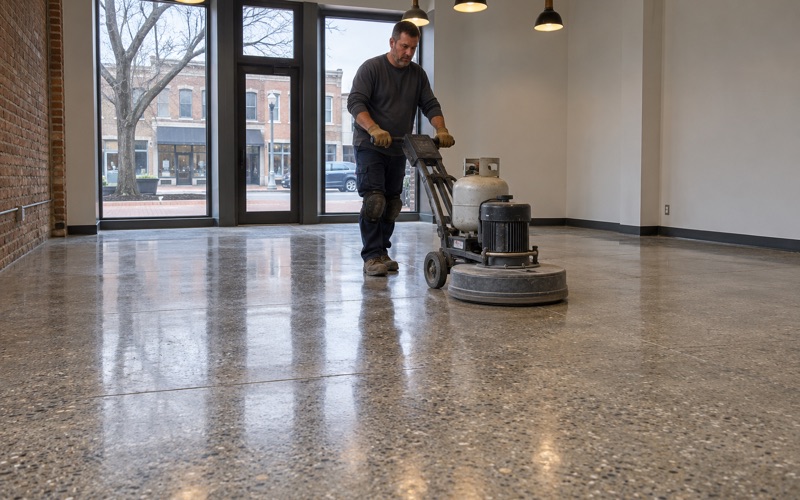
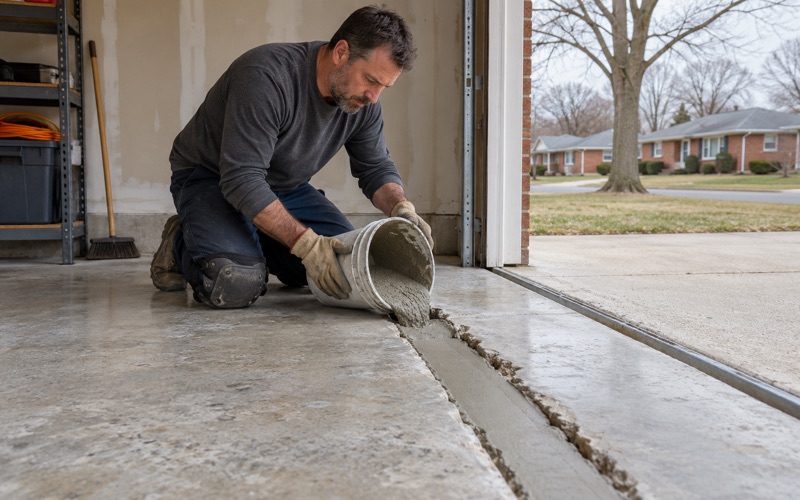
We grind to a measured ICRI concrete surface profile, take moisture readings such as ASTM F2170 in-situ relative humidity probes, and write both into the scope before the price is final. Concrete carrying grease, wax or old coating residue will not hold an epoxy bond, so a contaminated surface is degreased and profiled before any primer goes down. If the slab under the old floor is cracked, spalled or too damp for a coating, we say so plainly.
Phasing a Building That Has to Reopen
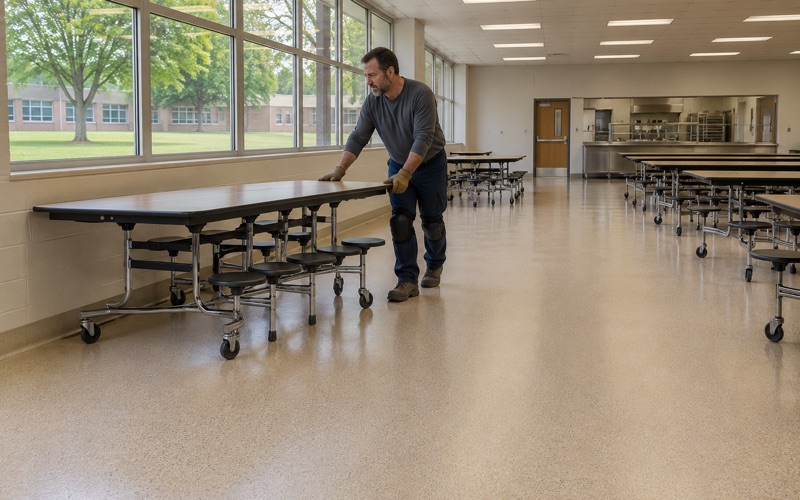
A parish office, a church hall or a small public building rarely wants to stay shut longer than it must. We phase coating work around operating hours, using overnight and weekend windows where a space has to reopen, and we set cure times by slab temperature and dew point rather than the calendar. Products are chosen inside the Illinois VOC limits for floor coatings, which bind whoever applies them.
Older Floors at Home: Test Before You Grind
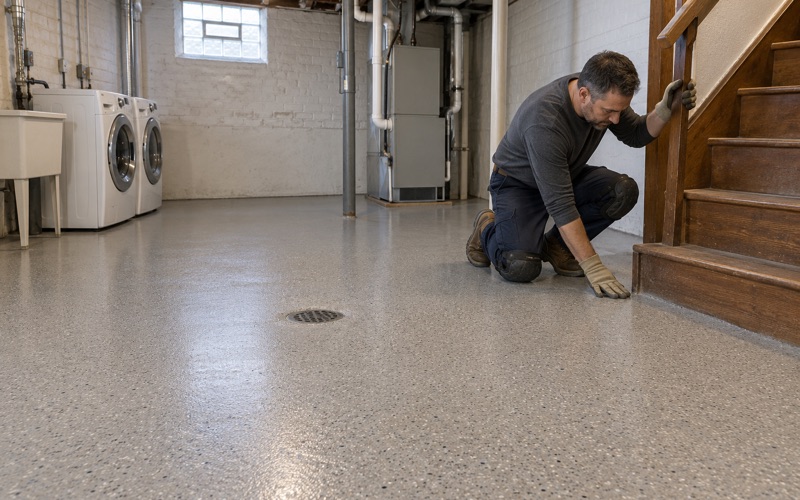
The same discipline applies in a house, even where the state notice for commercial and public buildings does not. A basement finished in the 1960s or 1970s may hide 9-inch tile and black mastic under carpet or a later floating floor. Test before you grind is the rule we follow in every one of those rooms, and we ask the owner to have the tile and the mastic sampled by an accredited lab before we quote.
Whether a homeowner may handle a positive result, or must hire a licensed contractor, is a question for an abatement professional, not for a coating crew. We will not guess at it on site, and we will not start the grinder while it is open.
When the Result Comes Back Negative
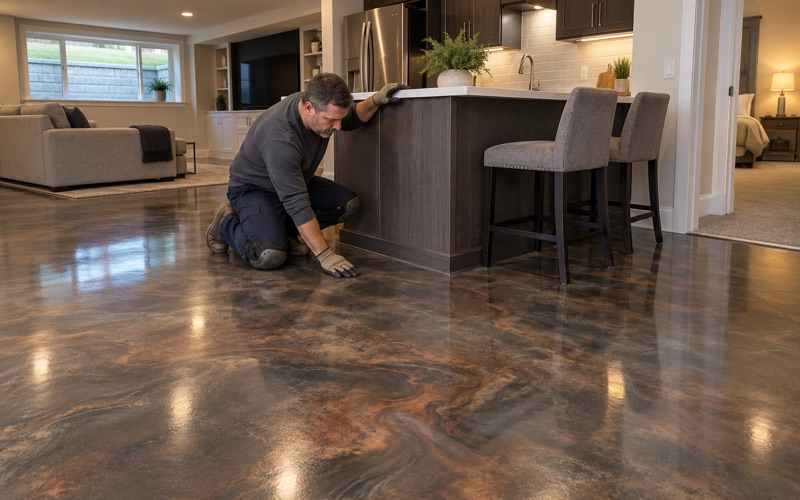
A negative result for both tile and mastic turns the job back into ordinary prep. We take the old floor up, grind the slab, map its defects and read moisture before choosing a system, often a 100% solids epoxy base with a polyaspartic topcoat. Basements get a check for past water first, since a coating does not stop seepage, a backup or a sump that cannot keep up.
When the Result Comes Back Positive
A positive result means removal by someone licensed for it, and then we come back. Our proposal keeps the same shape: product line, coats and finished thickness in writing, a moisture test in the scope, and the warranty exclusions explained up front, with moisture named first. Home jobs over the state threshold also get a written contract and the Home Repair: Know Your Consumer Rights pamphlet before any grinding starts.
Most Garages Start From a Cleaner Slate
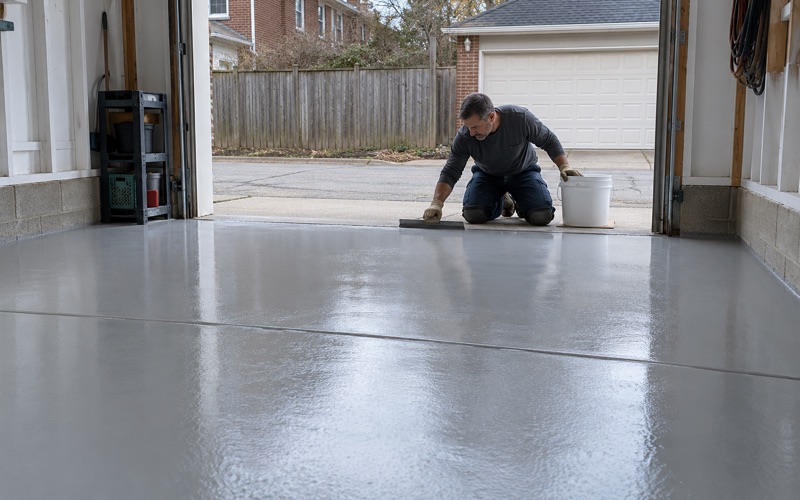
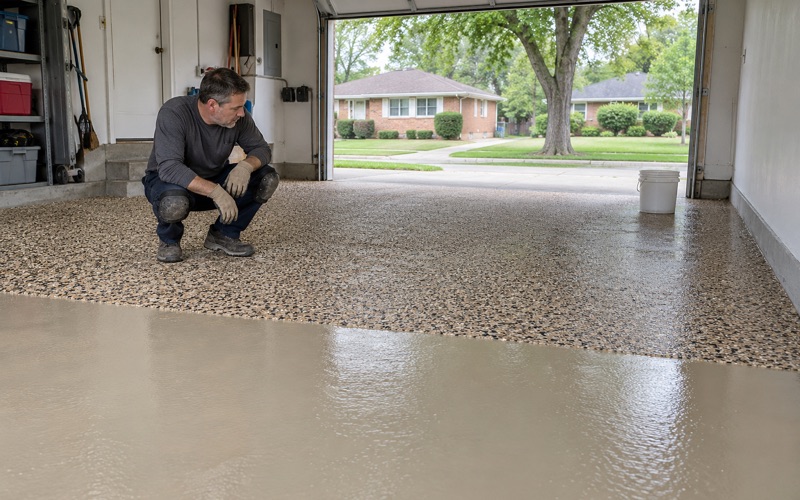
Because most of the village’s homes were built in or after 1980, the common first coating here goes onto a 35- to 45-year-old builder-grade garage slab with no old tile on it. For those, the questions are salt, moisture and profile. We choose garage systems that stand up to the rock salt and brine riding in on winter tires, and we capture grinding dust at the machine instead of rinsing it toward a floor drain.
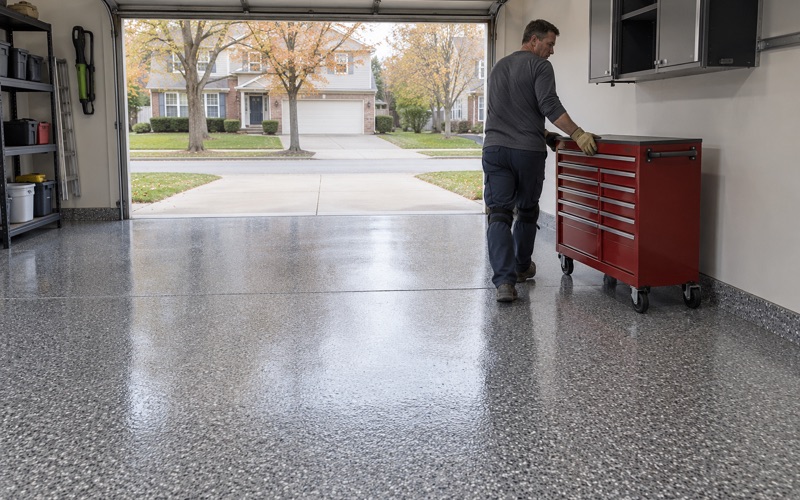
Hot tire pickup is the other garage complaint we hear most, and it is far more likely on a thin coating over a poorly prepared slab. We answer it with a full-thickness base, a polyaspartic or polyurea topcoat, and a vinyl flake or quartz broadcast whose slip resistance is set by the broadcast and topcoat we specify, not by a slogan. And if your garage sits unheated through deep winter, we will tell you to wait for spring rather than lay a coating the slab cannot cure.
- 20+ Years on Concrete
- Moisture Testing in Every Scope
- Ground, Never Acid-Etched