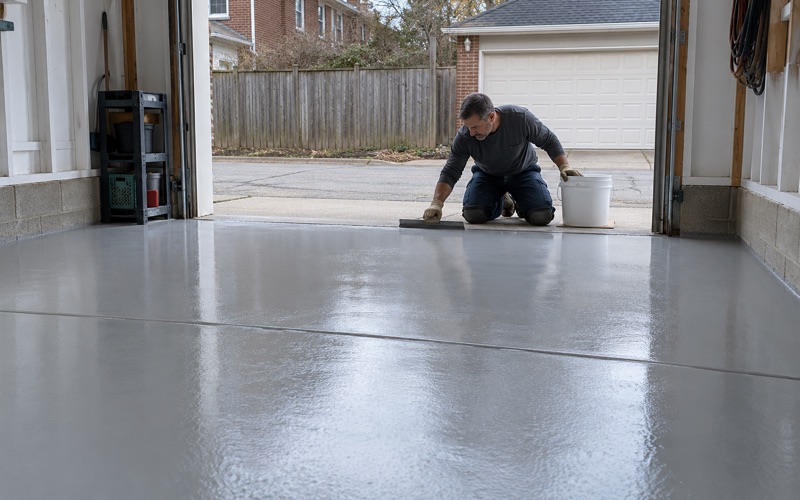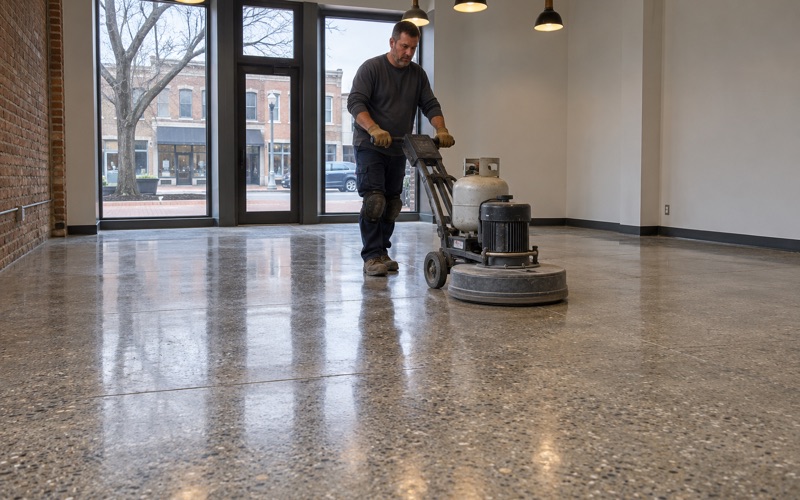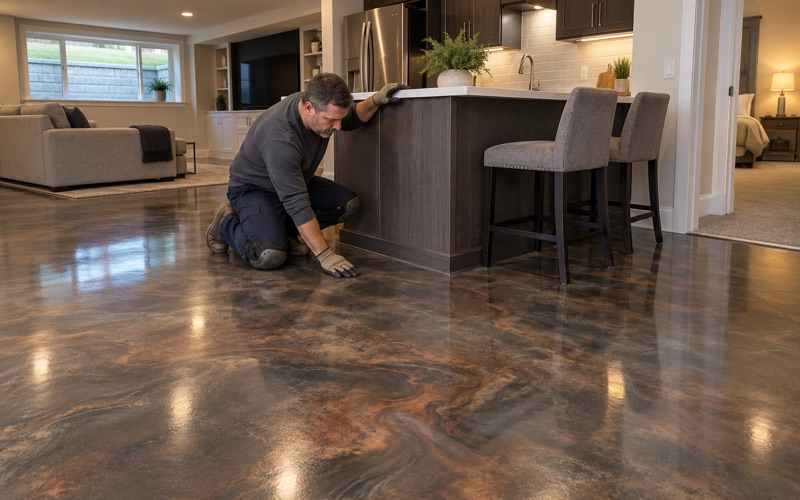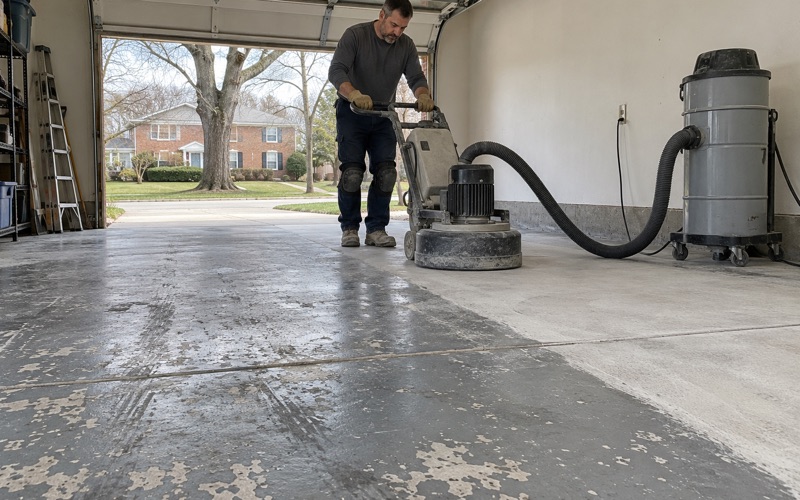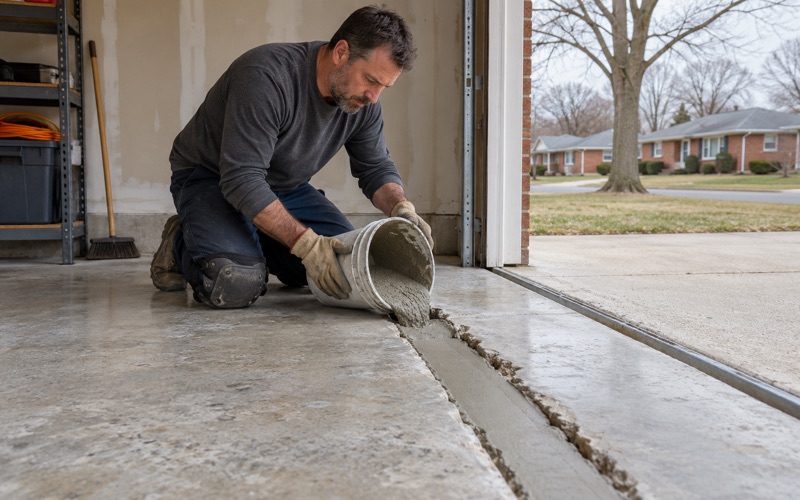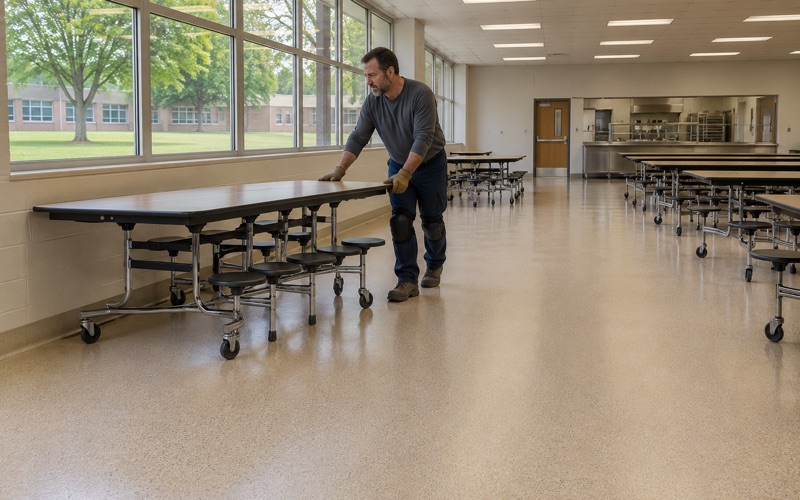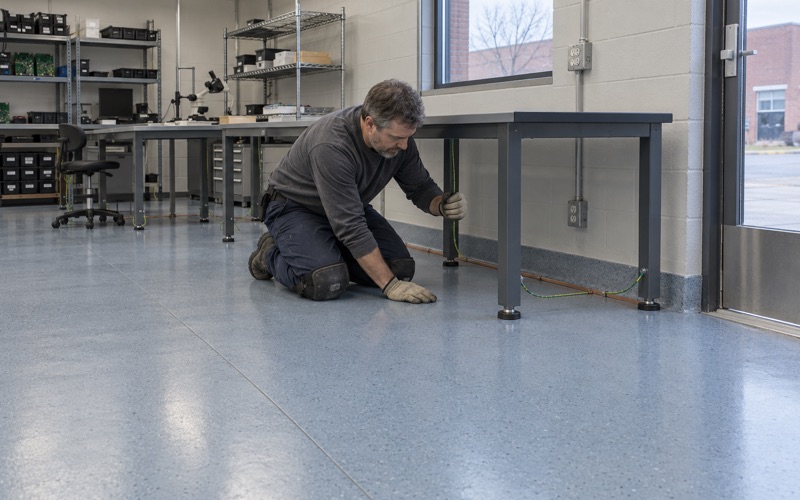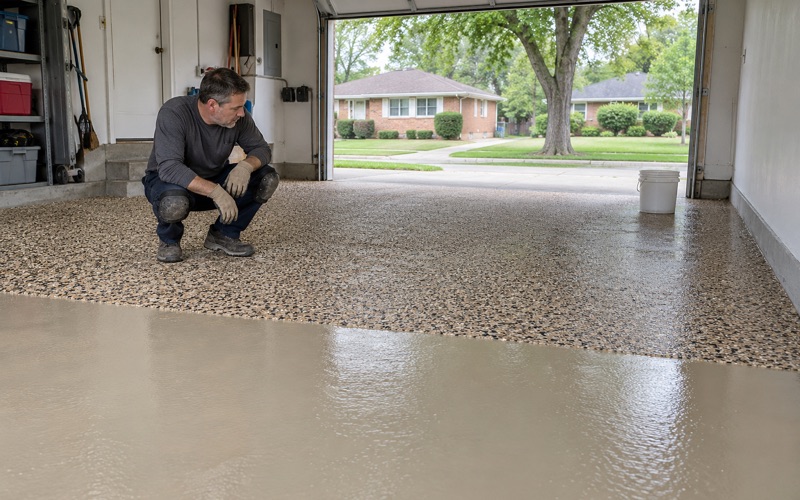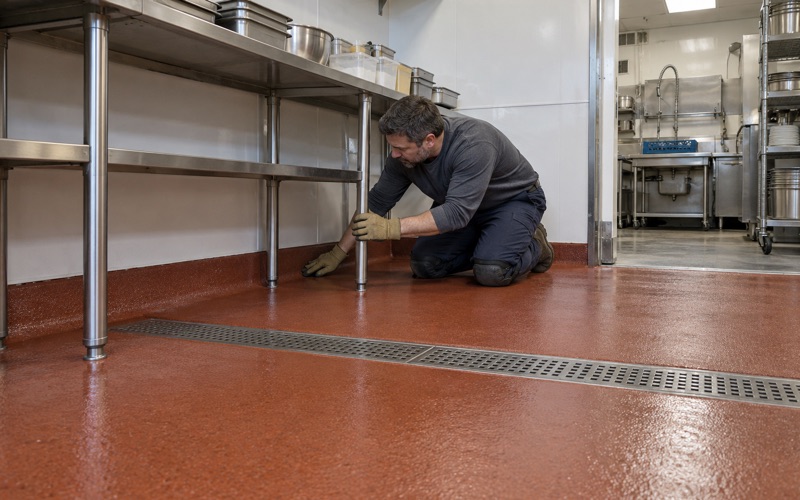
Elmhurst Epoxy Flooring has spent more than 20 years installing epoxy flooring in Western Springs homes and businesses, and every job starts with the slab rather than the color chart. We open the concrete with a diamond grinder or a shot blaster, never an acid etch, because a coating only holds as well as the profile it bonds to. Our written proposal names the product line, the coat count and the finished thickness, so you can measure what we leave against what we quoted.
Most floors get judged on looks first and on the day after something spills second. We would rather reverse that order. A floor should be chosen for the worst ordinary thing that happens on it, and the texture, color and topcoat follow from that event rather than from a sample board.
That holds for a shop floor customers walk all day and for a basement where someone keeps a few cases of wine. Before any price is final, we test the slab for moisture and map its cracks, spalls and old coatings. When a slab needs repair before it should be coated at all, we tell you plainly.
A Johnson Avenue Bottle Shop in a Former Cocktail Bar
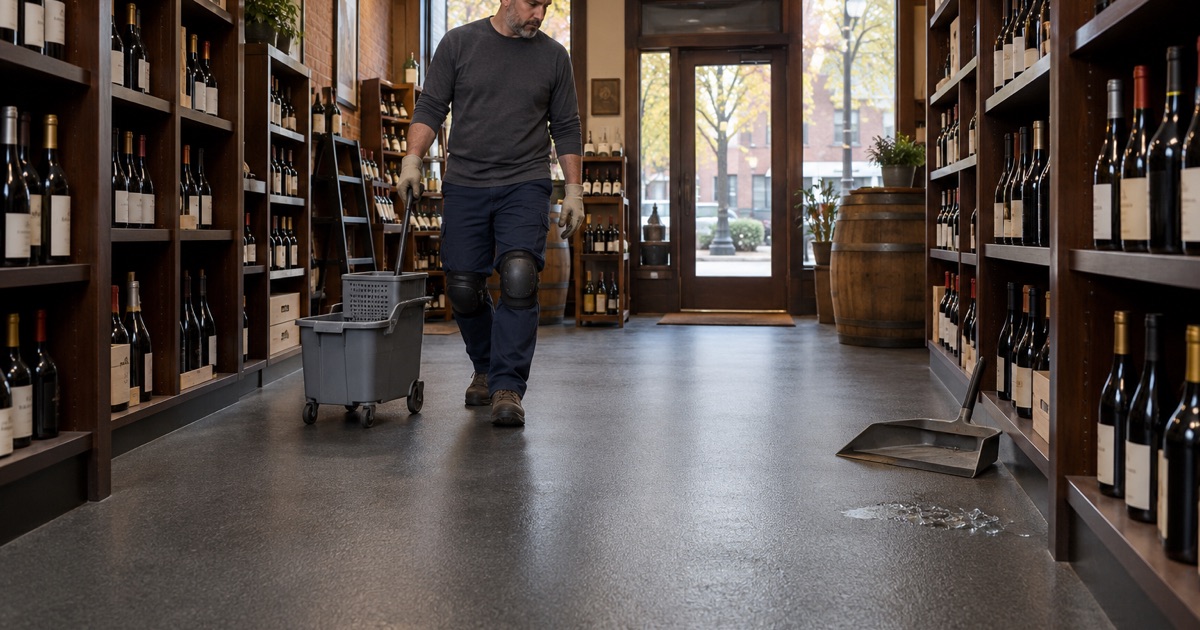
Retail space changes hands without the floor always changing with it. In June 2026, Patch reported that The Clever Drinker, a wine bottle shop owned by Western Springs resident Aron Dorner, was planned for 4354 Johnson Avenue, replacing The Opry. The report said the business planned to keep The Opry’s interior largely the same and did not plan to prepare food on site, and the shop was operating by late summer 2026.
The Opry had opened at the same address on January 12, 2024, as a cocktail bar with a small cafe and a bottle shop, and it closed in the spring of 2026. The address sits inside the village, in Lyons Township, Cook County. We have not seen the floor at 4354 Johnson Avenue and have no connection with either business; the address matters here because it is a clear local example of a common situation.
A Bar’s Floor Inherited by a Retail Shop
A cocktail bar picks its floor around a bar rail, stools and a crowd standing in one place for an evening. A bottle shop puts its weight on shelving runs, carts of cases and long aisles that customers browse at a walking pace. Those are different jobs, and a floor chosen for the first was never asked about the second.
Keeping an interior largely as it was is often the right call for a new owner, since it saves money and opening time. The floor is the one piece worth questioning before the shelves go back in, because once fixtures are fastened down and stock is loaded, recoating means emptying the room. If a change is coming, the gap between tenants is the cheapest window it will ever have.
When the Merchandise Is Glass
A bottle shop’s stock is heavy, breakable and stacked within reach of customers. That moves the floor question away from appearance and toward cleanup: how fast can staff make an aisle safe again after something hits the ground?
Heavy cases also mean concentrated loads where shelving feet and cart wheels sit. A coating over a poorly prepared slab tends to show that first, as chips at the shelf line and wear along the main aisle, which is one more reason the grinding step comes before any choice of finish.
Looking for epoxy-flooring closer to Brookfield? See Epoxy-Flooring Services in Brookfield.
A Dropped Bottle and OSHA’s Rule for What Lies Underfoot
In any shop that sells wine, the routine floor event is a dropped bottle. It is never one hazard at a time, because broken glass and a spreading puddle land in the same aisle at once, often while other customers are still walking it. The floor has to let staff deal with both without one making the other worse.
Glass and Liquid in the Same Spot
A spreading puddle can carry small fragments outward, so a broken bottle often covers more floor than the bottle did. A surface with deep valleys keeps some of those fragments after the visible pieces are picked up, and the slivers that stay are the ones too small to notice. Wet glass on a smooth, unprofiled floor is the opposite failure, because whoever cleans up is standing on a slick surface while they work.
What 29 CFR 1910.22 Asks of a Shop Floor
Federal workplace rules address both halves of that event. Under 29 CFR 1910.22(a)(3), walking-working surfaces are to be maintained free of hazards such as sharp or protruding objects, leaks and spills. Paragraph (d)(2) adds that a hazardous condition is corrected or repaired before an employee uses the surface again, or guarded until it is.
Read together, those clauses describe a floor that has to be returned to a clean, safe condition quickly and completely. The regulation does not name a coating, a texture or a product. It sets the outcome, and the floor is one of the tools a shop uses to meet it.
That is why we treat cleanup time as a design input for a retail floor. A coating that looks right but holds onto debris adds minutes to every broken bottle, and those are the minutes when an aisle is closed or a hazard is still underfoot.
Fine Texture Over Coarse: Grip That Still Sweeps Clean
Slip resistance on a resin floor comes from aggregate broadcast into the coating and locked under a topcoat. The size of that aggregate and how much of it goes down decide how the floor behaves. We specify both in writing instead of promising a nonslip floor as a slogan.
Why Coarse Grit Holds Glass Slivers
Stonhard’s flooring guidance puts the tradeoff plainly: ‘Excessive texture can trap dirt and debris, making the floor more difficult to clean and maintain.’ Other coating makers make the same point, that the more aggregate is broadcast and the coarser it is, the harder the surface is to clean. In a bottle shop the debris in question is glass, and a coarse broadcast can hold slivers in its profile long after the sweep.
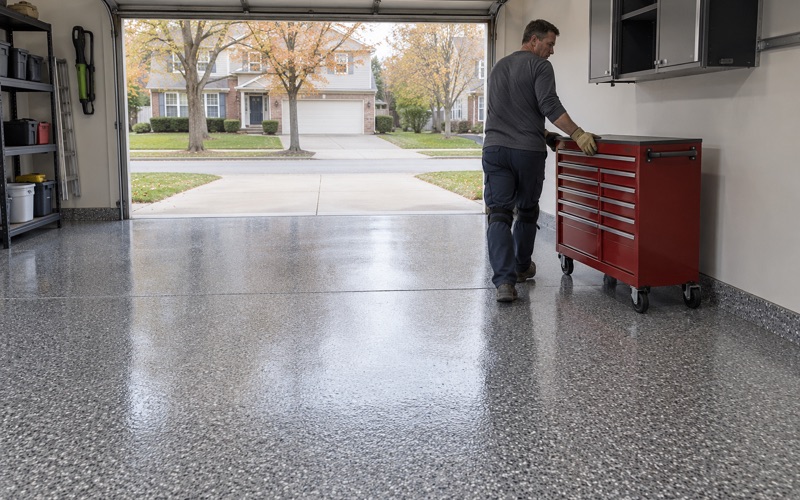
A fine texture is the middle ground for this kind of room. A light quartz aggregate broadcast, sealed under a polyaspartic or 100% solids epoxy topcoat, gives the floor grip when it is wet while leaving a surface a broom and a mop can actually reach. The cost is some slip resistance compared with heavy grit, a fair trade on a retail floor where spills are cleared promptly.
Sweep First, Then Mop
The cleanup order matters as much as the texture. Glass comes up first with a broom and pan while the liquid is still contained, and the mop follows to lift the wine and any remaining fine fragments. On a fine-textured floor, that second pass can finish the job instead of pushing slivers from one low spot to the next.
Color That Shows Clear Glass
Clear and pale-green glass can disappear against some floor colors. We talk through color contrast with shop owners, because a fragment that can be seen is a fragment that gets picked up. A flake blend or a solid color is chosen with that in mind, not only to match the shelving.
Getting the Base Right First
None of the texture matters if the coating lets go. We grind the slab to a measured ICRI concrete surface profile, map cracks and old coatings, and confirm moisture with ASTM F2170 probes or ASTM F1869 testing before the system is chosen. Commercial floors are scheduled around operating hours, using overnight and weekend windows when a space cannot close.
Wine Racks in Western Springs Garages and Basements
Plenty of people who buy wine by the bottle store it at home, and the same reasoning applies on a smaller scale. A loaded rack is heavy, it stays in one spot for years, and the occasional dropped bottle lands on whatever floor sits beneath it. The fine-texture logic that serves a shop aisle serves a cellar corner just as well.
Basement Cellars
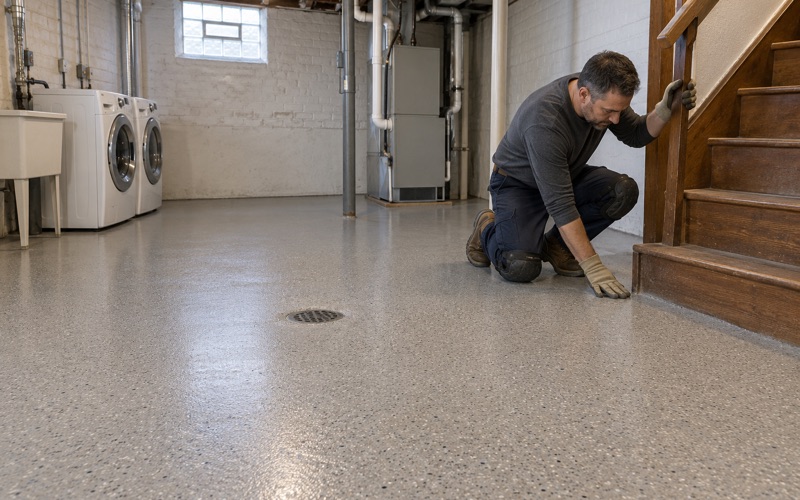
A basement wine area has two jobs: steady storage and a floor that stays dry under the racks. We read a basement for signs of past water before quoting, because a coating does not stop seepage, a sewer backup or a sump pump that cannot keep up. Moisture testing is part of the written scope, and moisture vapor transmission is the first exclusion we name when we explain what a coating warranty does not cover.
If the slab tests well, a fine-textured epoxy under the racks turns a broken bottle into a quick cleanup instead of a stain worked into bare concrete. If it does not, we say so, and the answer may be a moisture-mitigation primer or no coating at all.
Garage Racks and Winter Salt
Garage wine storage shares the floor with cars, which means rock salt and brine riding in on tires all winter. We choose garage systems to stand up to that exposure, and we set the cure by slab temperature and dew point rather than the calendar. An unheated garage in the coldest weeks is told to wait.
For home jobs above the state threshold, you receive a written contract and the Illinois Home Repair: Know Your Consumer Rights pamphlet before any grinding begins. Grinding dust is captured at the machine with a vacuum, not rinsed toward a floor drain or sump. The floor you get is the one the proposal described, coat for coat.
- 20+ Years on Concrete
- Moisture Testing in Every Scope
- Ground, Never Acid-Etched