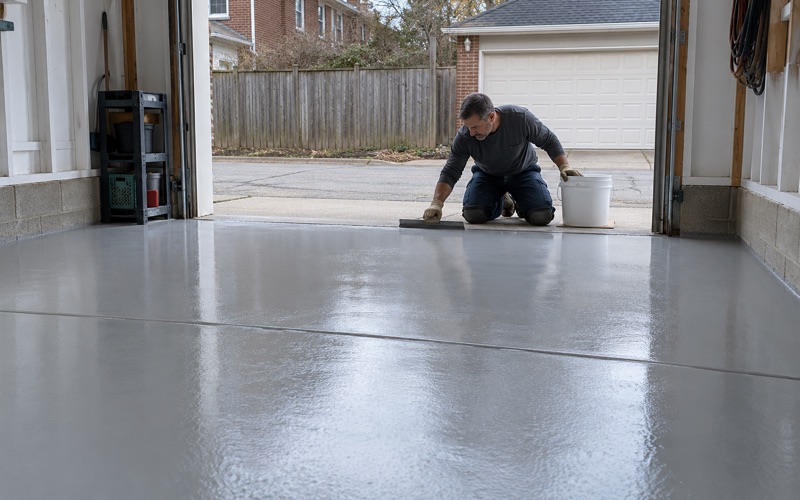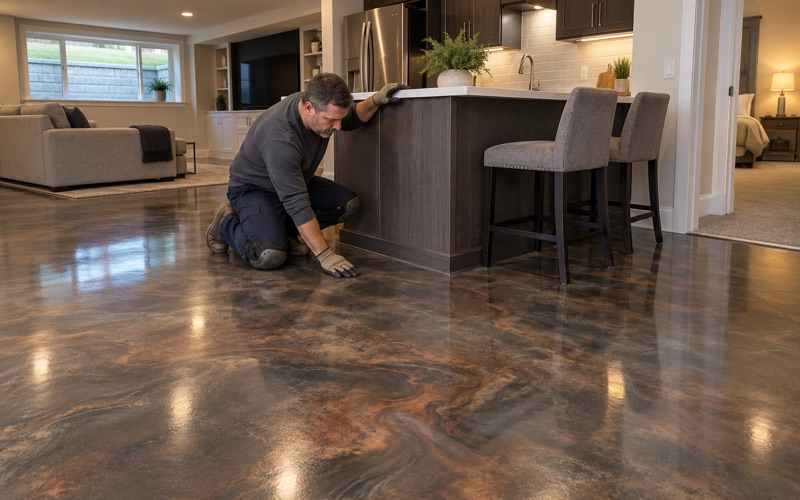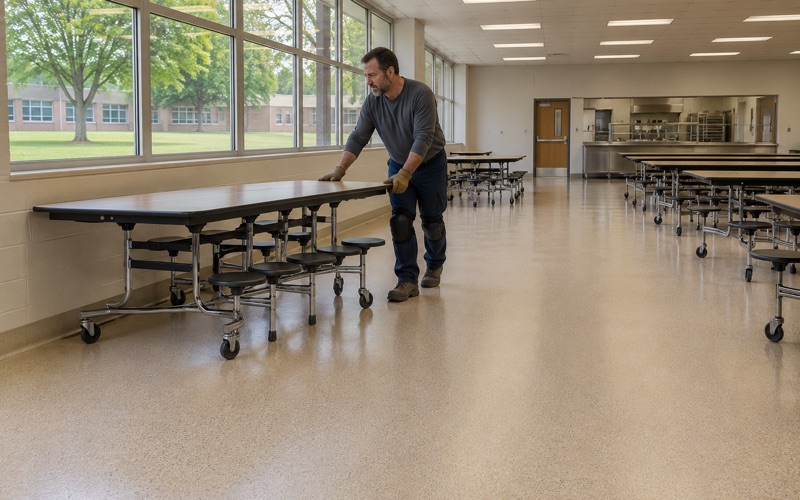
Elmhurst Epoxy Flooring has spent more than 20 years on epoxy flooring in River Grove and the surrounding suburbs, and a good share of that work happens in rooms the public never sees. A kitchen line, a dish room, a storage room where carts roll in wet: these are the floors that take water, grease, chemicals and wheels every single day. They are also the floors where a seamless resin system earns its cost, because grout lines and worn sheet goods are exactly where trouble starts.
The harder part of the job is often not the working room itself but its edges. Plenty of buildings carry finishes worth keeping, such as old tile, wood or terrazzo, right next to the space that needs a hard-wearing coating. We plan the prep, the transitions and the test areas so the new floor goes down without damaging what sits beside it.
Every proposal we write names the product line, the number of coats and the finished thickness. That gives an owner or a facilities manager a fixed standard to hold the finished floor against, instead of a vague promise.
A Donald Ross Club on Thatcher Avenue, With Two Kinds of Floor
Oak Park Country Club sits at 2001 N Thatcher Avenue, and despite its name the address is in River Grove, inside Leyden Township in Cook County. The parcel was bought in 1914, and Donald Ross designed the course that same year. The club’s own site describes a pool, a racquet complex, fine dining, banquet facilities and winter skeet and trap shooting, so it runs as a year-round operation rather than a summer course.
The club is a useful example of a building type we think about carefully. A recruiting profile for its general manager says the club operates from its original clubhouse, with later additions and updates keeping the Prairie School architecture of the founding era. The same profile lists a pool and tennis complex completed in 2003, over 500 member families and about $2,250,000 in food and beverage. We have not seen the clubhouse floors, and the club is not a customer, but the profile describes a familiar situation.
Member rooms
In a clubhouse kept in its founding character, the dining rooms, lounges and entry halls are where original finishes tend to live. Those floors are part of why the building feels the way it does, and they are not where a resin coating belongs. Our job in those spaces is usually to stay out of them and protect them while work goes on nearby. When we work in a service wing, the routes we use through member spaces are agreed in advance and the floors along them are covered.
Back of house
The back of house is the other floor in the same building. A kitchen serving daily dining and banquets, the dish room behind it, cart and bag rooms, locker-room wet areas and the service corridors that link them all carry heavy, wet, messy traffic. That is where a seamless, cleanable resin floor does real work, and it is where we focus.
Looking for epoxy-flooring closer to Schiller Park? See Epoxy-Flooring Services in Schiller Park.
Where Resin Belongs in a Working Clubhouse
Each back-of-house room asks something different of the floor, so we do not specify one system for the whole service wing. We look at what spills, what rolls, what gets hosed and how long each room can close. The answers decide the resin, the texture and the schedule.
Kitchen and dish room
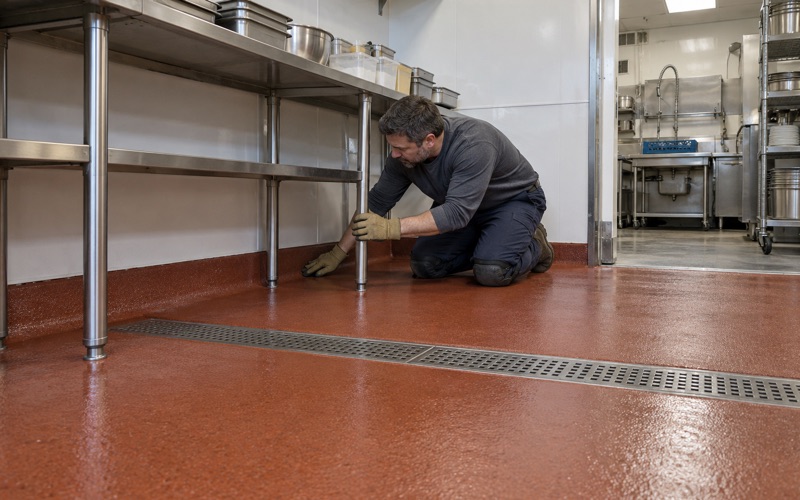
A busy kitchen floor sees hot water, grease, cleaning chemicals and constant foot traffic, and the dish room adds standing water around the machine. For these rooms we usually look at a urethane cement system, which tolerates heat, thermal shock and wet service better than a thin epoxy coat. A coved base turned up the wall closes the joint where floor meets wall, in line with FDA Food Code 6-201.13 on coved floor and wall junctures.
The Food Code asks for floors that are smooth and easily cleanable, and section 6-201.11 carries an exception for antislip floor coverings used for safety. That matters in a kitchen, where a glassy floor and a wet shift are a bad pairing. We set the slip resistance by naming the quartz aggregate broadcast and the topcoat in the proposal, not by printing a promise on the brochure.
In River Grove, food establishments fall under the Cook County Department of Public Health, and the village code also carries its own food sanitation chapter. We check with the operator about what the health department will want to see before a kitchen floor is replaced or recoated, and we schedule the work so the kitchen can be cleaned and inspected before service resumes.
Cart and bag rooms
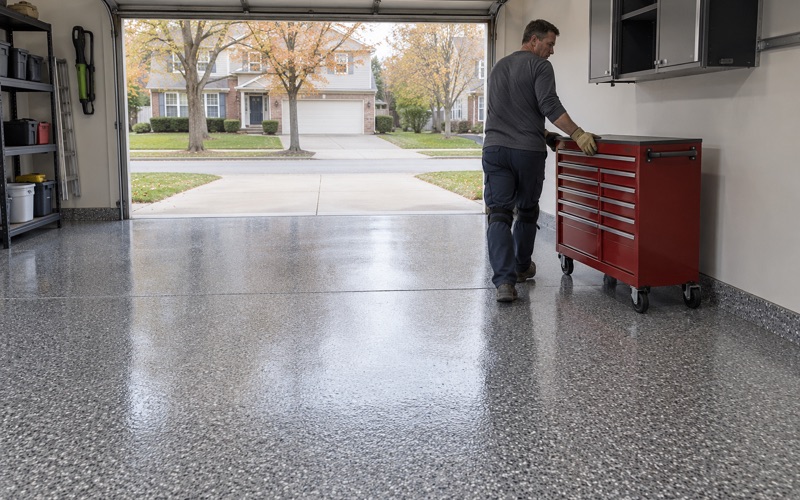
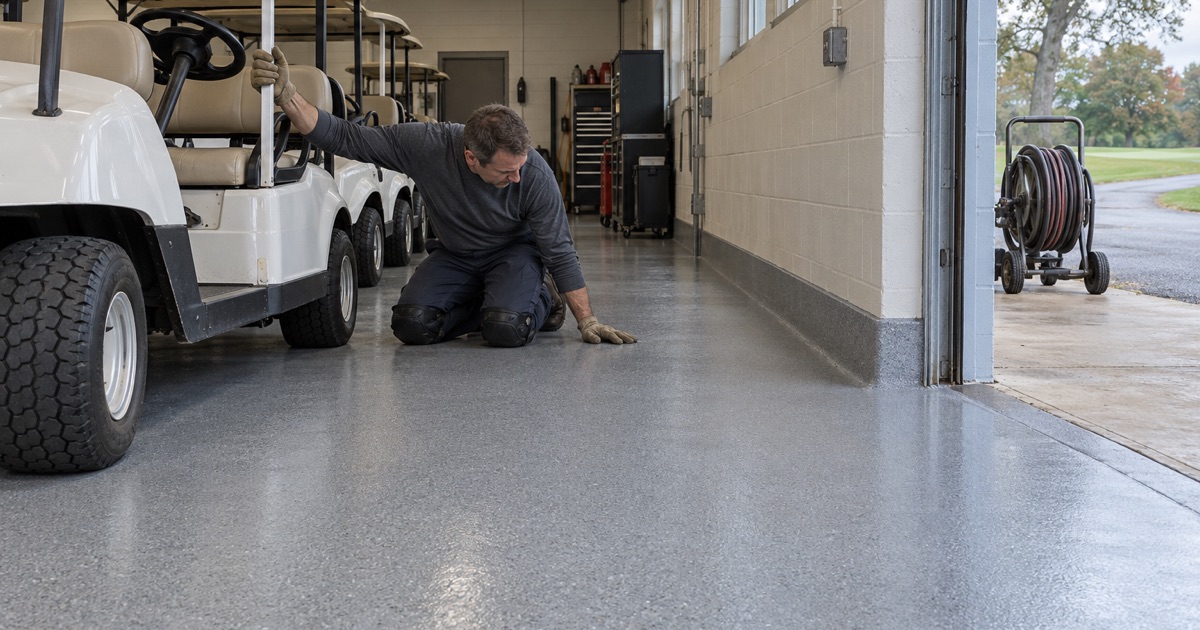
Golf carts, bag carts and maintenance carts bring tire wear, turning loads and whatever the course and the parking lot carried in. A broadcast system with a tough polyaspartic or polyurethane topcoat holds up to that wheel traffic and resists hot tire pickup. Winter matters here too, since brine and rock salt ride in on tires and boots, so we choose a system that stands up to deicers.
Bag rooms add a different load: storage racks, carts parked in rows and steady foot traffic at the start and end of a round. We note where racks are anchored before prep, so they can be lifted, the floor coated underneath and the racks reset on a cured surface.
Locker-room wet areas
Showers, wet corridors and the floor around sinks stay damp for hours each day. These areas need a texture that grips a wet bare foot or a wet shoe without becoming impossible to clean. We usually specify a fine aggregate under the topcoat and carry the coating up into a cove so water has no seam to find.
Gentlest Means at the Edge of Original Finishes
The federal Standards for the Treatment of Historic Properties, at 36 CFR 68.3, say chemical or physical treatments should be undertaken using the gentlest means possible. Those standards bind federally assisted work, and for a private club they are guidance only. We still find the principle useful wherever new resin meets old fabric, because grinding and shot blasting are aggressive by design.
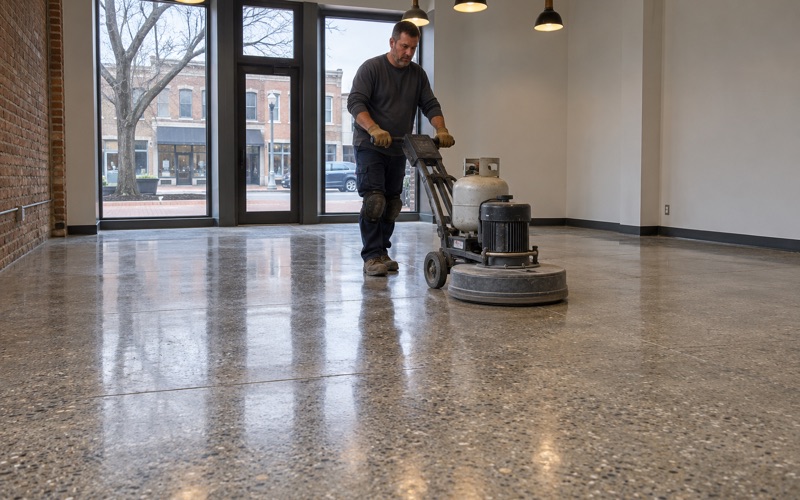
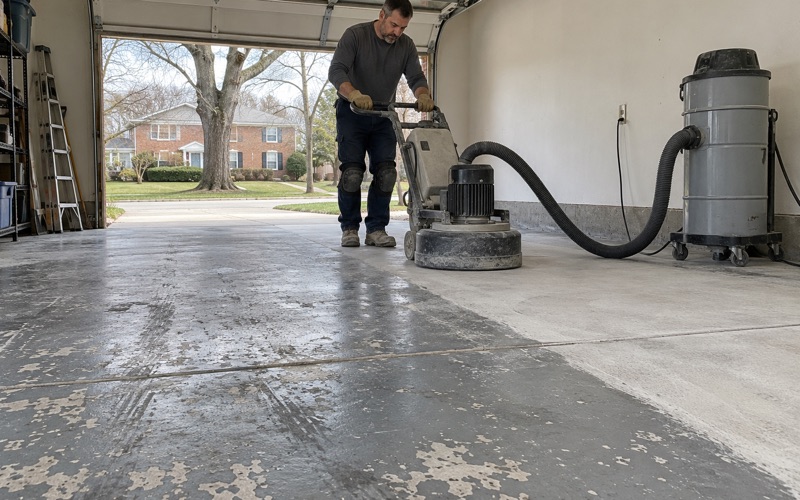
We prepare every slab mechanically, with a diamond grinder or a shot blaster, and we never acid etch. That gives the coating a real profile to grip, typically in the range of ICRI CSP 2 to CSP 5 depending on the system. The same power that opens a slab, though, can chip a tile edge, scar a wood threshold or spread dust into a dining room if it runs right up to the line.
Stopping short of the edge
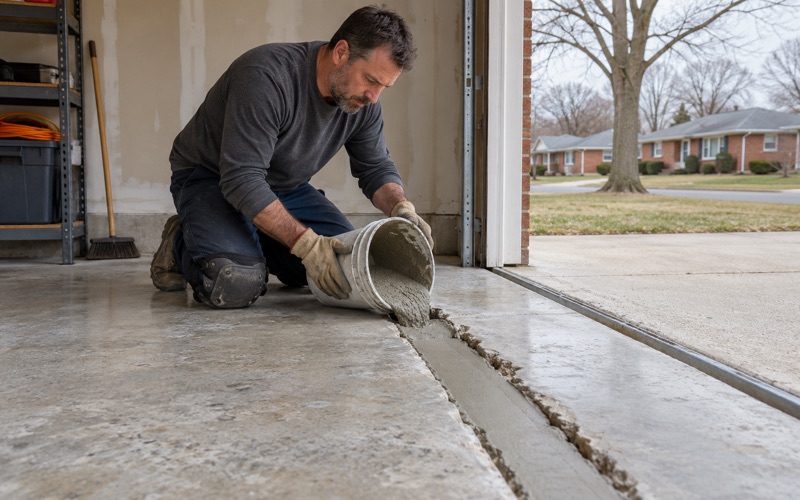
At a threshold with original tile or wood, the machine stops short and the last stretch is finished with hand tools. Dust is captured at the machine with a vacuum, and the doorway to the finished room is sealed and protected. We map cracks, spalls and old coatings before the price is set, and if a slab needs repair or replacement first, we say so plainly.
Test areas first
Before full prep starts, we open a small test area in an out-of-the-way spot. It shows how the slab responds to the grinder or blaster, what profile we can reach and what lies under any existing floor. The test also gives the owner a look at color, texture and sheen before the whole room is committed.
Transitions that do not cut into old floors
Where a coated kitchen floor meets an original corridor floor, the transition is detailed on purpose. A metal or stone threshold, a ground-in termination line or a short reducer keeps the resin from running onto old tile and keeps a saw from cutting into it. The aim is a clean, durable joint that a future owner could still undo without losing the original finish.
Older River Grove Buildings, Moisture and Permits
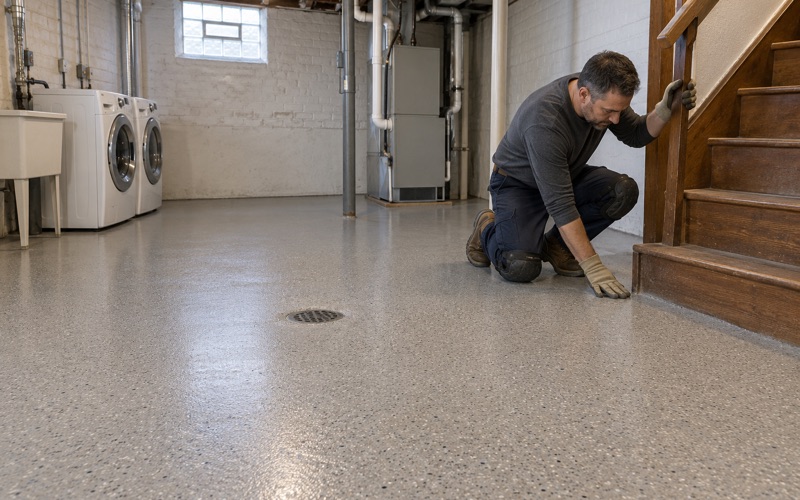
The same care applies well beyond a clubhouse. Older River Grove homes and storefronts can have original tile in a vestibule, a basement stairwell or a back hall, right next to a utility room or laundry that could use a hard-wearing coating. We treat that line the same way, with hand finishing at the edge and a test area before we commit.
Moisture comes before resin
A moisture test is part of our written scope before the price is final, whether the slab sits under a kitchen or a home basement. Depending on the floor, we use ASTM F2170 in-situ relative humidity probes, ASTM F1869 calcium chloride testing or a quick ASTM D4263 plastic sheet check. If the readings call for it, a moisture-mitigation primer goes into the scope, and we explain before the job is sold that moisture is the first exclusion we name in a coating warranty.
Cure follows the slab, not the calendar. We watch slab temperature and the dew point spread at the surface, because a coating laid on a slab near dew point can blush or fail to bond. An unheated room in deep winter is told to wait.
Permits and contractor licensing
River Grove’s Building Department is at 2621 N Thatcher Avenue, and the village requires a building permit for any remodeling valued over $100, including concrete work. Contractor licenses here run on the calendar year, January 1 to December 31, regardless of when the application is filed. The village also asks for a $10,000 trade-specific license and permit bond and a certificate of liability insurance naming the village, so we confirm those requirements before a job is scheduled.
Working around a building that stays open
A club kitchen, a restaurant or an office rarely closes for a week. We phase the work room by room and use overnight and weekend windows where a space cannot shut down, so the dining room keeps serving while the dish room cures. Products are chosen inside the Illinois VOC limits for floor and industrial coatings, which bind the people applying them.
- 20+ Years on Concrete
- Moisture Testing in Every Scope
- Ground, Never Acid-Etched