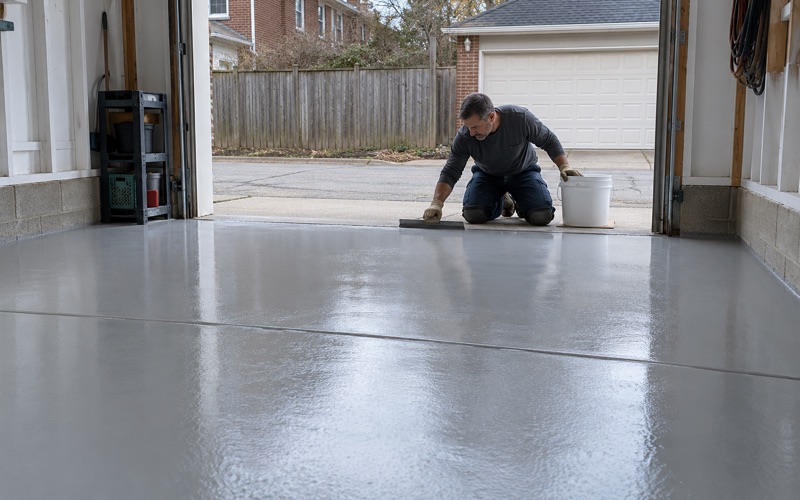
Elmhurst Epoxy Flooring approaches epoxy flooring in River Forest the way more than 20 years of commercial and home work has taught us to: one room at a time. A building almost never needs one floor everywhere. It needs the right surface in each space, judged by what gets spilled, rolled, tracked or stored there.
That way of thinking matters most in public and institutional buildings, where a lobby, a records office and a locked storage room sit under the same roof and fail in completely different ways. A seamless resin floor earns its cost where a spill has to come up completely. Elsewhere, carpet or resilient tile may be the sensible choice, and we will say so.
Our proposals put the product line, the number of coats and the finished thickness in writing, so the installed floor can be checked against the quote. A moisture test is part of the written scope before the price is final. Every slab is opened mechanically, never with an acid etch, so the coating has a real profile to hold onto.
A 1998 Village Hall and an Illinois Evidence Room
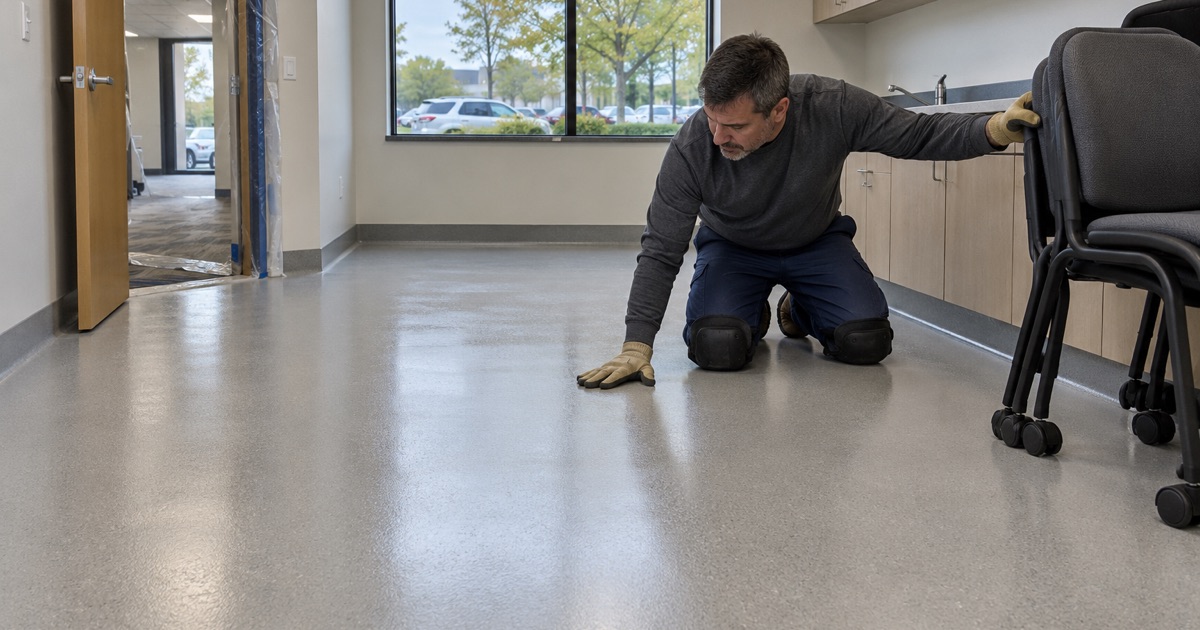
River Forest gives a clear local example of how floor decisions get made in a civic building. According to the village board packet for August 17, 2026, a Police Department memo asked to buy and install new flooring throughout Village Hall. The memo states that the Village Hall and Police Department facility was constructed in 1998 and that several areas have kept their original flooring since then.
The building sits at 400 Park Avenue, and the memo describes that original flooring as having reached the end of its useful life after more than 25 years. The rooms, products, vendor, cost and the board’s vote are not part of what we read. We have no role in that project, and nothing on this page describes the village’s own plans or how its police handle evidence.
Replacing flooring that old is rarely a matter of laying something new on top. Original tile and carpet leave adhesive, patching compound and uneven spots on the slab beneath, and each has to come off before a resin floor can bond. That removal work belongs in the scope and the price, not in a change order halfway through.
What NIOSH recorded
A federal evaluation shows why a police building is not one floor. NIOSH Health Hazard Evaluation 2018-0150-3340, published in March 2019, looked at potential narcotics exposure in an Illinois county evidence room. The drug evidence included marijuana, cocaine, phencyclidine and prescription and nonprescription opioids.
The report recorded carpet and vinyl tile in two different evidence rooms. One room on the 14th floor was carpeted, and a sub-basement room had vinyl tile. NIOSH’s comment was plain: porous materials are more difficult to clean than smooth, nonporous surfaces in the event of a spill.
Why that note was secondary
The flooring remark sat among the report’s other issues, not at the top. NIOSH’s first recommendation pointed to property-room standards calling for drug storage areas to be independently ventilated at about 10-12 air changes per hour. The evaluated rooms had no ventilation of their own, and evidence was opened or repackaged without local exhaust.
Looking for epoxy-flooring closer to Hinsdale? See Epoxy-Flooring Services in Hinsdale.
Property and Evidence Rooms: A Floor That Wipes Clean
In a property room, a drug-packaging area or an evidence-processing room, the floor question is narrow. When something spills, can every trace of it be picked up, or does some of it work into the surface? Carpet fibers hold residue, and even vinyl tile has seams where a spill can settle.
Seamless and sealed at the wall
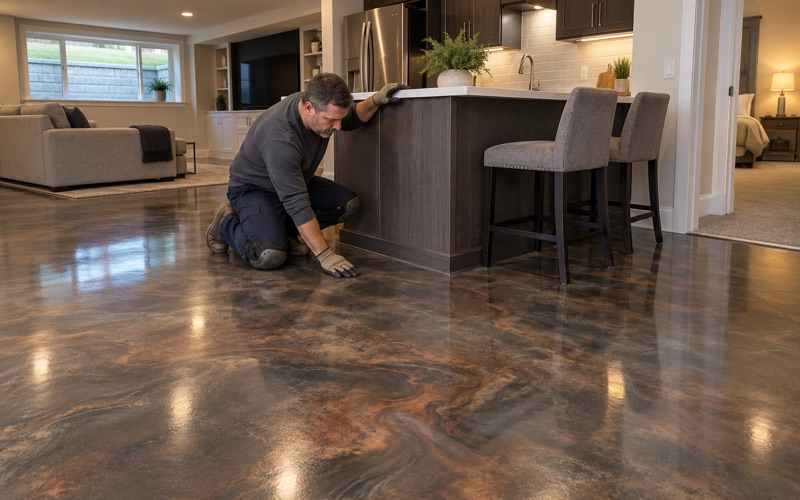
A 100% solids epoxy system laid as one continuous film has no seams for residue to sit in. We carry it up the wall as an integral cove, so the joint between floor and wall, where mops leave a line of dirt, is part of the same sealed surface. A smooth urethane or polyaspartic topcoat over the epoxy keeps the finish nonporous and easier to wipe and rinse.
Texture deserves the same care. A heavy quartz aggregate broadcast grips well, but it also gives residue more places to hide. In a storage or processing room we set the broadcast fine, specified by the actual aggregate and topcoat, so the floor has some slip resistance without turning into a surface that resists cleaning.
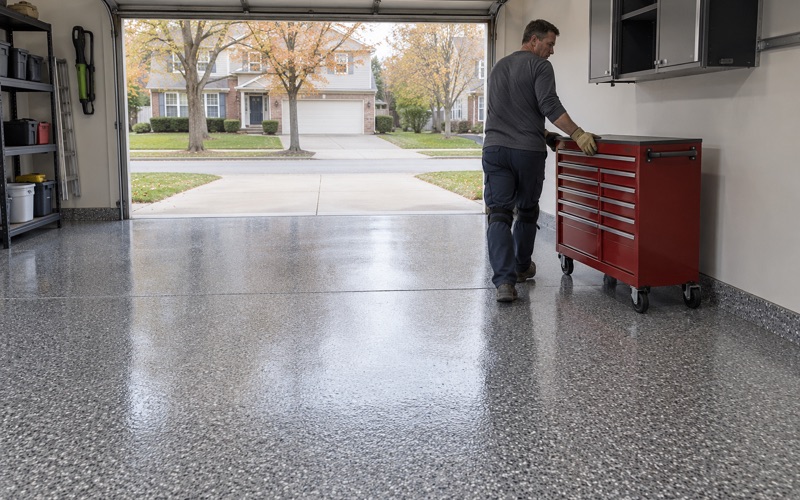
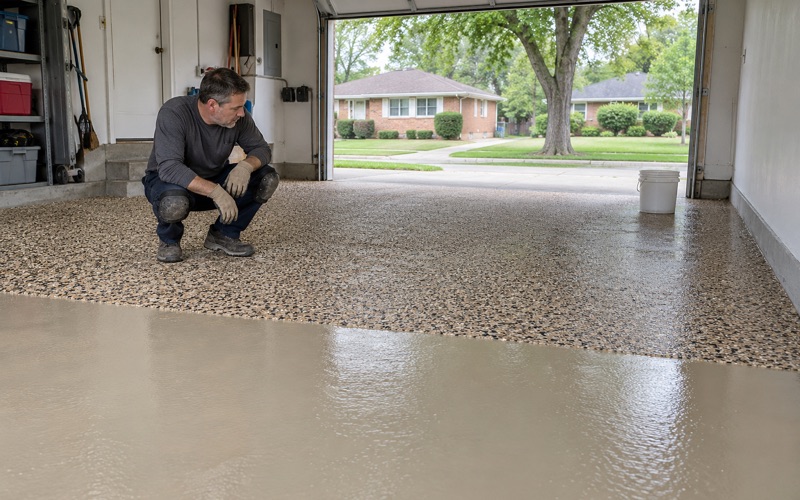
Color is a practical choice in these rooms as well. A light, solid color shows a spill or a stray pill clearly, where a busy decorative flake can hide one. A flake broadcast still suits a garage, where hiding dirt is the point.
Drains, doorways and edges
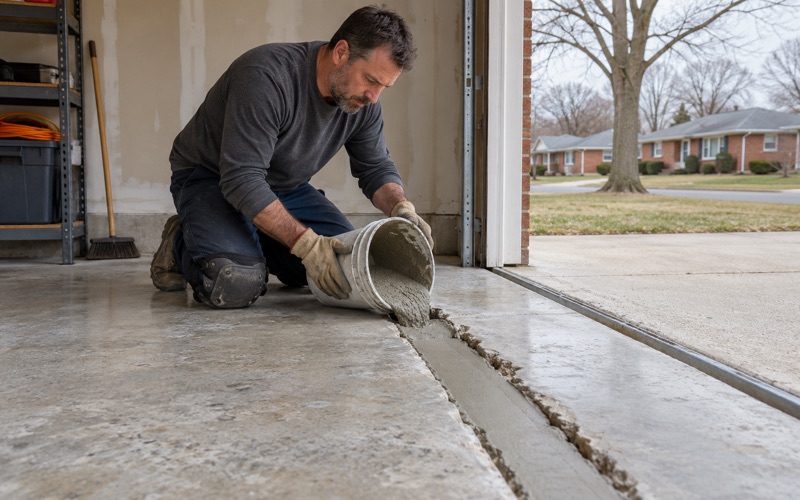
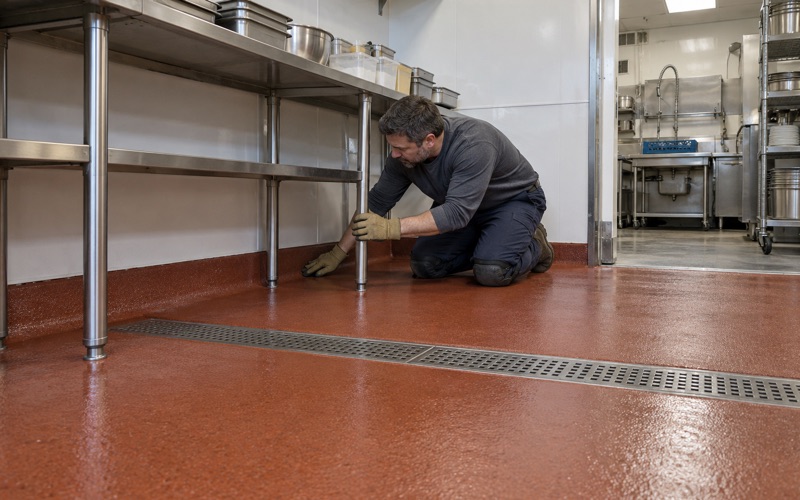
Spill-prone rooms often have a floor drain or a threshold where the resin floor meets another surface. We terminate the coating in a cut keyway at doorways and transitions, so the edge is locked into the slab rather than left as a lip that can lift and trap residue. Around a drain, the coating is turned down into the drain body so water and cleaning solution leave the room instead of finding the seam.
Preparation decides whether it lasts
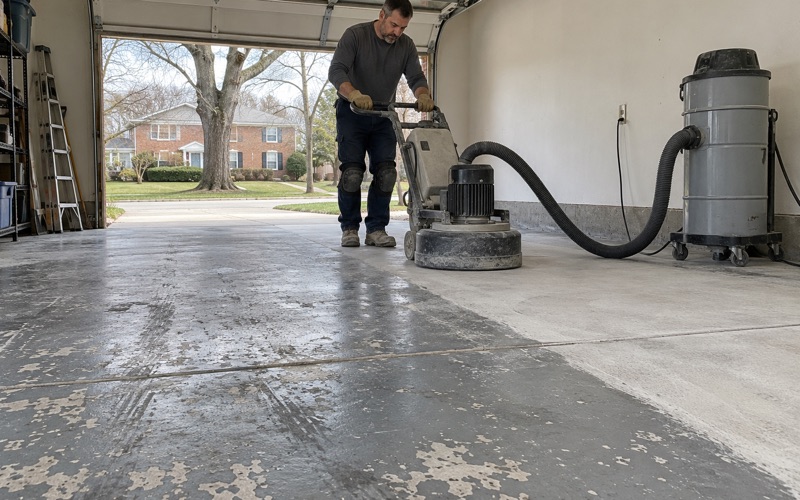
A seamless floor only stays seamless if it stays bonded. We open the slab with diamond grinding or shot blasting to a measured ICRI concrete surface profile, then map cracks, spalls and old adhesive before anything is applied. Where a slab needs repair first, the proposal says so.
Moisture readings come next. We use ASTM F2170 in-situ relative humidity probes or ASTM F1869 calcium chloride testing, and a moisture-mitigation primer goes into the scope when the readings call for it. Moisture vapor transmission is also the first exclusion we name when we explain what a coating warranty does not cover.
Each coat also has to be clean before the next goes on. Epoxy cured in cool, damp air can develop amine blush, a waxy film that weakens the bond to the topcoat, so we check for it and remove it rather than recoat over it.
Offices, Lobby and Lockers: Different Rooms, Different Floors
A building that replaces its original flooring is really making a dozen separate decisions. Only a few of those rooms need a resin floor. Treating the whole building as one coating job usually means paying for performance in places that will never use it.
Public areas and offices
A lobby is where the outdoors comes in, so a durable, slip-resistant surface makes sense near the entry. Offices and meeting rooms see chairs and foot traffic, not spills, and carpet or resilient tile is often the quieter, cheaper answer there. We would rather point a client toward the right mix than sell resin into a room that does not need it.
Winter is the hard test at an entry. Rock salt and calcium chloride deicers tracked across a lobby leave a white film and grit that scratch a soft finish, so a hard urethane topcoat is worth its cost there. A walk-off mat at the threshold does the rest.
Locker rooms, storage and service spaces
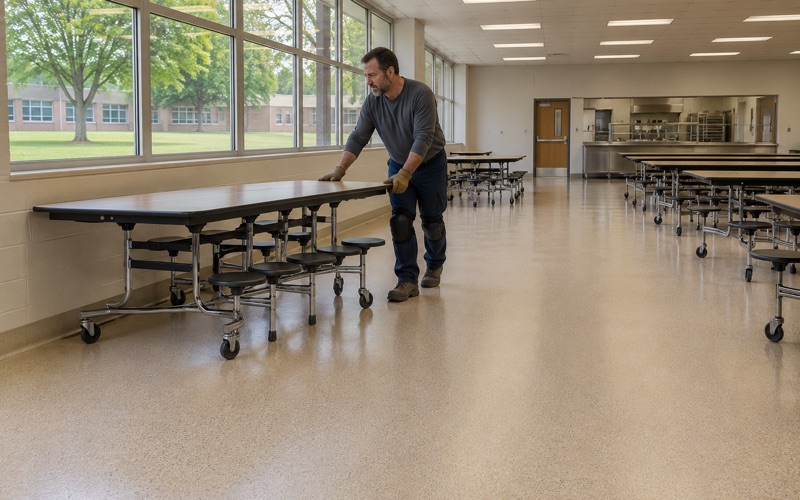
Locker rooms, restrooms and janitor closets see standing water, cleaning chemicals and daily mopping. A coved resin floor with a textured topcoat holds up in those rooms and keeps water out of the wall base. Service corridors that carry carts benefit from a smoother broadcast, so wheels roll without grinding grit into the finish.
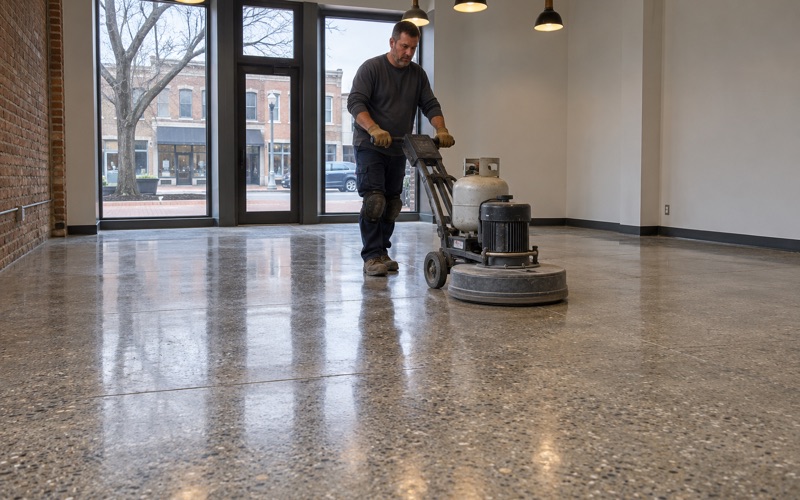
Not every back room needs a coating at all. A dry storage room that sees boxes and foot traffic can be ground, treated with a lithium silicate densifier and polished, which hardens the surface and cuts dusting at a lower cost than a full resin system. It is not seamless or chemical-tolerant, though, so it does not belong where spills are expected.
Working around an open building
Police and municipal buildings rarely close. We phase floor work room by room, with overnight and weekend windows when a space cannot shut down, and we capture grinding dust at the machine with a vacuum instead of washing it toward a floor drain. Cure schedules follow slab temperature and dew point, not the calendar, so a room is handed back only when the coating is ready for traffic.
What a Floor Cannot Do
A sealed floor is one layer of housekeeping, not a safety system. NIOSH put ventilation, local exhaust, personal protective equipment and handling procedures ahead of anything the floor does. No coating replaces those controls or decides how evidence is opened, stored or repackaged.
Drug take-back and stored items
The Cook County Sheriff’s list of Prescription Drug Take Back Collection Partners names the River Forest Police Department. Any station that holds collections has more passing through its storage rooms, which is one more reason those floors should be easy to clean. The list gives no addresses, hours or accepted items, and we make no claim about how any collection is handled.
What to ask before any room is coated
For any building, the useful questions are practical. Which rooms see spills, and of what? Which rooms must stay open during the work, and for how long can each one close? Does the slab hold moisture, and has anyone tested it?
The answers shape a room schedule: which spaces get resin, which get another floor, and what order the work runs in. Pricing that schedule room by room lets a facilities manager drop or add a space without reopening the whole job.
The same thinking at home
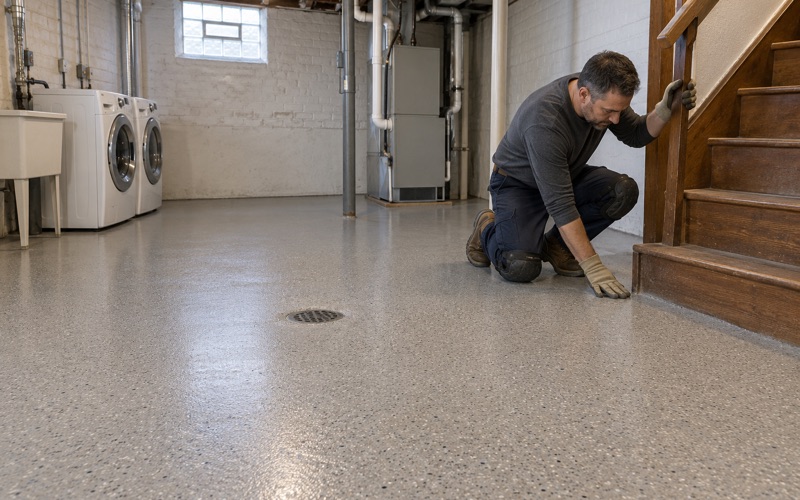
River Forest homes raise the same room-by-room question on a smaller scale. Much of the housing predates 1940, so prewar basement slabs and older garage slabs are common, and each one is tested and read for past water before we recommend a system. A coating does not stop seepage, a sewer backup or a sump that cannot keep up, and we say that before a job is sold.
The village reports about 6-10 renovations a year in its moderate and very high-end housing, so a floor job here is often one trade inside a larger project. We schedule the coating after the dusty work and before trim and fixtures go back, so the cured floor is not scuffed by other trades.
Home jobs over the Illinois threshold get a written contract and the state’s Home Repair: Know Your Consumer Rights pamphlet before any grinding starts. Garage systems are chosen to stand up to the rock salt and brine that ride in on tires all winter. Whether the floor is in a civic building or a basement, the scope tells you exactly what is going down and why.
- 20+ Years on Concrete
- Moisture Testing in Every Scope
- Ground, Never Acid-Etched