Elmhurst Epoxy Flooring has spent more than 20 years putting down epoxy flooring in Prospect Heights and across the northwest suburbs, and the jobs that teach us the most are the rooms where a floor meets something stronger than foot traffic. A garage takes road salt and hot tires. A nail room takes solvent, and that is a different conversation.
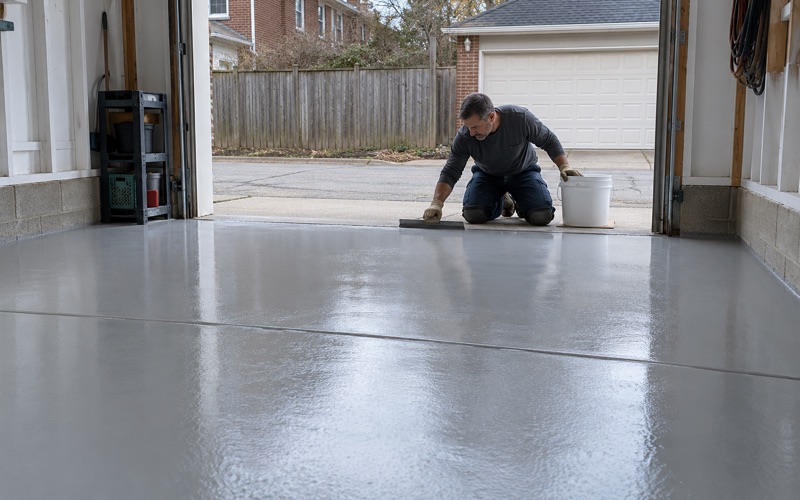
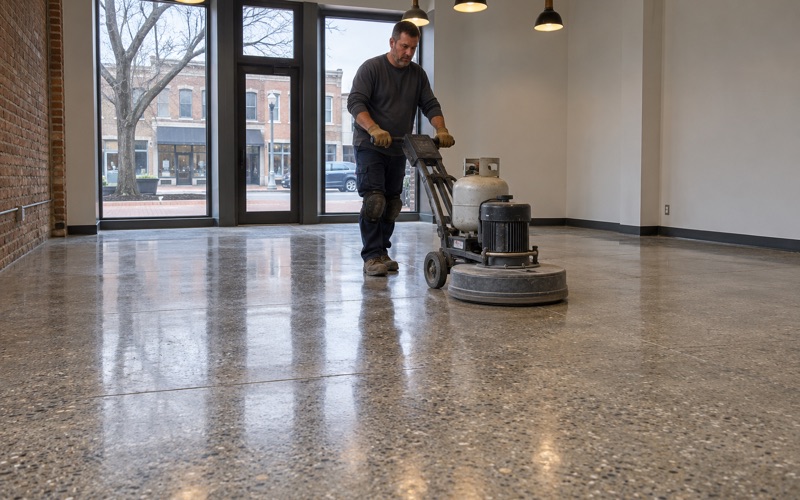
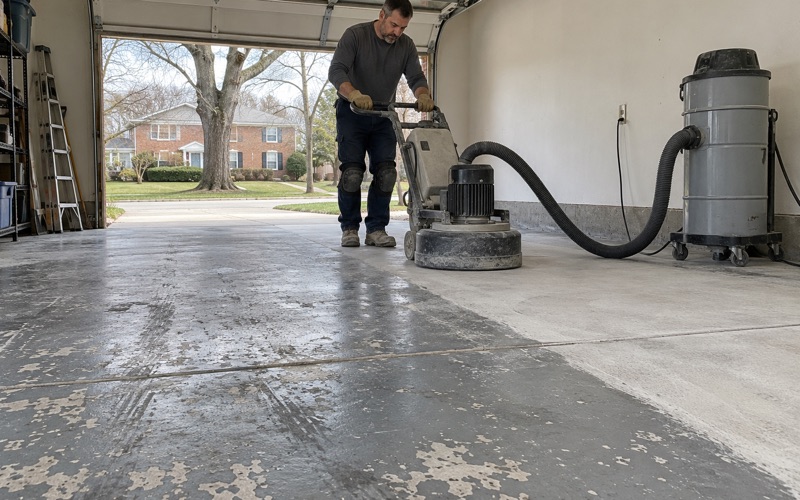
Our starting point never changes. We open the slab with a diamond grinder or a shot blaster rather than an acid etch, we put a moisture test into the written scope before the price is final, and the proposal names the product line, the number of coats and the finished thickness. You can hold the finished floor up against the quote and check it.
What changes from room to room is what we promise about the surface once it is down. On this page we walk through one kind of room in detail, a salon or nail-training space in a converted office suite, because it shows why an honest resin floor is described by how it is maintained and not by a slogan.
A Nail School in an Office Building on Wolf Road
The City of Prospect Heights keeps a resource directory, and one of its listings is a nail school: American Nail College, also listed as Lumigarnet USA, in Suite 302 at 1301 South Wolf Road. The school’s own site describes a 350-hour Nail Technician curriculum and a 625-hour Nail Technician Teacher curriculum, with about 2,000 square feet given over to teaching. The address sits inside the city, in Wheeling Township of Cook County.
The teacher curriculum mentions classroom, practice floor and auditorium settings. In any training space laid out that way, a practice floor lined with stations works the surface very differently from a lecture area, so a floor plan can treat the two zones differently instead of paying for the heaviest system everywhere.
We have no relationship with the school or the building owner, and we have never seen their floor. We use the address because it is a real example of something that happens across the area: a trade that works with solvents moves into space that was built for desks.
An office building, not a salon building
Commercial listings describe 1301 South Wolf Road as the Piper-Wolf Building, a Class B office property of 21,377 square feet built around 1989. Suites run in the 300s, and the school shares the building with ordinary office tenants. A room like that was most likely finished with carpet or a light commercial floor chosen for chairs and filing cabinets.
Office carpet is the wrong floor for nail work. It holds filing dust, it soaks up a spilled bottle of remover, and it cannot be wiped down between clients the way a sanitation routine expects. A seamless resin floor fixes those problems, but only if the owner understands what it will and will not do.
Shared walls and shared air
A suite in a multi-tenant building also shares corridors and air handling with its neighbors. When we grind a slab and coat it in a space like that, the dust is captured at the machine with a vacuum, and the coating products are chosen inside the Illinois VOC limits for floor coatings. Timing gets planned around the building’s other tenants, with evening or weekend windows when a training floor cannot close during the week.
Looking for epoxy-flooring closer to Palos Hills? See Palos Hills Epoxy-Flooring.
What Illinois Asks of a Salon Floor
Illinois sets sanitation standards for salons and shops in Section 1175.115 of Title 68 of the Illinois Administrative Code. The floor rule is a single line: floor surfaces shall be kept clean, orderly and in good repair. The section does not name a floor material, so no coating is approved or required by it.
That short rule matters more than it looks. It means the owner is judged on the condition of the floor today, not on what was installed years ago. A floor that has dulled, softened or worn through at the stations is a repair item under the same standard that a cracked tile or a torn carpet seam would be.
What good repair looks like on a resin floor
On a coated floor, good repair is easy to see and easy to lose. Edges lifting at a doorway, a worn path between the stations and the front desk, or a dull ring under a chair base are all signs to schedule work before the surface opens up. Caught early, many of these can be handled with a light recoat rather than a full grind.
The rest of the section points at the same stations
The same section makes porous nail files and disposable nail bits single-use, requires adequate ventilation, and asks that the premises stay free of excessive vapors, odors and fumes. It also prohibits nail products containing the monomer methyl methacrylate, known as MMA. That ban concerns nail liquid, not floor resins, and we mention it only so the two are not confused.
Read together, these lines describe a room where liquid chemicals, fine dust and frequent cleaning all land in the same few square feet around each table. That is the area a floor plan should be built around.
No floor is approved by the state
We hold no cosmetology or state licensing credential, and we never describe a coating as carrying any state or salon approval. What we offer is a coating system matched to the work, a written scope, and a maintenance plan that helps the owner meet the rule the state actually wrote.
Acetone, Monomer and Filing Dust at Every Station
Acetone is the trade’s everyday remover, and it is the chemical that makes resin floors in nail rooms tricky. One flooring maker’s chemical-resistance chart lists acetone as not resistant across every product group it covers. Another maker’s resistance sheet notes that ratings depend on exposure time, temperature and concentration as a liquid evaporates.
Those are one maker’s chart and one maker’s note, not a rating of any floor in Prospect Heights. They are still enough to rule out any promise of chemical immunity. No resin floor simply shrugs off acetone, and we will not sell one as if it did.
What actually lands on the floor
Around a nail station the floor sees drips of remover, polish, monomer liquid and cleaning products, plus a steady fall of filing dust. Most of it is small in volume, but it is constant, and it collects in the same spots under each chair and table. A quick wipe usually costs the surface nothing, while a puddle left under a cart over a weekend can soften or dull a topcoat.
Why texture and sheen matter here
A high-gloss finish shows every dull spot where solvent has touched it, and that can make a sound floor look damaged. A satin topcoat hides small marks better and is easier to touch up evenly. Slip resistance comes from the broadcast and topcoat we specify, and in a room that is mopped often we size the texture so it still cleans easily.
Choosing the system
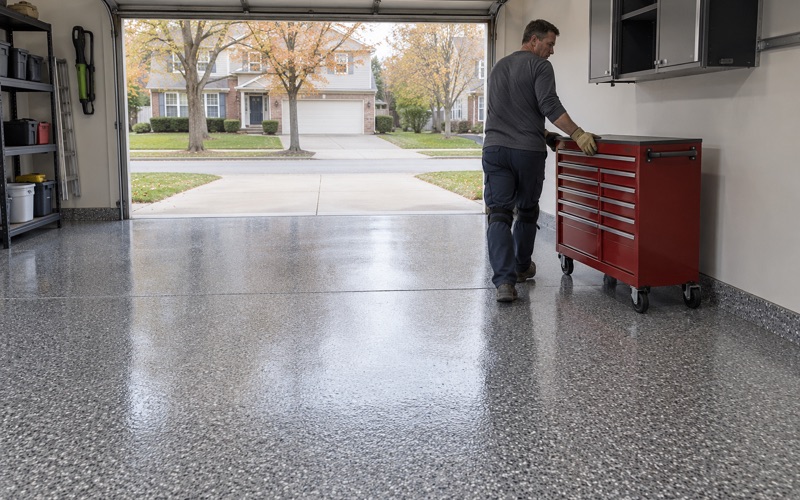
For a slab like this we typically look at a 100% solids epoxy base with a polyaspartic or urethane topcoat, and a vinyl flake or quartz aggregate broadcast if the owner wants texture and color. Before any of that, cracks, spalls and old coatings are mapped, and the slab gets a moisture test. If the concrete needs repair before it should be coated, we say so in writing.
Spot Tests, Mats and Repairs on a Schedule
The most useful hour on a job like this is the one spent on a spot test. Before the whole room is coated, we lay a sample of the chosen topcoat and let it cure. Then the school or salon puts its own remover, its own monomer and its own disinfectant on it, for about as long as a spill would really sit.
We use the owner’s own products because the label on a generic test bottle is not what will be spilled on Tuesday afternoon. If the sample dulls or softens, we change the topcoat or the plan for the stations before the room is finished, not after.
We note what was applied, how long it sat and how the sample looked once it was wiped, so the owner can compare options with the evidence in hand. A sample that survives a short contact can still mark under a longer one, which is why the test times follow the room’s real habits rather than a best case.
Removable mats and a renewable zone
Stations can sit on removable mats that take the drips and lift out for cleaning. Another option is to treat the floor under and around each table as a renewable topcoat zone, a defined area that can be lightly abraded and recoated without touching the rest of the room. Either way, the part of the floor that works hardest is the part designed to be renewed.
Wipe at once, then plan the repair
The daily rule is simple: drips are wiped at once, not left for closing time. When a patch dulls anyway, it gets scheduled as a repair, which is exactly what keeping a floor in good repair already asks for. We explain up front what the coating warranty covers and what it leaves out, and moisture is the first exclusion we name.
The same thinking at home
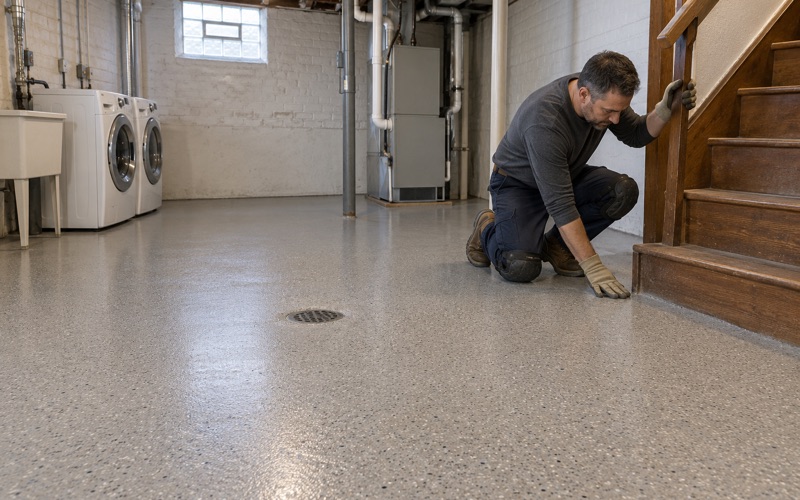
The same habits suit a home nail station or a craft corner in a basement or spare room. A mat under the work area, a satin topcoat, a test spot with the remover you actually use and a prompt wipe will do more to keep a coated floor looking even than any claim on a product label.
For a home job above the state threshold, you get a written contract and the Illinois Home Repair: Know Your Consumer Rights pamphlet before any grinding starts. Cure times follow slab temperature and dew point rather than the calendar, so a cold basement or spare room may be told to wait. If you are planning a salon room, a training floor or a small home studio here, we will start with a site visit, a moisture test and a proposal you can check line by line.
- 20+ Years on Concrete
- Moisture Testing in Every Scope
- Ground, Never Acid-Etched