Elmhurst Epoxy Flooring installs polyaspartic floor coating in Elmhurst, IL, serving surrounding cities including Northlake, Bellwood, Bensenville, Franklin Park and Westchester. Over 20+ years we have watched polyaspartic go from a specialty product to the topcoat most garage and commercial floors now finish under, and we have learned where its speed helps a floor and where it gets one into trouble.
Polyaspartic is a member of the polyurea family. It cures quickly, resists abrasion and chemicals, and holds its color under sunlight far better than most epoxies. Used well, it lets a floor return to service sooner and look better longer. Used carelessly, its short working time and quick cure magnify every shortcut in the preparation underneath.
That is why our polyaspartic floors start exactly like every other floor we install: a ground slab, a moisture test, mapped and repaired cracks, and a proposal that names the product line, the coat count and the finished thickness. The speed comes at the end of the job, never at the expense of the beginning.
What Polyaspartic Is, and Why It Cures So Fast
A Polyurea Built for Working Time
Original polyurea coatings cured in seconds and had to be sprayed with special equipment. Polyaspartic esters slow that reaction to a working window measured in minutes, enough to roll and squeegee by hand while still curing far faster than epoxy. That balance is why it became practical for garage and commercial floors.
The short window is still short. Crews mix smaller batches, work in coordinated passes and keep a wet edge moving across the floor, which takes practice and planning that a slower epoxy does not demand.
Ultraviolet Stability
Most epoxies amber, or yellow, under ultraviolet light, which shows first along a garage door line or near windows. Aliphatic polyaspartic topcoats resist that change, so a light gray flake floor stays light gray. For any floor that sees daylight, a UV-stable topcoat is the difference between the color you picked and the color you live with.
UV stability also protects what lies underneath. An epoxy body coat sealed under a stable polyaspartic layer is shielded from the light that would otherwise yellow it, so the whole floor keeps its color, not just the top few mils. That is one reason we finish epoxy floors this way even in garages with few windows.
Abrasion and Chemical Resistance
A polyaspartic topcoat resists the scuffing of shoes, tires, carts and dragged equipment better than many epoxy topcoats, and it stands up to road salt, gasoline, oil and common household chemicals. That durability is concentrated in a thin layer, which is why the topcoat must go over a properly built base rather than stand in for one.
Polyaspartic Floor Systems We Install
Epoxy Base With a Polyaspartic Topcoat
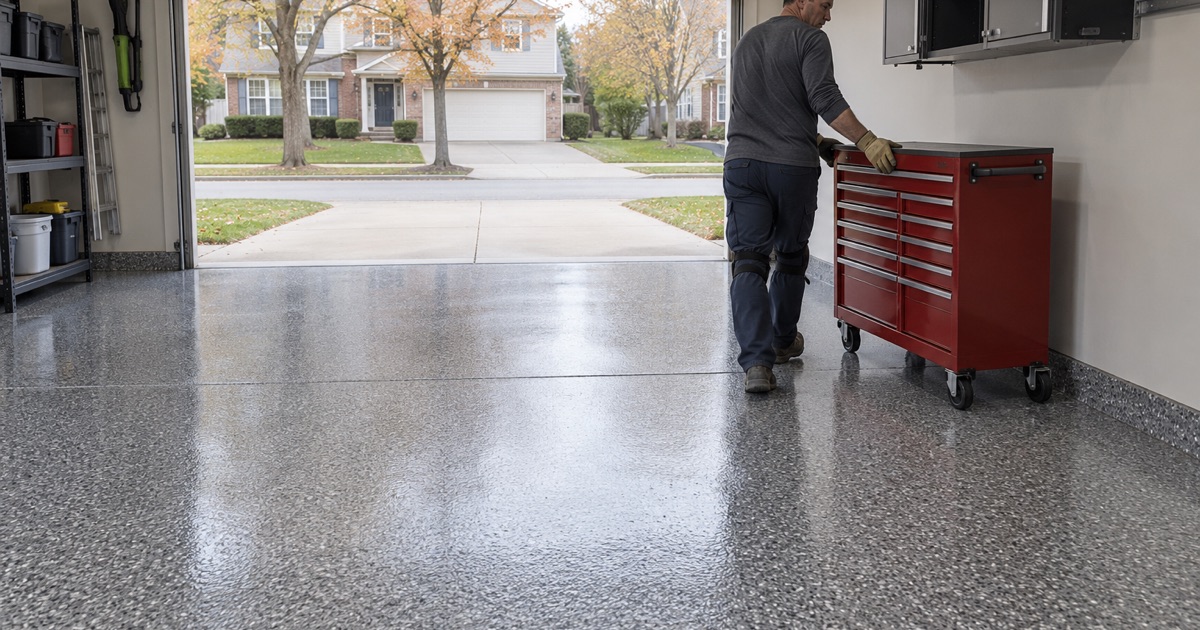
This is our most common build. A 100% solids epoxy primer and body coat bond deeply to the ground slab and build thickness, flake or quartz is broadcast into the body coat, and a clear polyaspartic topcoat seals it. It combines epoxy’s strong bond and build with polyaspartic’s color stability and wear resistance.
Because epoxy cures more slowly, this build usually spans more than one day. In exchange it tolerates more slab variation and gives a thicker, tougher floor than a thin system rushed to finish by evening.
Full Polyaspartic Flake System
On smaller, sound, dry slabs, the base, broadcast and topcoat can all be polyaspartic, which shortens the schedule considerably. It is a good fit for a garage that needs to be back in use quickly, provided the moisture test and the repairs say the slab is ready for it.
The trade-off is tighter tolerance. A full polyaspartic system has less time to wet into the ground surface than a slow epoxy, so grinding quality and slab cleanliness matter even more. When the slab is marginal, we steer the job back to an epoxy base and accept the extra day rather than gamble on the bond.
Clear Polyaspartic Over Stained or Ground Concrete
A clear polyaspartic coat can protect a stained, ground or lightly exposed concrete floor while keeping its character. It adds stain and abrasion resistance with a satin or gloss sheen, and it suits basements, sunrooms and storefronts where the look of concrete is the point.
Polyaspartic in Elmhurst Garages
A Wider Seasonal Window, Not an Unlimited One
Polyaspartic generally cures at lower temperatures than a standard epoxy, which widens the spring and fall season for garage work in DuPage County. It does not make a frozen slab ready. We still measure slab temperature and the dew point spread at the surface, and an unheated garage in deep winter still waits.
Salt, Brine and Snowmelt
Calcium chloride and rock salt that drip from cars all winter cannot reach a slab sealed under a continuous polyaspartic topcoat. The topcoat shrugs off the brine, and a squeegee pushes it out the door. That protection is only as good as the coating’s coverage at the edges, drains and door line, where we build the topcoat with extra care.
We also look at where the slab meets the driveway. The overhead door line takes the most slush and the most scraping from snow shovels, so we make sure the coating is properly terminated there rather than feathered to a thin edge that chips.
Hot Tire Resistance
The hard, chemically resistant surface of a well-built polyaspartic topcoat resists the softening that causes hot tire pickup. Real resistance still depends on what lies beneath, so we pair the topcoat with a ground surface and a properly bonded base rather than counting on the topcoat alone.
Commercial Polyaspartic Floor Coatings
Fast Return to Service
For stores, offices, clinics and restaurants that cannot close for long, polyaspartic topcoats let a floor reopen far sooner than an all-epoxy system. We plan overnight and weekend installs in sections, so a business can keep operating while each area is finished and released in turn.
The release time for each section is written into the phasing plan, along with where the crew will stage equipment and how odor will be handled on shared air. Facility managers know in advance which aisle, suite or dining room is out of service on which night, instead of learning it from a barricade at opening time.
Front-of-House and Retail Floors
Polyaspartic topcoats keep decorative flake, quartz and metallic floors looking clean under heavy foot traffic, and their UV stability helps floors near storefront glass hold their color. We specify texture by the broadcast and topcoat chosen, so entries and wet areas get grip that is written down rather than promised.
Product Selection Under Illinois VOC Limits
Illinois limits volatile organic compounds in coatings under 35 Ill. Adm. Code Part 223, and those limits bind the person applying the coating as well as the seller. Some polyaspartics are solvent-borne, so we choose products that fall within the limits for their labeled category, which matters across the Chicago ozone nonattainment area.
Where Polyaspartic Is Not the Answer
Damp or Untested Slabs
A fast-curing coating does nothing to stop vapor coming up through a slab. Where testing shows elevated moisture, the floor needs a moisture-mitigation primer under it, and where a basement takes on liquid water, it needs drainage work before any coating at all.
Rushed One-Day Promises
A one-day floor is a feature of the chemistry, not a guarantee for every slab. When a floor needs crack repair, a mitigation primer or a warmer day, we would rather add time than skip a step and watch the coating lift. The schedule we write follows the slab.
- 20+ Years on Concrete
- Moisture Testing in Every Scope
- Ground, Never Acid-Etched