
Elmhurst Epoxy Flooring installs polished concrete floors in Elmhurst, IL, serving surrounding cities including Northlake, Bellwood, Bensenville, Franklin Park and Westchester. After 20+ years of grinding slabs for coatings, we know how much a floor changes under the diamonds, and we use that knowledge to tell you what your slab can realistically become before any work is priced.
Polished concrete is not a product poured on top of your floor. It is your existing slab, ground flat, hardened with a lithium silicate densifier and refined through finer and finer diamonds until it reflects light. That makes it one of the most durable and lowest-maintenance floors available, and it also means the concrete you already have decides how the finished floor will look.
Our proposals name the exposure level, the final grit and the sheen, so the finished floor can be checked against what was quoted. Where we have doubts about a slab, we grind a sample area first rather than ask you to commit to a look the concrete may not give.
How a Polished Concrete Floor Is Made
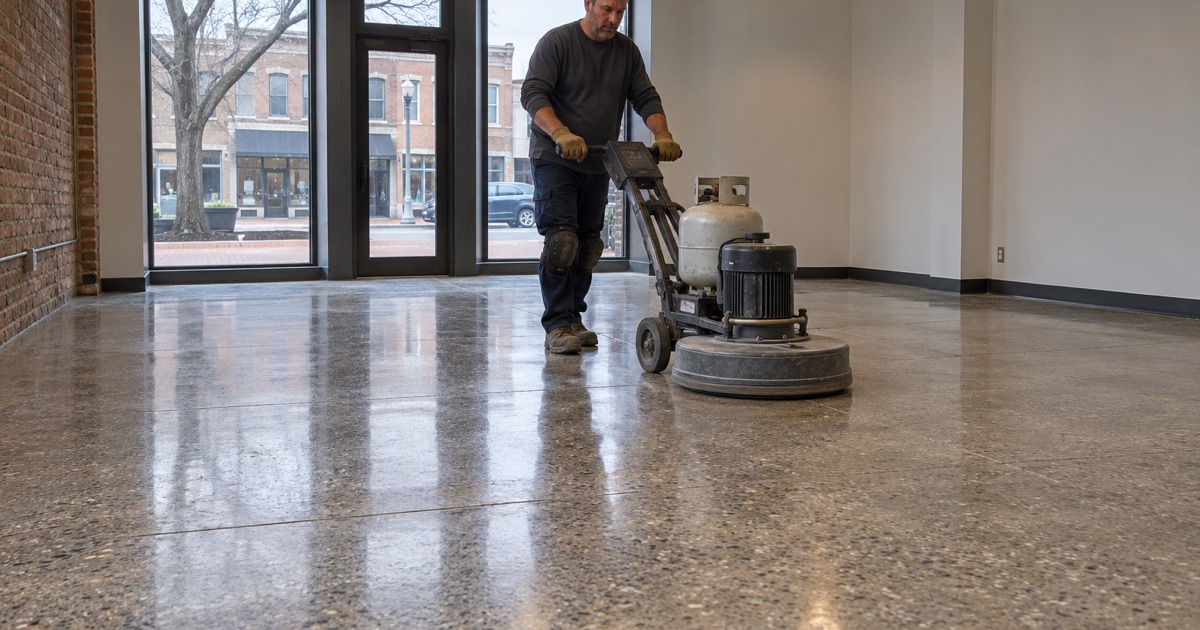
Grinding Through the Diamond Sequence
The floor is ground with metal-bonded diamonds to flatten it, remove coatings and adhesives, and open the surface to the depth the chosen exposure needs. Each pass uses a finer grit, then resin-bonded diamonds take over to refine the scratch pattern left by the one before. Skipping steps leaves swirl marks that show under daylight and store lighting.
Our grinders run with vacuums connected at the head, so the fine dust is captured at the machine. That matters in occupied buildings and in homes, where silica dust drifting into ductwork or down a hallway is a cleanup problem long after the floor is finished.
Lithium Silicate Densifier
Partway through the sequence, a lithium silicate densifier is applied and soaks into the open surface. It reacts with the concrete to harden the top layer, which reduces dusting, improves abrasion resistance and helps the slab take a higher polish. Lithium formulations penetrate without the heavy residue some older sodium densifiers left behind.
Stain Guard and Final Burnish
A penetrating stain guard is often applied after the last polishing pass to slow down oil, coffee and wine stains, then burnished with a high-speed machine. It is not a coating and does not change the character of the floor. It simply buys time to wipe up a spill before it soaks into the concrete.
Choosing Aggregate Exposure and Sheen
Cream Finish
A cream finish keeps the grinding at the very top of the slab, leaving the smooth paste with little or no stone showing. It is the most uniform look and the least invasive, but it depends on a slab with a consistent surface, because shallow grinding cannot hide trowel marks, patches or surface damage.
Salt-and-Pepper Exposure
A slightly deeper grind exposes the fine sand in the mix, giving a speckled, salt-and-pepper look that hides dust and minor marks well. This is the exposure we recommend most often for retail, office and residential floors, because it removes more surface variation than a cream finish without exposing large stone unevenly.
Full Aggregate Exposure
A deep grind cuts down into the larger stone, producing a terrazzo-like floor with visible aggregate across the slab. It takes more passes and more diamonds, and the distribution of stone depends entirely on how the concrete was placed. On some slabs the stone is even and striking; on others it bunches near joints or edges.
Because nobody can see the stone before grinding, we cut a test patch in an inconspicuous spot when full exposure is on the table. Seeing a square foot of your actual slab at that depth is the only honest way to choose it, and it costs far less than discovering an uneven spread across a finished room.
Matte, Satin or High Gloss
Sheen is controlled by the final grit. A lower final grit gives a soft satin glow that hides scuffs, while a higher final grit produces a reflective, high-gloss finish that brightens a space. We match sheen to the lighting, the traffic and the cleaning routine rather than to a sample photo.
Commercial Polished Concrete Floors
Retail Stores and Showrooms
Polished concrete gives storefronts and showrooms a bright, clean floor that stands up to foot traffic and display moves without a coating to scratch through. We work after hours and in sections so a shop can keep trading, and we plan entry zones around the slush and salt that come in on boots every winter.
Display fixtures, old tile lines and anchor holes from previous tenants leave marks that polishing reveals rather than hides. We map them during the walk-through, patch what can be blended and show you what will remain visible, so a store opening is not surprised by a ghost outline of the last tenant’s checkout counter.
Warehouses and Distribution Floors
In warehouses, densified and polished concrete reduces dusting from forklift traffic and makes floors easier to scrub. It has no coating to wear through in drive lanes, which makes it a practical option where heavy wheel loads would chew up a thin film. Joints still need filling so hard wheels do not break their edges.
Offices, Lobbies and School Corridors
Office lobbies, corridors and school hallways benefit from polished concrete’s light reflectance and low maintenance. A satin or medium gloss is usually the right balance between appearance and how quickly scuffs show. Work in occupied buildings is phased around hours, with dust captured at the machine so neighboring suites are not affected.
Residential Polished Concrete Floors
Finished Basements
A polished basement slab makes a durable, modern floor for a family room, gym or workshop, and with no film on top there is nothing for moderate vapor to blister. We still test the slab and look for signs of past water, because polishing does not stop seepage, and efflorescence can still appear where moisture moves.
Basement slabs in older homes often carry paint, carpet pad glue or floor tile adhesive, and those layers come off with coarse diamonds before the polishing sequence begins. Where a sump pit, floor drain or ejector basin interrupts the slab, we grind carefully to its edge and keep every lid and grate accessible for service.
Garages and Mudrooms
Polished concrete can work in a garage, but it is not the right choice for every one. Road salt and brine can etch and stain a polished surface over a winter, so where cars bring in heavy salt, a coating system usually protects the slab better. We tell you which way your garage leans.
What Polishing Can and Cannot Fix
Cracks, Patches and Stains
Polishing makes a slab more beautiful, but it does not hide its history. Cracks, old patches, deep oil stains and plumbing trenches remain visible in the finished floor. We fill cracks with a color-matched repair material where appropriate, and we point out every patch that will read through before the work starts.
Slabs That Are Too Soft or Too Damaged
Some slabs are too soft, too worn or too heavily patched to polish to an attractive result. When the test area shows that, we say so and suggest an alternative, such as a coating, a quartz broadcast system or a thin overlay, rather than polishing a floor that will disappoint.
- 20+ Years on Concrete
- Moisture Testing in Every Scope
- Ground, Never Acid-Etched