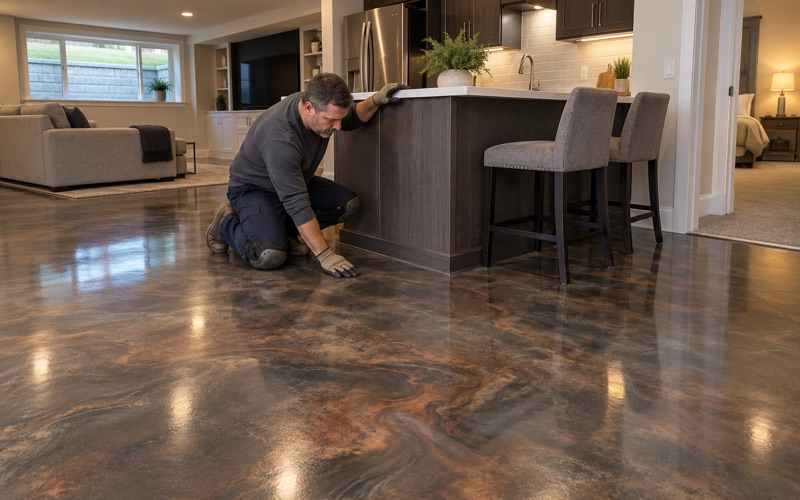
Elmhurst Epoxy Flooring installs epoxy flooring in Palos Hills with more than two decades in the trade behind it, and the rooms we think hardest about are the ones that have to come back clean on demand. A sealed resin floor does not hold onto fine dust, spills or residue the way carpet or bare concrete does. That one property drives most of the decisions on this page.
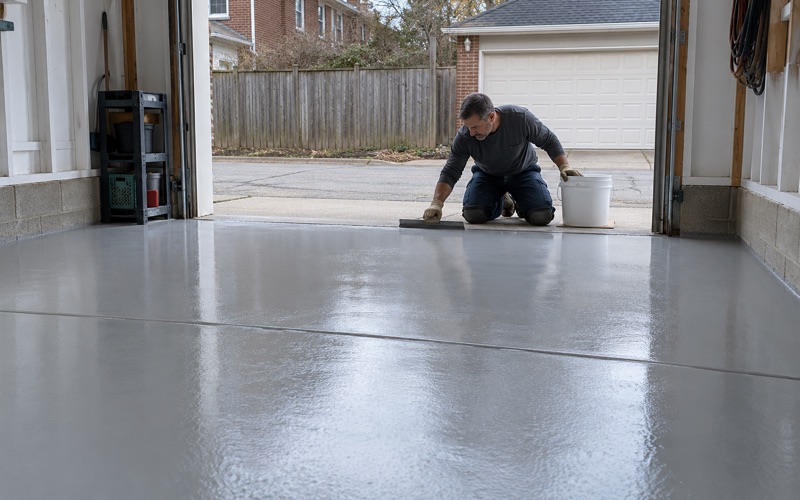
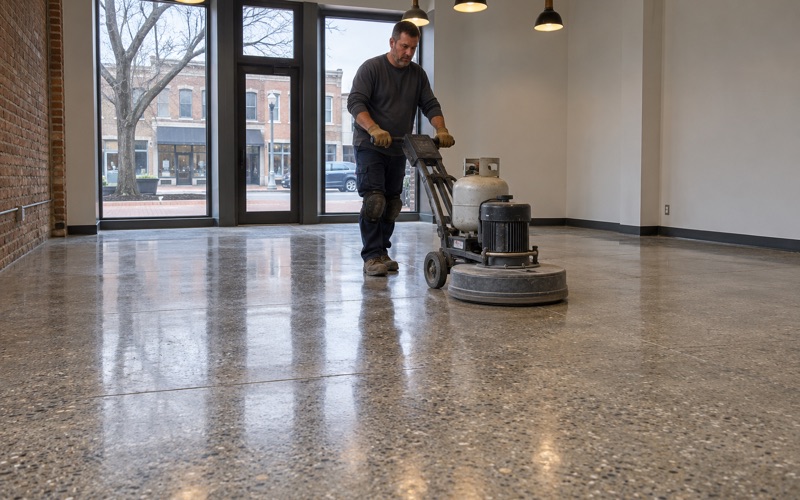
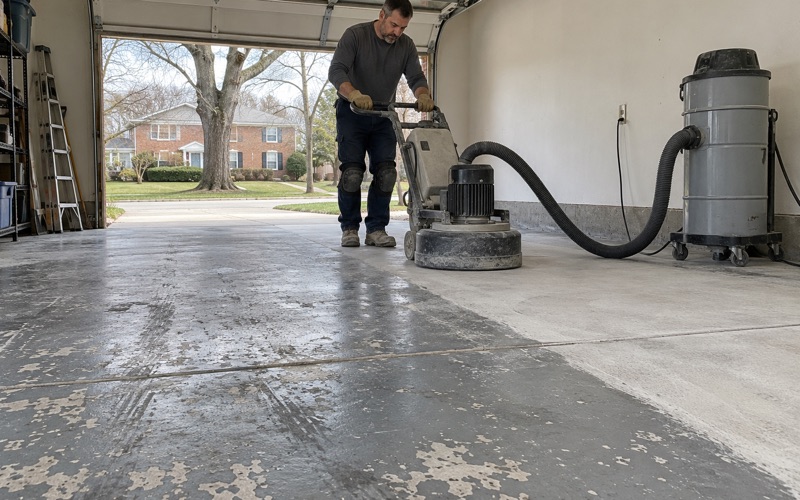
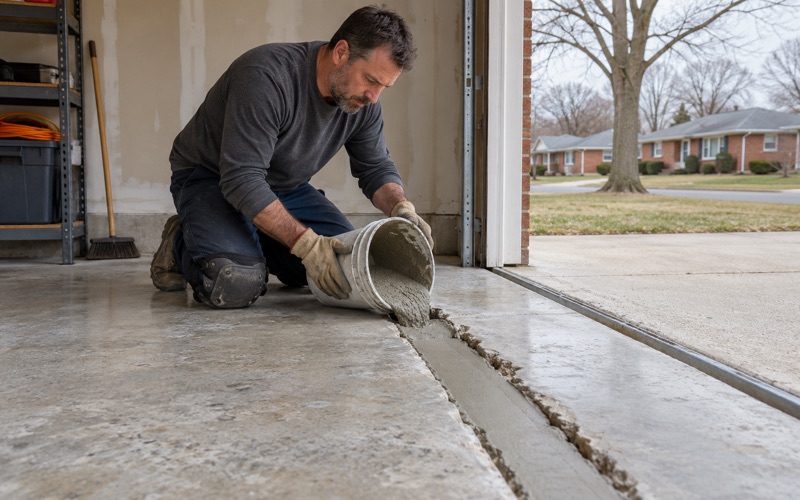
Every job starts with the slab, not the color chart. We open the concrete with a diamond grinder or a shot blaster rather than an acid etch, map the cracks, spalls and old coatings, and say so plainly when a slab needs repair or replacement before anything goes on it. A moisture test is written into the scope before the price is final, whether the slab is in a basement or a garage.
The proposal you sign names the product line, the number of coats and the finished thickness. That gives you a way to hold the finished floor up against the quote instead of taking our word for it.
A Crime Lab Built Like an Apartment at Moraine Valley
Moraine Valley Community College opened a Crime Lab in Building C on its main campus in Palos Hills for the fall 2025 semester. The college’s August 4, 2025 announcement describes a lab that resembles a small apartment, complete with a bedroom, living room and office space, with two-way glass walls and cameras to record labs. It serves CRJ-203 Forensic Science and CSI, which covers fingerprint, footprint and impression analysis along with evidence collection and crime scene photography.
Assistant professor Dave O’Connor described the design this way: “Each one of those rooms can be set up differently depending upon what our investigative focus is.” The rooms are staged, worked, documented and cleared again, scenario after scenario. We have not seen the Crime Lab’s floors or its cleaning routine, and the college is not a customer of ours.
We bring it up because it is an unusually clear case of a question that comes up in ordinary buildings too. A room that is deliberately dusted, examined and reset over and over puts a particular demand on whatever is underfoot. The finish decides whether a reset takes minutes or whether the last scenario stays behind in the fibers.
Rooms that get staged and cleared
A training room like this is used the way a real scene is used, only far more often. Furniture moves, markers go down, powders go onto doors, counters and glass, and people kneel and walk through the space while they work. Then the whole thing is cleared for the next group.
The flooring point follows from that. A floor collects whatever the room is used for, and in a room where prints are raised, that means fine powder settling at the base of every surface that was dusted.
Looking for epoxy-flooring closer to Chicago Ridge? See Epoxy-Flooring in Chicago Ridge.
Fingerprint Powder Is Made to Cling, and Carpet Lets It
Fingerprint powder is built for one job: sticking to the faint residue a fingertip leaves behind. To do that it has to be very fine, and the carbon, metallic and colored powders used to raise prints and shoe impressions are made to grip. A carpet-care maker’s spotting guide notes that there are literally hundreds of varieties of fingerprint dust, in many colors and with different properties.
What happens when powder meets carpet
The same guide is blunt about what comes next. If foot traffic grinds the powder in, or someone already tried to remove it, you are unlikely to remove it all. It warns against getting the material wet at first, and its method runs from vacuuming toward the center without a brush, to vacuuming again with a brush, to a gel, agitation, extraction and dry blotting.
That is a long list of steps for a carpet that may still show a shadow when it is done. Fibers and pad give a particle that fine countless places to lodge, and every footstep presses it deeper.
Why a sealed floor gives it back
A seamless resin floor has no pile and, installed properly, no open pores at the surface. Powder that lands on it sits on top, where a vacuum and a dry cloth can reach it. Victim guidance from police in New South Wales, as summarized in search results, draws the same line: residue on glass, tile, plastic and painted surfaces is wiped with a dry cloth and then an ammonia-based cleaner, while carpet is dry-vacuumed first.
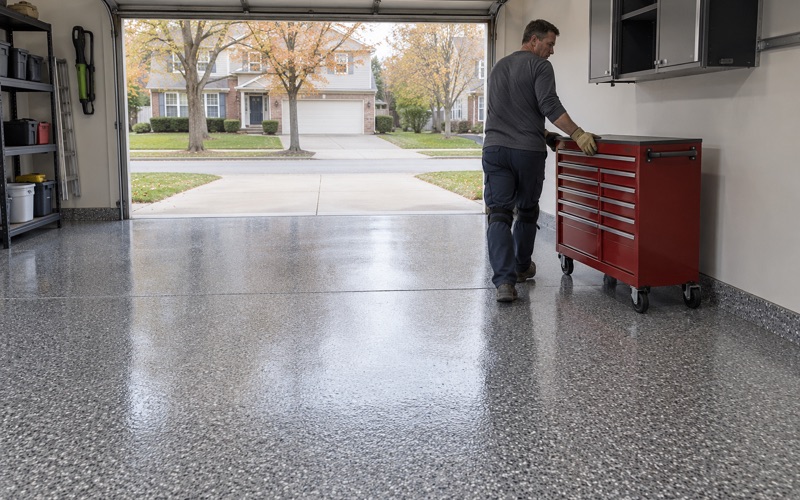
The finish matters as much as the resin. A smooth or finely textured topcoat releases dust more readily than a deep, coarse broadcast, and a plain field color makes residue, footwear marks and dropped items easier to see. Where a room needs grip, we specify slip resistance by the broadcast and topcoat used rather than promising it as a slogan.
Resetting a Room: Vacuum, Wipe, Repeat
Any room cleaned back to a blank state again and again benefits from the same floor traits, whether it is a training space, a lab, a studio or a workroom. The surface should be seamless, resistant to the cleaners the room actually uses, and hard enough that repeated wiping does not dull it into a surface that holds a film. Those three traits shape the system we put down.
Building the system
For rooms like this we usually look at a 100% solids epoxy base under a polyaspartic or polyurea topcoat, or urethane cement where a room sees heavier chemical exposure or hot water. A coved base at the wall keeps dust from packing into the corner seam where a vacuum head cannot reach. A full vinyl flake broadcast can hide residue you would rather see, so a light quartz aggregate texture or a solid color is often the better choice in a room meant to show what is on the floor.
Under all of it sits a profile the coating can grip. We grind to the ICRI concrete surface profile the product calls for, rougher for heavier builds than for thin coatings. Skipping that step is how a cleanable floor turns into a peeling one.
Cure before the first reset
A coating that is scrubbed hard before it has cured can be marked for good. Our cure schedules follow slab temperature and dew point rather than the calendar, and we tell you when the floor can take foot traffic and when it can take wet cleaning. Published schedules generally assume about 70 degrees and 50 percent relative humidity, so a cold or damp room takes longer.
Amine blush is the other cure problem worth knowing about. In cool, humid conditions some epoxies form a waxy film at the surface that has to be removed before a topcoat goes on, and a topcoat laid over blush can let go later. Watching the dew point spread at the slab surface is how we avoid it.
Working around a schedule
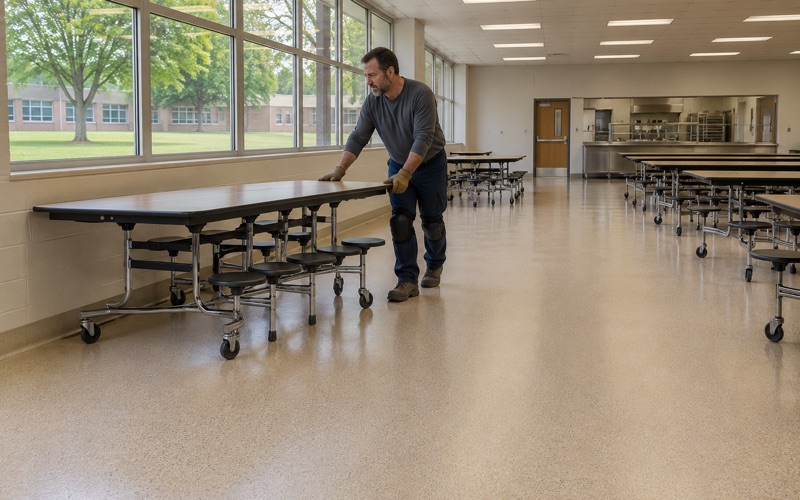
Schools, offices and other buildings that cannot close are phased around their operating hours, with overnight and weekend windows where a space has to stay open. Grinding dust is captured at the machine with a vacuum rather than rinsed toward a floor drain, a sump or a storm inlet. That matters more in a room whose whole purpose is to stay clean.
After an Investigation at Home or Work in Palos Hills
The same physics applies after police have processed a house, a condo or a business. Officers may dust doors, frames, counters and windows, and some of that powder ends up on the floor. We are not a cleanup or remediation service, and a floor coating is a floor, not a cleanup.
What we can do is explain how surfaces compare. Powder on a sealed floor, a coated garage or a tiled entry generally vacuums and wipes up, while powder walked into carpet may never fully come out. When an owner decides a carpet or worn floor is going anyway, a coated floor is one replacement option, and that conversation starts with the slab underneath.
Choosing what goes back down
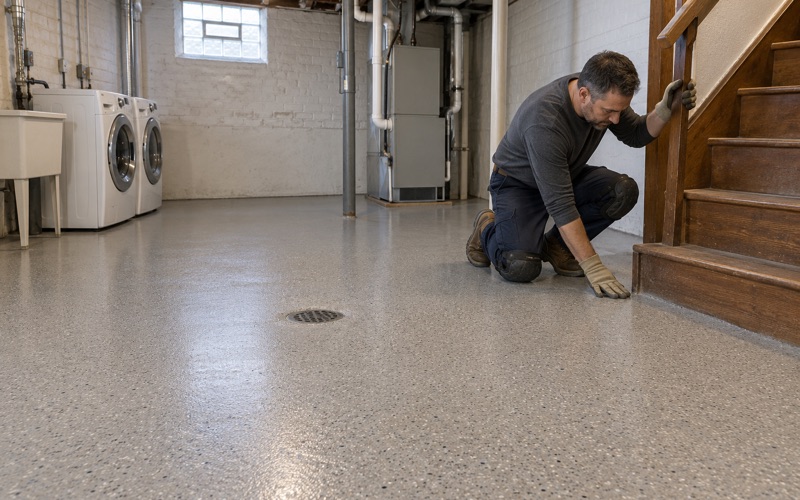
If the carpet is coming out, the first question is what the slab or subfloor under it will accept. Our systems are built for concrete, so a basement room or a slab-on-grade space is a candidate, while a framed upper floor is a different conversation. We look at the concrete, test it for moisture and tell you whether a coated floor makes sense there before anything is priced.
Basements and water
Parts of the city carry a flooding record that shapes any lower-level job. The city reports that Roberts Road north of 103rd Street floods, and that the area from 103rd Street north to 99th Street, between 78th Avenue and the Lucas Ditch, is a FEMA floodplain with repetitive flooding. We read a basement for past water before quoting, because a coating does not stop seepage, a backup or a sump that cannot keep up.
Moisture is also the first exclusion we name when we explain what a coating warranty leaves out. That conversation happens before the job is sold, alongside readings from methods such as ASTM F2170 in-situ relative humidity probes or ASTM F1869 calcium chloride testing. Where readings run high, a moisture-mitigation primer may be part of the scope, and sometimes the honest answer is to wait.
Registration, contracts and products
The City of Palos Hills Building Department registers contractors who work in town. A general contractor pays a $50 fee and posts a $25,000 surety bond, both good for two years, along with a certificate of liability insurance, and the city requires registered contractors on commercial property. Illinois itself licenses no flooring or coatings contractor, so the city registration and bond are the requirements that bind.
Home jobs over the state threshold get a written contract and the Home Repair: Know Your Consumer Rights pamphlet before any grinding starts. Products are chosen inside the Illinois VOC limits for floor and industrial coatings, which bind the person applying them. A floor coating is never sold as radon reduction, because in Illinois that is licensed mitigation work.
- 20+ Years on Concrete
- Moisture Testing in Every Scope
- Ground, Never Acid-Etched