Elmhurst Epoxy Flooring brings more than 20 years of epoxy flooring work to Norridge, and some of the hardest floors we coat are also the smallest. A restroom in a busy food business gets scrubbed harder and more often than almost any other floor in the building. A coating that is only decorative will not last there, while a system chosen and installed for the job can outlast the tile it replaces.
This page is about that floor: the toilet room in a restaurant, cafe or bakery, and the bathroom floor at home that fails the same way for the same reasons. We explain what Illinois asks of it, what breaks down first under daily cleaning, and how a seamless resin floor answers both.
Our approach does not change with the size of the room. We open the slab with a diamond grinder or a shot blaster, test it for moisture before the price is final, and write a proposal naming the product line, the number of coats and the finished thickness. You can hold the floor we leave up against that paper and check it.
A Lawrence Avenue Cafe and an Old Illinois Rule
Norridge has food businesses with a long working day: the Blossom Cafe at 8349 West Lawrence Avenue serves breakfast, lunch and dinner, opening at 6:00 a.m. seven days a week and closing at 10:00 p.m. Monday through Saturday and 9:00 p.m. on Sunday. It also has a banquet room and caters parties. We have no connection to the cafe and have never seen its restrooms, but its published hours show exactly what a food-service floor in this village is up against.
What the Sanitary Food Preparation Act says
Illinois’ Sanitary Food Preparation Act, at 410 ILCS 650/5, reaches every building, room or premises used to produce, prepare, store, sell or distribute food. It requires adequate toilet rooms, and it requires them to be separate and apart from the rooms where the food work happens. The floors of those toilet rooms “shall be of cement, tile, wood, brick or other non-absorbent material, and shall be washed and scoured daily.”
That last clause is the one a flooring contractor should read twice. Washed and scoured daily means a cafe open every day of the year scours its toilet-room floor every day of the year. There is no slow season for that floor, and no week when it gets to dry out and rest.
The Food Code points at the same floor
As of January 1, 2025, the Village of Norridge food code is the 2022 FDA Food Code as adopted by the State of Illinois. Section 6-201.14(A) of that code bars carpet in toilet room areas where handwashing lavatories, toilets and urinals are located, and Section 6-101.11(A)(3) calls for nonabsorbent materials in toilet rooms. The older statute and the newer code arrive at the same place: a smooth, nonabsorbent floor that can take a wet cleaning every single day.
Looking for epoxy-flooring closer to Lyons? See Epoxy-Flooring Services in Lyons.
Scoured Daily: What Wears Out First
A daily scouring does not wear a floor evenly. It finds whatever absorbs water and works on that spot every day until it gives way. The face of a good glazed tile rarely fails first; the weak points are the joints, the cracks and the bare concrete around them.
Open grout joints
Cement-based grout is porous unless it is kept sealed, and a grout sealer on a floor scrubbed every day does not stay in place for long. Once the joint is open, mop water and urine soak into it instead of lifting off with the mop. The grout holds them, darkens, starts to smell and slowly erodes, so each scouring pushes water into a deeper gap.
Cracked tile
A cracked tile is a new joint that nobody grouted. Water works under it, the setting bed softens, and the crack spreads into the tiles around it. In a restroom this tends to happen where the floor is wetted most and walked on in the same narrow path, in front of the toilets and urinals.
Bare concrete at the fixtures
Many older restrooms have patches of bare or worn concrete at the base of fixtures, where a toilet was reset, a tile was never replaced or an old coating wore through. Raw concrete is absorbent, so it takes in whatever is mopped across it. That small patch is often where a lingering odor starts, however carefully the rest of the room is cleaned.
Why scrubbing harder does not fix it
The usual response to a restroom that smells after cleaning is more cleaning, and more water makes an absorbent floor worse. The problem is not the effort of the staff; it is a floor with places for liquid to hide. Replacing those places with a continuous, nonabsorbent surface is what changes the result.
Seamless, Coved and Non-Absorbent
The answer to a joint that absorbs is a floor with no joints. A resinous system goes down as one continuous layer from wall to wall, so there is no grout line for mop water to settle into. Carried up the wall as a coved base, it also removes the square corner where floor meets wall, which is the hardest line in any restroom to keep clean.
A seamless floor is not a disinfectant, and we never sell one as if it were. What it does is leave cleaning nothing to soak into, so the mop and the restaurant’s own cleaners finish the job on the surface. That is the practical meaning of non-absorbent in a room scoured every day.
Preparing the slab
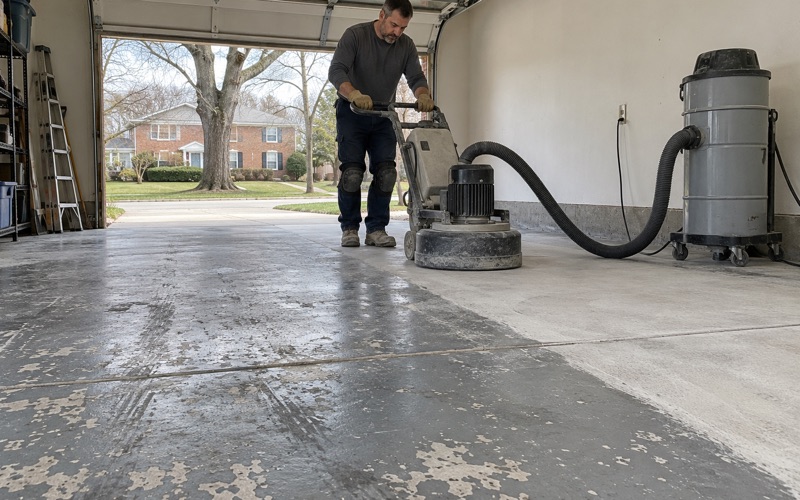
Everything depends on the bond to the concrete underneath. We grind or shot blast to the ICRI concrete surface profile the chosen product calls for, never an acid etch, and the grinding dust is captured at the machine with a vacuum rather than washed away. Before any of that, we map every crack, spall and patch of old coating, and if tile has to come up we look hard at what was under it. When a slab needs repair or replacement before it should be coated, we say so in writing.
Moisture is tested before the price is final, with ASTM F2170 in-situ relative humidity probes or ASTM F1869 calcium chloride testing depending on the slab. A restroom slab that has been wetted daily for years may hold more moisture than its dry surface suggests. A reading above the product’s limit calls for a moisture-mitigation primer or a different system, and moisture is the first exclusion we explain in any coating warranty, before the job is sold.
Choosing the system
For a commercial restroom we usually look at 100% solids epoxy with a quartz aggregate broadcast, or urethane cement where a room sees hot water and heavy chemical cleaning. A polyaspartic or urethane topcoat over the broadcast sets the finished texture. Slip resistance is specified by that broadcast and topcoat and written into the proposal, rather than promised as a slogan, and every product we use is picked inside the Illinois VOC limits that bind the person applying it.
The cove and the edges
FDA Food Code 6-201.13 addresses coved floor-and-wall junctures, and a restroom cleaned every day is exactly where that detail earns its place. We build the cove in resin so it is continuous with the floor, running it behind the toilets and around the urinals and lavatories, where tile cove pieces usually crack first. Door thresholds and any isolation joint at a wall get a flexible treatment, because a joint designed to move should never be rigidly bridged just to look seamless.
Bathroom Floors at Home Take the Same Beating
No statute tells a family to scour the bathroom floor daily, but a busy household comes close. Showers, bath water, small children and a mop every few days wear on the same grout and the same cracked tile. The failure pattern at home is a slower version of the one in a cafe restroom.
An older village of owned houses
Norridge was incorporated in 1948, when a local improvement association made it a village and stopped an effort by Chicago to annex the area. Together with Harwood Heights it forms an enclave inside Chicago, sometimes called the “Island Within a City.” Most of its housing came soon after: of 6,002 housing units, 1,938 were built in the 1950s and 1,553 in the 1960s.
That means many bathroom and powder-room floors here are decades old, original or patched more than once. With 82.4 percent of occupied homes owner-occupied, the person living with a tired floor is usually the person deciding what replaces it. A seamless resin floor with a coved base is one of the options worth weighing.
Where a coated bathroom floor makes sense
A resin system belongs on concrete, so the natural candidates are basement bathrooms, powder rooms on a slab and laundry rooms next to them. Basement floors are read for past water before anything is quoted, because a coating does not stop seepage, a sewer backup or a sump that cannot keep up. If the slab shows that history, we say so rather than coat over it.
Cure schedules follow the slab temperature and the dew point, not a date on the calendar. A cold basement in deep winter can need warming or a wait before the coating goes down. We would rather move a start date than leave a soft or blushed floor behind.
Permits and paperwork in Norridge
The Village of Norridge Building Department registers contractors annually by calendar year, and registration is required for kitchen and bath remodels along with other work. The village also requires a permit for all construction, remodeling or upgrading of property, so we check with the Building Department about the specific job before it goes on the schedule. For home jobs above the state threshold, you get a written contract and the Illinois Home Repair: Know Your Consumer Rights pamphlet before any grinding starts.
Whether the floor is a cafe restroom scoured every morning or a basement powder room used by the whole family, the work starts the same way. We look at the slab, test it, map what is wrong with it and put the system, the coats and the thickness on paper. Then the floor gets built to take the cleaning it will actually see.
- 20+ Years on Concrete
- Moisture Testing in Every Scope
- Ground, Never Acid-Etched