Elmhurst Epoxy Flooring brings more than 20 years of epoxy flooring work to Lyons, and some of the floors we plan most carefully are the ones that take heat. A weld bench, a cutoff saw or a plasma torch drops hot metal on the slab every working day. A resin coating in that room has to be designed around the falling metal rather than hoping it holds up.
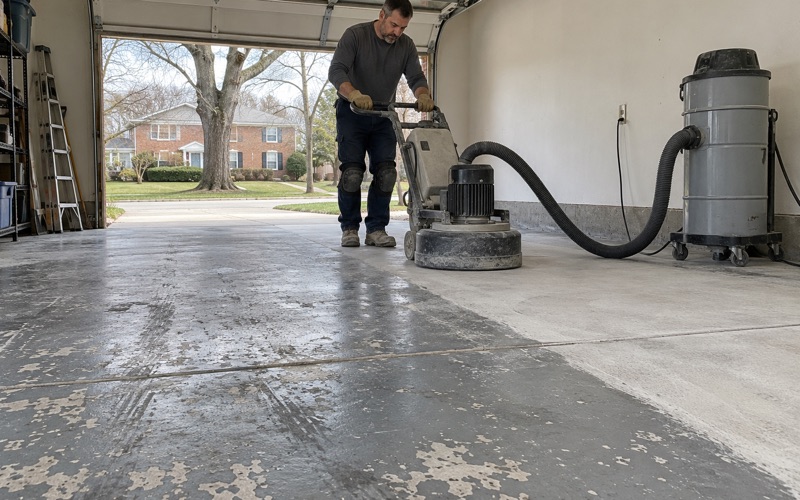
The groundwork is the same on every slab we touch. We open the concrete with a diamond grinder or a shot blaster, never an acid etch, and a moisture test sits in the written scope before the price is final. The proposal names the product line, the number of coats and the finished thickness, so the floor can be checked against the paper.
Where welding happens, we add one step before any product is picked. We map where the sparks and slag actually land, bench by bench. That map decides the topcoat, the texture, the color and what covers the coating while the work goes on.
A Welding Repair Shop on 47th Street, and What Slag Does to Resin
The kind of work done along West 47th Street
AMS Welding, at 7800 West 47th Street near Center Avenue, is a welding repair shop working in aluminum, stainless and cast iron, and its directory listings also mention welding training. It sits on the north-side 47th Street strip of Lyons, inside the village limits. We have no relationship with AMS Welding and have never seen its shop or its floor, so we describe the trade here, not that building.
Repair welding in metals like those throws spatter from the arc and leaves slag on the bead to be chipped away. Cutting a damaged part free or trimming a patch sends a shower of sparks toward the floor. Grinding a weld flush adds a stream of hot grit on top of that.
Why a hot bead marks a resin film
On bare concrete, a slag ball or a spatter bead cools on a mineral surface that does not burn. A resin coating changes that, because it is the one combustible layer on an otherwise concrete floor. A hot bead dropped on it leaves a burned pit even when nothing catches fire.
One pit is cosmetic, but a working bench produces hundreds of them over a season. They collect in a ring around the vise and along the path the welder walks while moving a part. Each one is a small break in the topcoat where grime settles, and a dense cluster is where wear begins.
What a coating can and cannot promise
No floor coating is fire protection, and no coating can bring a shop into line with OSHA. A 100% solids epoxy or a polyaspartic topcoat stands up well to oil, coolant and cleaning chemicals, but it still scars under hot metal. We say that before anything is sold, because the honest plan protects the film where slag falls instead of selling the film as the protection.
Looking for epoxy-flooring closer to Summit? See Summit Epoxy-Flooring.
OSHA’s Welding Rule: Guards, a Swept Floor and No Wet-Down
What 29 CFR 1910.252 asks of the floor
The federal rule for welding, cutting and brazing, 29 CFR 1910.252, opens with fire prevention. Where the object being welded cannot be moved and the fire hazards around it cannot be removed, it says guards shall be used to confine the heat, sparks and slag. Those guards are the same tool that saves a resin floor.
The rule also deals with what lies on the floor itself. Where combustible materials such as paper clippings, wood shavings or textile fibers are present, the floor must be swept clean for a radius of 35 feet. Where practicable, combustibles are moved at least 35 feet from the work site as well.
The shock warning that rules out water
The same section lets a combustible floor be kept wet, covered with damp sand or protected by fire-resistant shields. It then adds that where floors have been wet down, anyone operating arc welding or cutting equipment must be protected from possible shock. On a coated shop floor, we read that warning as the deciding one.
Water is not part of our plan anywhere near an arc. A wet topcoat is slick, it raises the shock risk the rule warns about, and it does nothing a blanket cannot do better. Shields and blankets are the floor protection we design around.
Where the rule and the coating plan meet
A shop that already follows its fire-prevention practice is halfway to a floor that lasts. The 35-foot sweep keeps rags and shavings away from sparks, and it also keeps abrasive grit from being ground into the topcoat underfoot. Compliance with the rule is the shop owner’s job, and we explain how a coating fits around those practices rather than claiming the floor delivers them.
Planning the Weld and Cut Zone Before the Coating Is Chosen
Mapping where slag and cutting sparks land
We start by walking the shop with whoever does the welding. The bench, the cutting station, the grinder stand and the spot where heavy parts get tacked on the floor each throw metal in a different pattern. Cutting sparks travel farther than weld spatter, so a torch or abrasive saw usually defines the outer edge of the zone.
The result is a simple floor plan with the heat zones drawn on it. Inside those lines the coating is protected and expected to need touch-ups. Outside them, the floor can be finished for cleaning, appearance and traffic like any other shop.
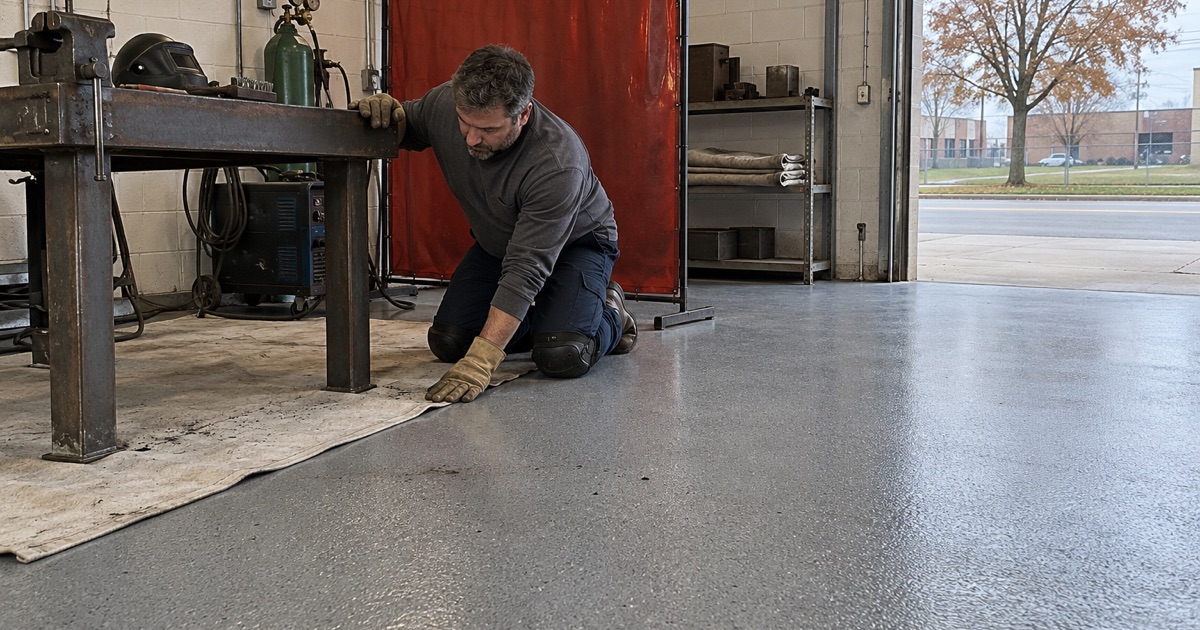
Welding blankets and shields where slag falls
Fire-resistant welding blankets laid on the coated floor under a bench catch slag before it reaches the film. A blanket can be lifted, shaken out and replaced as it wears, which a coating cannot. Upright shields around a cutting station keep sparks from skipping across the room and onto a finished aisle.
This is the same idea as the guards in the federal rule, applied to the floor itself. We plan the coated surface on the assumption that blankets will be there. If a shop does not intend to use them, we say plainly that the topcoat in that zone will show burns quickly.
A textured, recoatable topcoat in a mid-tone
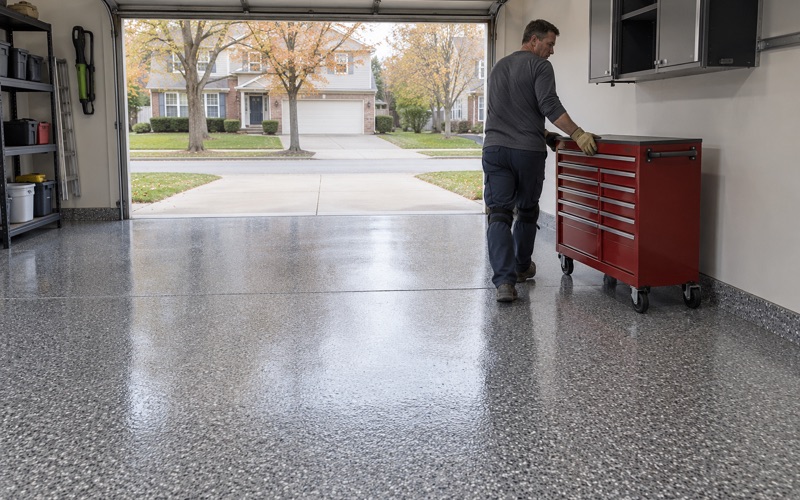
Inside the weld zone we favor a broadcast texture with a topcoat that can be scuffed and recoated without grinding the whole system off. A recoatable topcoat turns a burned patch into a short repair. The texture also gives grip where spatter beads and metal fines collect underfoot.
Color matters more than most owners expect. A bright white or a high-gloss black shows every small burn, while a mid-tone gray hides scattered pits and keeps the floor looking cared for between recoats. We name the broadcast, the topcoat and the expected recoat interval in the written proposal, so the slip resistance and the maintenance plan are specified rather than promised.
Preparation still decides whether any of it holds
None of this works on a poorly prepared slab. We grind or blast to a measured surface profile, map cracks, spalls and any old coating first, and tell an owner when a slab needs repair before it should be coated. Cure schedules follow slab temperature and dew point, so an unheated shop in deep winter may be told to wait.
The Hobby Welder in a Coated Lyons Garage
Why the same planning applies at home
A garage welder with a small wire-feed machine throws the same spatter onto a coated floor as a professional bench does, just less often. Many owners coat the garage for looks and only later start welding brackets, trailers or furniture repairs on it. The first burned spots usually appear right under the vise.
A home garage also has fewer guards than a shop. Cars, cardboard, gas cans and lawn equipment often share the space, so clearing combustibles away from the work, as the federal rule asks of workplaces, is worth borrowing at home. That habit protects the topcoat as much as the house.
We ask about welding at the first visit, even when it sounds occasional. A welding blanket stored on a hook and laid down before the machine comes out costs little. Picking a mid-tone flake blend and a recoatable topcoat for the whole garage is easiest at the start.
Older slabs and the Lyons garage stock
Lyons has built almost nothing since 2010, with zero housing units recorded for that decade, so nearly every garage we see here is an existing slab. That means recoats, failed earlier coatings and first coatings on concrete that has seen decades of road salt and oil. Each of those changes the preparation, and we map the condition before quoting.
Winter adds its own load. Brine and rock salt ride in on tires all season, so we choose garage systems that tolerate them, and we keep grinding dust captured at the machine with a vacuum instead of washing it toward a drain. The Village of Lyons runs its own contractor license application and publishes garage specifications, so we check the current requirements with the village before a job is scheduled.
Where shop and home sit close together
Lyons is a village in Cook County, incorporated in 1888, with 10,817 residents at the 2020 census and the Chicago Portage National Historic Site within its borders. Trade shops along 47th Street sit a short drive from blocks of houses and two-flats. For a garage or shop floor here, that mix comes down to one practical question we ask on every visit: will anyone be welding on it.
- 20+ Years on Concrete
- Moisture Testing in Every Scope
- Ground, Never Acid-Etched