Elmhurst Epoxy Flooring has spent more than 20 years on epoxy flooring in Lemont and the surrounding suburbs, and the floors we think hardest about are the ones that get abused on purpose. A truck shop, a fleet garage or a trailer bay does not need a showroom finish. It needs a coating that is honest about where it will be beaten up and simple to repair when it is.
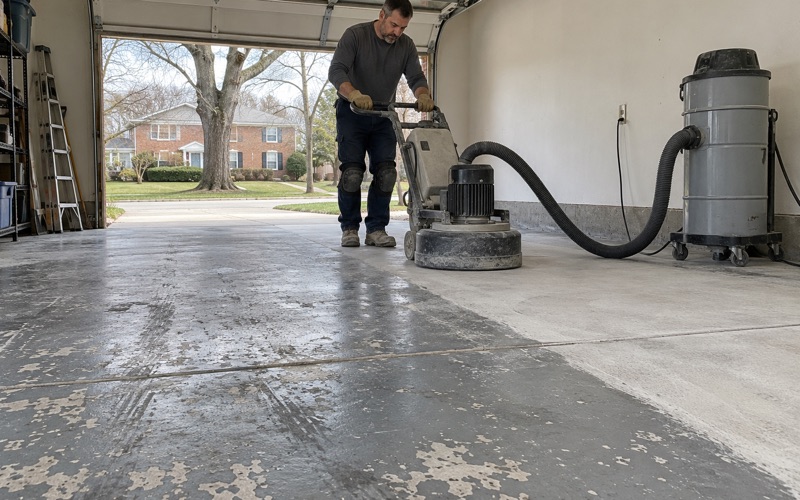
Every job starts the same way. We open the slab with a diamond grinder or a shot blaster rather than an acid etch, map the cracks, spalls and old coatings, and run a moisture test before the price is final. The written proposal then names the product line, the number of coats and the finished thickness, so you can hold the floor up against the paper.
This page is about one corner of a shop floor that most coating pitches skip: the tire bay. We give no tire-service safety training, and no coating makes a bay safe or legal on its own. What a floor can do is support a layout that keeps the rules easy to follow, and survive the rough work that happens there.
A Truck Shop on Main Street and the Rule Behind Its Tire Bay
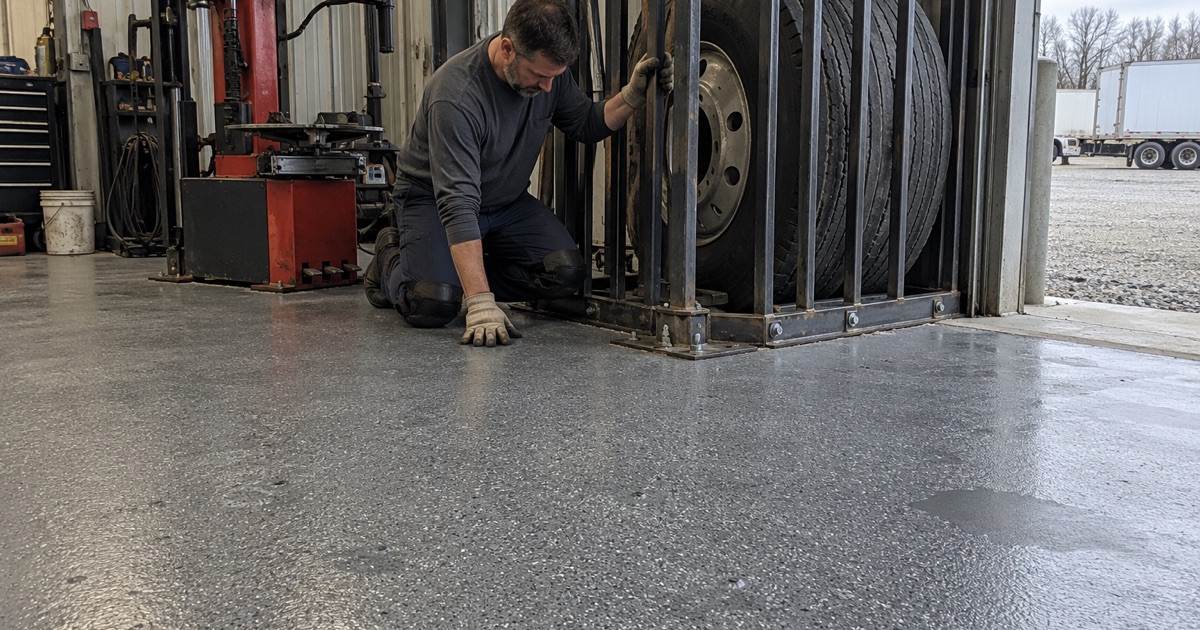
Lemont Truck Center sits at 13751 Main Street, inside the village limits, and its own site lists truck and trailer repair, DOT inspections, oil changes and maintenance alongside truck tires. Its pages also name truck tire service and tire repair and replacements. We have no relationship with the shop and have not seen its tire bay or its floor, but that list of services describes a kind of building we are asked about often.
A shop like that rolls heavy steel wheels across the same slab where diesel work, inspections and oil changes happen. That mix is why the floor plan matters more than the color chart. The tire bay is the one area where a federal safety rule and the slab under it are directly connected.
What 29 CFR 1910.177 covers
Federal OSHA’s rule for servicing rim wheels is 29 CFR 1910.177. Its scope paragraph says it applies to multi-piece and single piece rim wheels used on large vehicles such as trucks, tractors, trailers, buses and off-road machines. That is the work a truck tire bay does every day.
The rule defines trajectory as any potential path a rim wheel component may travel during an explosive separation or the sudden release of pressurized air. In plain terms, it is the direction a tire or its parts can go when something lets go. The rule names no floor material at all.
The flat, solid surface line
Paragraph (g)(7) of the rule reads: ‘Tires shall not be inflated when any flat, solid surface is in the trajectory and within one foot of the sidewall.’ Paragraph (g)(8) adds that employees shall stay out of the trajectory when inflating a tire. Those two sentences are where a floor contractor’s work and a safety rule meet.
Looking for epoxy-flooring closer to Worth? See Worth Epoxy-Flooring.
Why a Truck Tire Is Never Aired Up Flat on the Floor
Picture a truck tire lying on its side on the shop floor. The concrete is a flat, solid surface, and it sits right against the lower sidewall, well inside one foot. Inflating it there is exactly the situation the rule describes, which is why truck tires are aired up in the restraining cage instead.
What the restraining cage is for
The rule says restraining devices and barriers must be capable of preventing rim wheel components from being thrown outside or beyond the device. It also says that while a rim wheel is in a restraining device, nobody rests or leans any part of their body or equipment against it. The cage is the safety device, and the floor under it is not.
That changes how we think about the slab in a tire bay. The floor does not protect anyone during inflation; its job is to give the cage a level, solid place to stand and to keep the area around it clean and readable. A floor that is chipped down to bare concrete in front of the cage is a housekeeping problem, not a safety feature.
A coating is never a reason to skip the cage
We occasionally hear the idea that a fresh coating is too nice to drag a cage across, or that a tire can be topped off where it lies to spare the floor. We push back on both. A coating can be patched in an afternoon, and the floor plan should make the cage the easy choice rather than the inconvenient one.
That is also why we make no safety claim for any coating in a tire bay. The rule’s requirements are about equipment, procedure and where people stand. Our part is narrower: build a floor that holds up where the cage lives and never gives anyone a reason to work outside it.
The Cage and Changer Square: A Floor Built to Be Dented and Touched Up
The square of floor around a tire changer and the inflation cage takes more punishment than anywhere else in a truck shop. Steel wheels get dropped, tire irons get set down hard, and bead lubricant ends up on the surface. A thin, glossy coat in that square is usually chipped within weeks.
A broadcast system, not a smooth film
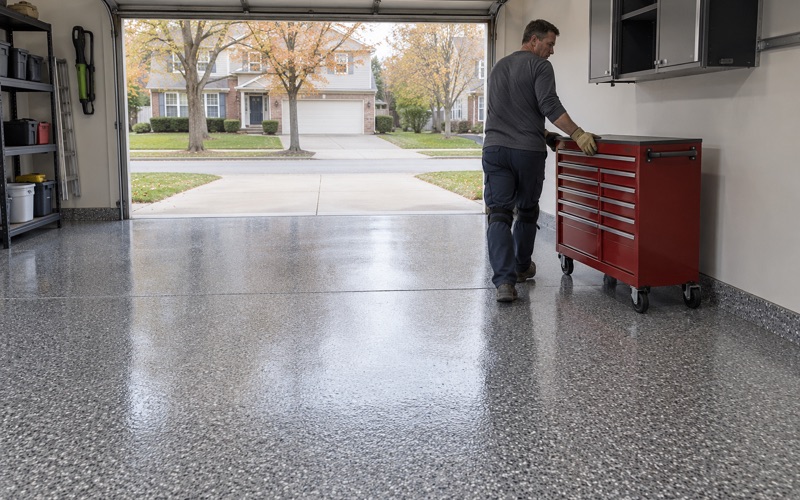
For that zone we usually specify a 100% solids epoxy base with a quartz aggregate broadcast, locked in with a topcoat. The aggregate gives the system body, and the texture is set by the broadcast and topcoat we choose rather than promised as a slogan. Lubricant on the floor still gets wiped up as part of the shop routine; the broadcast is there mainly because a built-up, textured system takes impact better than a smooth one.
Where a shop wants a faster return to service, a polyaspartic or polyurea topcoat over the broadcast is an option. We explain the trade-offs in cure time, pot life and recoat window before anything is chosen. Either way, the proposal states the products and the finished thickness for that square separately from the rest of the floor.
Built to be repaired, not to be perfect
The goal is not an undentable square, because nothing that is still a floor coating is. The goal is a system that can be sanded, cleaned and recoated in a patch without stripping the whole bay. We pick a topcoat with a recoat path the manufacturer documents, and we write that path into the proposal so the shop knows what a repair involves.
Dents in a broadcast floor are cosmetic until they go through to the concrete. When they do, the spot is ground back, filled and rebroadcast, and the area returns to service once the patch cures. A shop that plans for that keeps a dull, scarred square in front of the cage and a clean floor everywhere else.
Preparation decides whether patches hold
A repair only bonds as well as the original floor did. That is why we grind or shot blast to a real concrete surface profile on the ICRI CSP scale instead of etching with acid, and why oil-soaked concrete near the service bays is cleaned and tested before anything goes down. Grinding dust is captured at the machine with a vacuum, never rinsed toward a trench drain or a floor drain.
Cracks and spalls get mapped before the quote is final. If a slab needs repair or replacement before it should be coated, we say so plainly rather than coating over a problem that will show through the first winter.
Where the Trajectory Points: Walkways, Parked Equipment and the Cage
Where the cage stands is a layout decision, and it is worth making before the floor is coated rather than after. The cage belongs where the open side and its trajectory are clear of walkways, benches and anything parked. Moving a cage later can mean moving the heavy-duty zone with it.
Zones instead of one finish
In most truck shops we plan the floor in zones. The cage and changer square gets the broadcast, repairable system, the walk paths get a texture suited to foot traffic, and the service bays get a build chosen for the fluids they see. One coating across the whole building is usually either too thin for the tire bay or more than the parts room needs.
We mark where each zone starts and stops on the drawing that goes with the proposal. That way the shop can see which square was built to take abuse and which areas were not, and a future repair can match the right system.
Lemont details that change the job
Lemont is a village that spans Cook, DuPage and Will counties, set on a hillside along the south bank of the Des Plaines River. Permit and building questions go to the Village of Lemont Building Department, which works under the village building code with the 2021 International Codes adopted. We could not read the village’s contractor registration terms online, so we ask the Building Department directly before a job is scheduled.
A Lemont mailing address is not always a Lemont building job. One truck and trailer repair shop with a Lemont address on Archer Avenue sits in unincorporated Homer Township in Will County, so we confirm which authority covers a property before we plan permits or timing.
Winter, salt and cure timing
Truck bays have large overhead doors that open all winter, and brine and rock salt ride in on every tire. We choose systems meant to hold up to those deicers, and we set cure schedules by slab temperature and dew point rather than the calendar. An unheated bay in deep winter is told to wait for warmer conditions or temporary heat.
Before any of that is sold, we walk through what the coating warranty leaves out. Moisture coming up through the slab is the first exclusion we name, which is why the moisture test sits inside the written scope and not after it.
- 20+ Years on Concrete
- Moisture Testing in Every Scope
- Ground, Never Acid-Etched