Elmhurst Epoxy Flooring has spent more than 20 years on epoxy flooring in Justice and across our service area, and the floors that teach us the most are the ones around running machines. A machine shop floor is judged on a wet afternoon in the middle of a shift, not on the day the coating cures. That is the standard we write every shop proposal against.
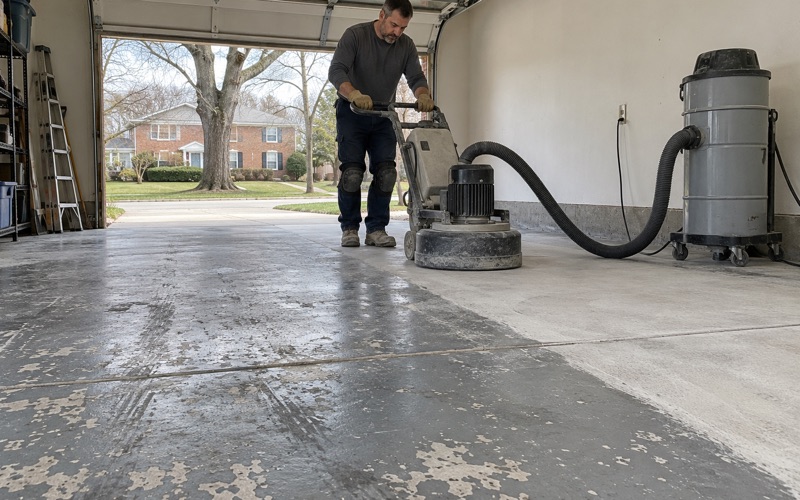
Our work starts with the slab itself. Every floor is opened with a diamond grinder or a shot blaster rather than an acid etch, and cracks, spalls and old coatings are mapped before we put a number on anything. If the concrete needs repair or replacement first, we say so in writing instead of coating over the problem.
The proposal then names the product line, the number of coats and the finished thickness, so an owner can hold the installed floor up against the quote. A moisture test is part of that written scope before the price is final. For a shop floor, the proposal also states which texture goes where and why it was chosen for the fluids in that room.
A Machine Shop on 86th Court, From the Village’s Own List
Justice describes itself as a village of small businesses with no major industries. Its own hazard plan points to the truck repair shops and body shops in its industrial park rather than to any large plant. The Village of Justice business list, updated July 2025, is the clearest map of what actually runs there.
What the business list shows
Under the heading MACHINE SHOPS, that village business list carries two entries. One is Peter’s Machine Works, Inc., at 8277 South 86th Court, an address that geocodes inside the village in Lyons Township. We have no relationship with the shop and have not seen its floor, its machines or the fluids it runs.
We mention it because it describes a kind of floor that exists in Justice and that most garage-floor contractors rarely plan for. A shop that turns or mills metal with a water-miscible coolant has a floor problem of its own, and it is not the one a truck bay down the street has. Any CNC lathe or mill running that kind of metalworking fluid raises the same questions, whoever owns it.
Who signs off on floor work here
Floor coating in Justice runs through the Village of Justice Building Department at 8748 West 82nd Place. Its Contractor’s Work Permit Program requires every contractor to be insured, licensed and registered with the village, and no building permit issues until each contractor under it is registered and bonded. The permit bond is $10,000 for contractors other than sewer contractors, and it runs on a licensing year of February 1 through January 31.
Concrete work is a listed permit item that also calls for a plat of survey, so a job that includes slab repair is scoped with that in mind. Illinois licenses no general, flooring or coatings contractor, which makes the village registration and bond the credential that actually binds. We confirm with the village what the permit covers before a start date is set.
Looking for epoxy-flooring closer to Bridgeview? See Epoxy-Flooring in Bridgeview.
Coolant Film: Why a Glossy Floor Gets Slick Around a Mill
OSHA’s Metalworking Fluids: Safety and Health Best Practices Manual lists wet and slippery work surfaces among the hazards of these fluids. The manual is guidance, and it says plainly that it is not a standard and creates no new legal obligations. Its floor advice is still the most practical reading we know for a machining area.
Where the film comes from
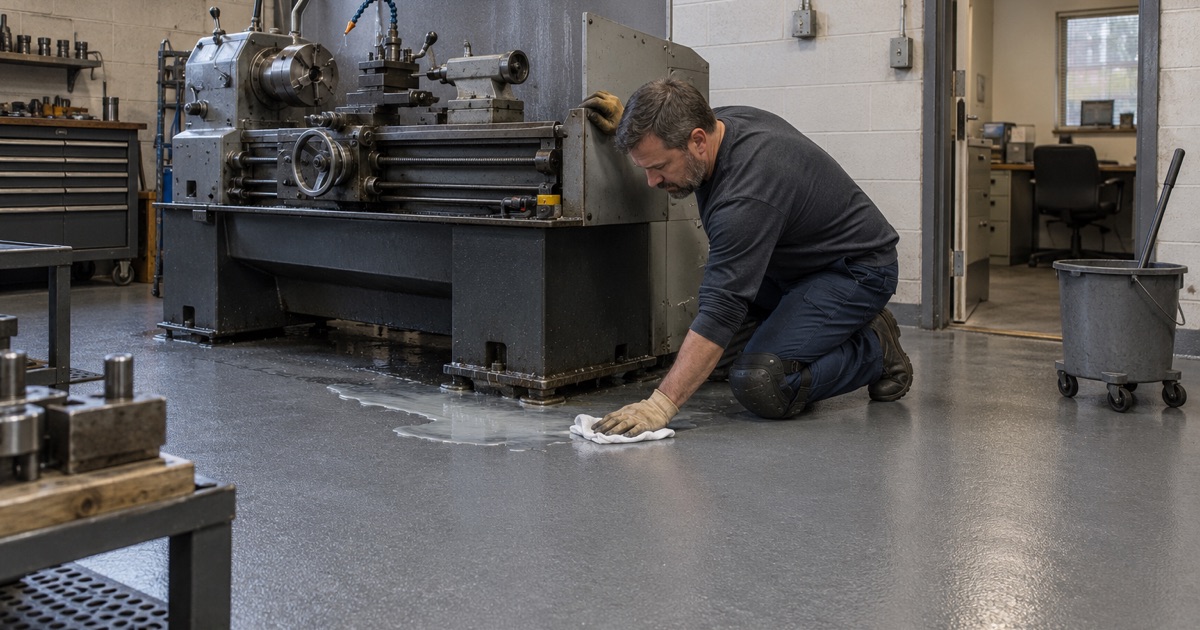
Around a running machine the problem is rarely a puddle. Coolant drips from doors when they open, travels out on chips and conveyors, and rides along on parts set down wet, and the result is a thin layer spread across the floor in front of the machine. That layer is what operators walk on all shift.
A smooth, high-gloss coating makes that film worse, not better. The same finish that looks clean on the first day gives a shoe sole nothing to bite through once a wet film sits on it. The manual’s answer for the person is safety shoes with slip-resistant soles where floors are oily, and our answer for the floor is texture.
What rides in the film
The film is not just water and concentrate. The OSHA manual notes that tramp oil can be a significant carrier of metallic fines, and those fines settle wherever the fluid spreads. It also says that fluid turning gray or black often means bacteria are present, which tells a shop its coolant needs attention well before its floor does.
Fines in a floor film act like grit on a smooth coating, scratching it under foot traffic and carts. They also hold the film in place, so a quick pass with a dry mop smears the layer rather than lifting it. That is one reason we treat cleaning as part of the floor design rather than an afterthought.
Splashguards, Same-Day Cleanup and the Coolant Sump
A new floor around a leaking machine starts wearing the day it cures. So before we price a coating in a machining area, we ask what is putting fluid on the floor in the first place. Usually the answer is at the machine, not in the slab.
Guards come first
The OSHA manual says well-designed enclosures and splashguards keep metalworking fluids from spilling on the ground. It also says existing enclosures and splashguards should be maintained, and missing ones restored. We ask that guards, door seals and conveyor drips be dealt with before the floor is redone, because a coating cannot keep up with a machine that is still spraying.
Spills cleaned the same day
The manual’s day-to-day rule is that spills should be cleaned up immediately, by properly trained and equipped people. A textured topcoat helps traction, but it does not make a standing film safe to leave until the end of the week. We hand over a cleaning note with every shop floor, naming what to use and what to avoid on the topcoat we installed.
Floor wash water stays out of the sump
One line in the manual matters more on a coated shop floor than most owners expect. Wastes, including floor wash water, should not be dumped or swept into metalworking fluid sumps or coolant return trenches. A mop bucket emptied into the nearest coolant sump puts floor dirt, detergent and fines straight back into the fluid the machine runs on.
So the cleaning note names where the wash water goes, and the answer is the shop’s waste handling, never the machine or a coolant trench. That also keeps floor-cleaner chemistry from changing the coolant mix. Our own crew follows the same logic during the job, capturing grinding dust at the machine with a vacuum rather than rinsing it toward a drain, a sump or a trench.
Choosing a Topcoat Against the Coolant Actually in Use
Water-miscible coolants are not one product. Concentrates differ in chemistry and in the dilution a shop runs them at, so a topcoat’s resistance has to be read against the actual fluid rather than assumed from the coating’s label. We ask for the coolant maker’s data sheet before we choose the system.
Reading the coolant against the coating data
We compare the concentrate and its working mix with the coating manufacturer’s chemical-resistance data, and where that data is silent we say so in the proposal. Our usual starting point for a machining area is a 100% solids epoxy base with a polyaspartic or polyurea topcoat, but the topcoat is the layer the coolant touches, so it is the one we settle last. A coating does not make a shop compliant with anything; it gives the cleanup routine a surface that can take it.
How much texture the machine zone gets
Slip resistance comes from what is broadcast and how it is locked in, not from a word in a brochure. In front of the machines we broadcast quartz aggregate into the coat and hold it under the topcoat, which gives a shoe sole something to grip through a coolant film. Aisles and benches that stay dry can carry a finer texture that is easier to clean.
The tradeoff is cleaning. A coarse texture holds fines and film longer than a smooth one, so it needs a scrub rather than a dry mop, and the cleaning note says so. We set the coarseness by zone so the wettest floor gets the most grip and the rest of the shop stays easy to keep.
Prep, moisture and cure in a working shop
A floor around running machines needs a clean, open surface before any primer will bond to it. We grind or shot blast to the ICRI concrete surface profile the primer calls for, and we test moisture with ASTM F2170 in-situ relative humidity probes before the price is final. Where the slab shows something the grinder cannot remove, we say so before anyone pays for a coating that will not hold.
Cure follows slab temperature and the dew point at the surface, not the calendar, and an unheated space in deep winter is told to wait. In a working shop that usually means coating in zones, so some machines keep running while others are down. We write that sequence into the proposal so the shop knows which machines stop and for how long.
- 20+ Years on Concrete
- Moisture Testing in Every Scope
- Ground, Never Acid-Etched