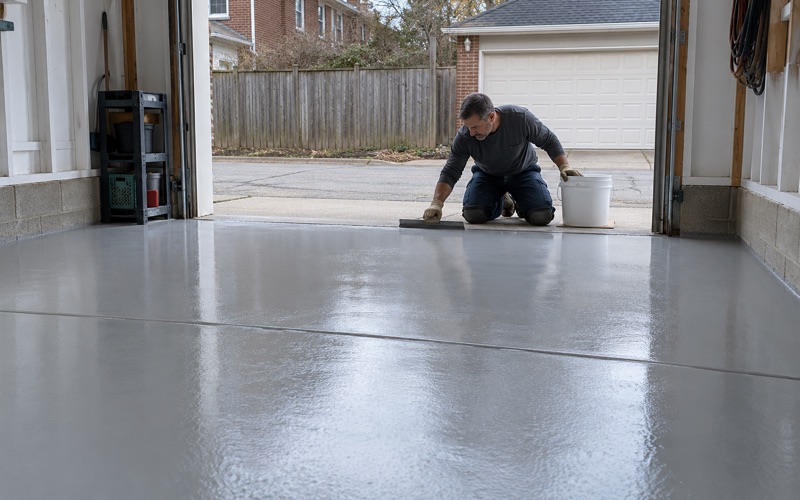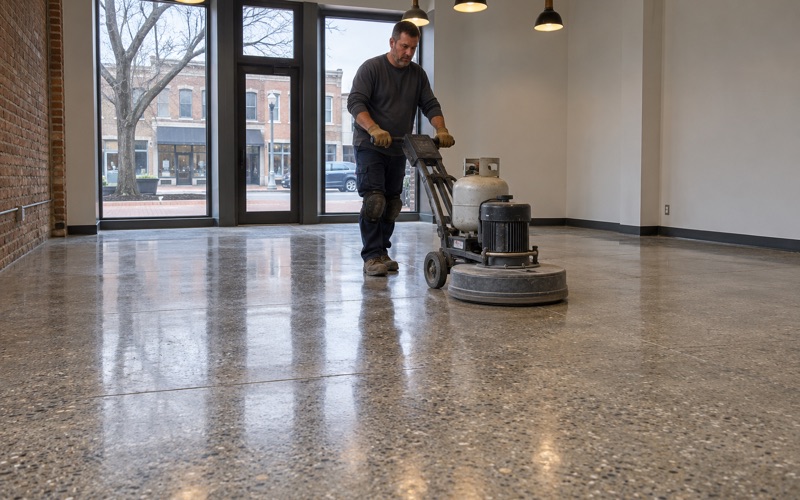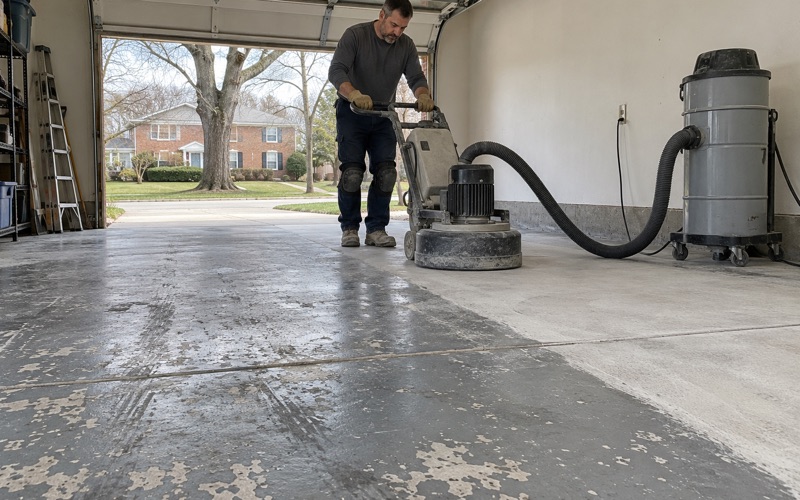
Elmhurst Epoxy Flooring installs epoxy flooring in Hickory Hills on concrete that has been opened with a diamond grinder or a shot blaster, never with acid, and we have been doing this work for more than 20 years. The grind leaves a real profile for the resin to bite into, and the dust is pulled into a vacuum at the machine rather than rinsed toward a floor drain, a sump or a storm inlet. Every system we propose starts from that prepared surface.
Before a price is final, the written scope includes a moisture test, because a slab that pushes vapor will lift a coating no matter how well it was ground. Cracks, spalls and old coatings are mapped on the same visit, and when a slab should be repaired or replaced before anyone coats it, we say that plainly. The proposal then names the product line, the number of coats and the finished thickness, so the floor that goes down can be checked against the paper.
Most of our calls are garages and basements. This page follows a different kind of room, one that shows what a seamless floor is really for: a shared room that changes jobs in a single day, and the cleanup a spill on it demands.
Blood Drives at the Community Center on 89th Place
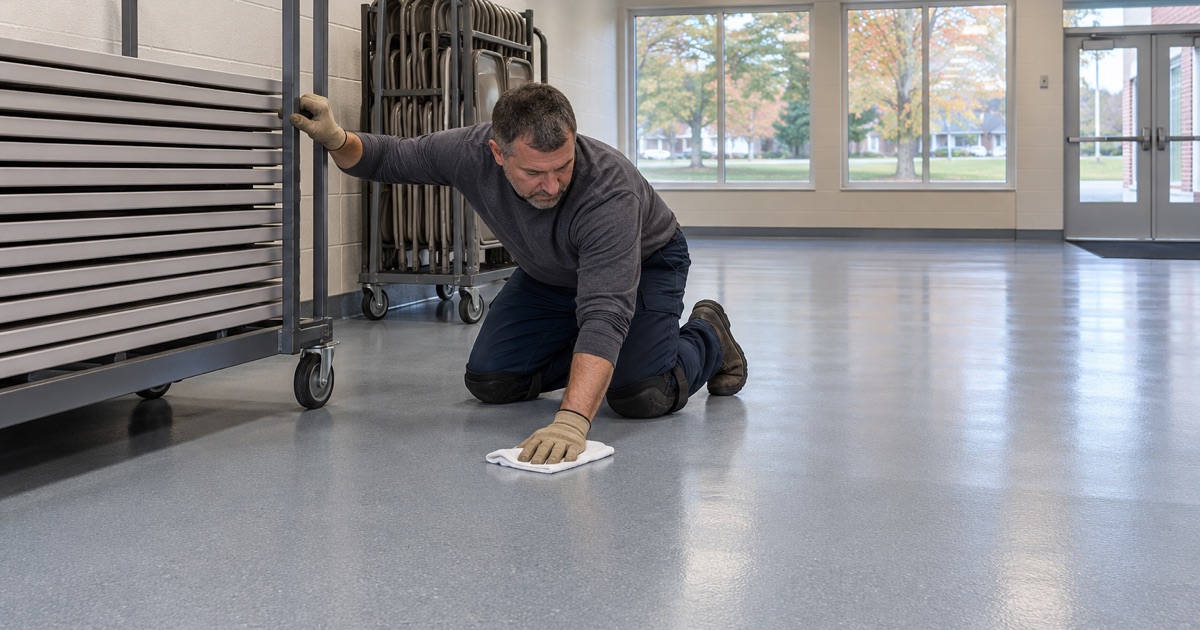
The City of Hickory Hills holds its blood drives at the Hickory Hills Community Center, 7800 West 89th Place. In a March 2020 notice the city called it a scheduled quarterly blood drive, with Vitalant as its blood partner. Council minutes from July 23, 2026 set the next one for the morning of Sunday, August 2.
The city also lists that building as its senior center. It hosts senior luncheons, meetings and events such as the Senior Resource Fair, so the room a drive borrows is a room with plenty of other jobs. For a few hours on a drive day, it becomes a collection floor.
We have not seen the floors in that building, and the city is not our customer. The building is worth writing about because the arrangement is so ordinary: a meeting room is lent to a blood collector, used hard for a morning, and handed back.
What a collector asks of a host room
Collectors publish what they need from a host. One sponsor sheet, from RWJBarnabas Health Blood Services in New Jersey rather than from Vitalant, asks for an open space of about 1,000 square feet with a restroom and running water close by. It also wants several electrical outlets, heating and air conditioning, and elevator access if the room is not on the ground floor.
Setup takes about two hours before the drive and about the same afterward, and that collector says it will inspect the site to make sure it meets FDA standards. The inspection is the collector’s decision, not the floor’s. No coating makes a room acceptable for collection, and we would never sell one as if it did.
Donor beds, a canteen and red bag waste
A drive puts three different loads on one room. Donor beds stand in one zone, a canteen serves donors after they give, and red bag waste collects through the morning until the collector’s team removes all of it at the end of the drive. Each zone touches the floor in its own way.
Bed legs and rolling equipment press into whatever is underneath them. The canteen area sees spilled juice and crumbs, and the collection area is where a drip of blood is most likely to land.
Looking for epoxy-flooring closer to Warrenville? See Epoxy-Flooring in Warrenville.
Tarps on Carpet, or a Floor That Wipes Clean
The same sponsor sheet carries one line about flooring: if the room is carpeted, the collector will lay tarps in the donor bed areas. That is a sensible answer to a porous floor. Carpet fibers and backing hold whatever soaks into them, so the collector puts a temporary barrier on top and carries it away afterward.
Tarps have their own costs. They have to be brought in, spread, taped or weighted, and folded up again inside the teardown window, and a lifted edge catches cart wheels and bed legs. The tarp protects the carpet for a morning and does nothing for the room the rest of the year.
What a seamless resin floor changes
A continuous resin floor has no fibers and no grout lines for a spill to run into. A drip or a dropped tube is wiped where it lands, the spot is disinfected, and the surface underneath is the same surface it was before. A collector may still choose to put protection down, and that choice stays with the collector.
Building the floor for a room like this
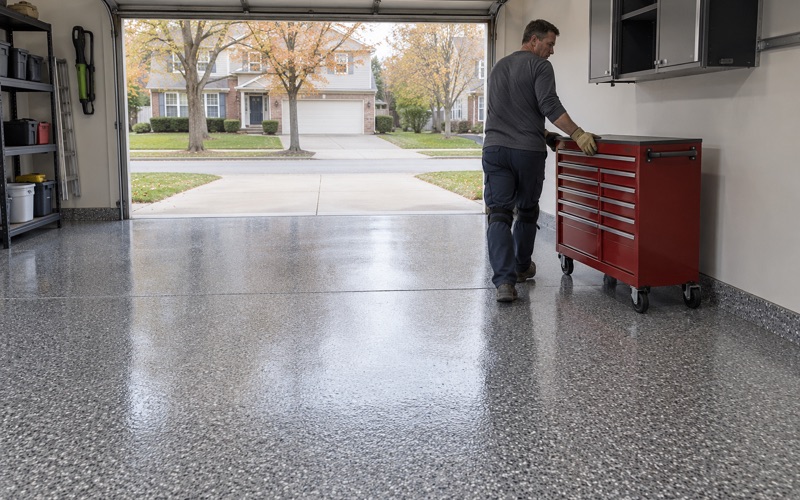
For a multi-use room we would usually look at 100% solids epoxy as the body coat under a polyaspartic or polyurea topcoat, because the topcoat takes the cleaning and the foot traffic. A fine quartz aggregate broadcast adds grip without leaving deep texture that holds residue. The slip texture is set by the broadcast and topcoat we specify, and the proposal names both.
Coves matter as much as the open floor in a room that gets disinfected. Running the coating a few inches up the wall as an integral cove removes the corner where floor meets base, which is where spilled liquid and dirt usually gather. Food-service floors use the same detail under FDA Food Code 6-201.13.
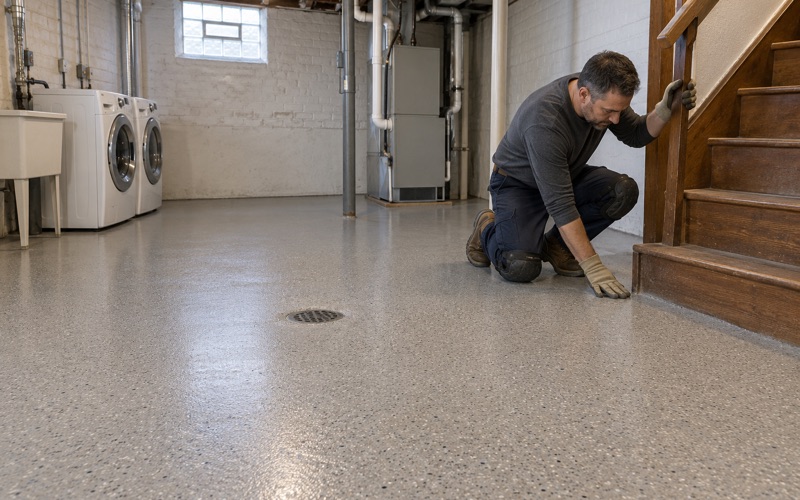
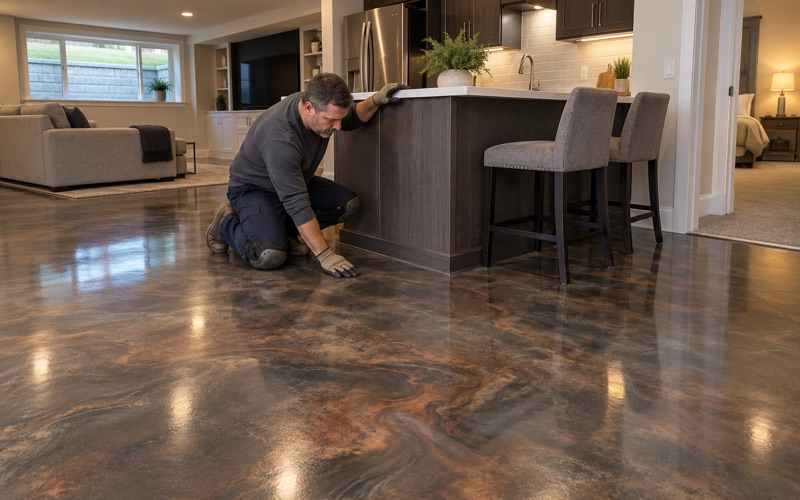
The same build works at home. A basement rec room or an attached garage in Hickory Hills takes the same ground profile and the same seamless finish, and a garage system is chosen to hold up to the brine and rock salt that ride in on tires all winter.
A Spill on the Floor and the Bloodborne-Pathogen Rule
The federal bloodborne pathogens standard, 29 CFR 1910.1030, says equipment and environmental and working surfaces must be cleaned and decontaminated after contact with blood or other potentially infectious materials. Paragraph (d)(4)(ii)(A) is specific about timing. Contaminated surfaces are decontaminated with an appropriate disinfectant immediately or as soon as feasible after any spill, after procedures are complete, and at the end of the shift if they may have been contaminated since the last cleaning.
That duty falls on the employer whose staff are exposed, which on a drive day is the collector, not the owner of the building. A host room does not become compliant because of its floor, and no floor finish carries any certification under that rule. What a floor can do is make the required step quick and complete.
Why porous surfaces make that step hard
Decontaminating a surface means the disinfectant reaches everything the spill reached. On carpet a spill wicks into the pile and the backing, and on worn vinyl tile it can find the seams. A sealed, seamless resin floor keeps the spill on top, where a wipe and a disinfectant can actually get to it.
Joints, cracks and the edges of the room
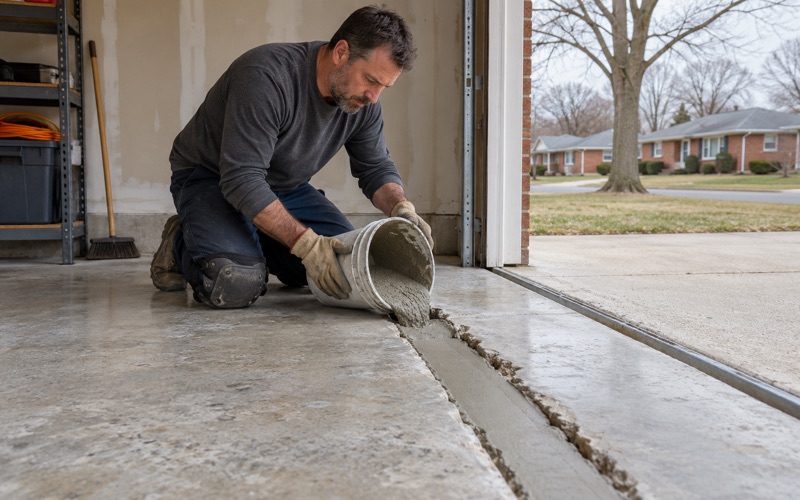
The weak spots in a coated floor are the places where it stops being continuous. Control joints, old cracks and spalls are filled flush before coating so the surface runs unbroken across them, and any slab damage we map goes into the proposal before the price is set. An open joint in the collection zone would be the one place a spill could hide.
Back to Senior Lunches the Same Day
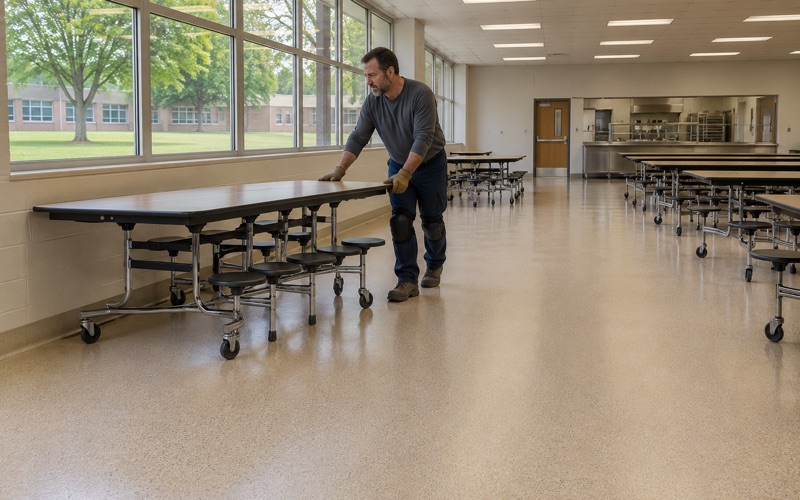
A Sunday morning drive ends around midday, and the room is expected to be ready for whatever comes next. On a resin floor, once the collector’s team has taken out its beds, canteen and waste, the reset is a mop and the room’s usual cleaning routine. There is no tarp to dry and no carpet left damp from spot cleaning.
That same-day turnaround is the real argument for resin in any room that changes use. A meeting, a lunch and a collection morning in a single week each leave a different residue, and a surface that wipes clean handles all three without a separate covering for each.
Scheduling the installation around a working room
Shared rooms rarely close for long. We phase that kind of work around the hours a space is used, with overnight and weekend windows when it cannot shut, and cure schedules follow slab temperature and dew point rather than the calendar. A cold slab, or one sitting close to its dew point, is a reason to wait rather than a reason to push through.
Moisture before anything goes down
In Hickory Hills, moisture is the first question on almost any slab. More than half of the city’s housing units were built from 1960 through 1979, before under-slab vapor retarder practice was routine, and the city names blocks where storm sewers fall short and structures flood. We test with ASTM F2170 relative humidity probes or ASTM F1869 calcium chloride kits, and a slab that fails gets a moisture-mitigation primer or a different floor.
Moisture is also the first exclusion we explain in the warranty, before the job is sold. A coating does not stop seepage or hydrostatic pressure, and we would rather say so at the estimate than after a blister appears.
Paperwork the city asks for
Hickory Hills requires every contractor working in the city to hold a city contractor license, $100 for the calendar year with no half-year option. A certificate of insurance naming the city goes with the application, and a copy goes to the homeowner or business owner before work begins, though no bond is required. The city’s hauler does not take contractor debris, so ground concrete and spent material leave with us.
On residential work above the state threshold, you receive a written contract and the Home Repair: Know Your Consumer Rights pamphlet before any grinding starts. That is Illinois law under the Home Repair and Remodeling Act, and we treat it as the first step of the job rather than the last.
- 20+ Years on Concrete
- Moisture Testing in Every Scope
- Ground, Never Acid-Etched