Elmhurst Epoxy Flooring has installed epoxy flooring in Franklin Park and across the near-west industrial suburbs for more than 20 years, and the floors that teach us the most are the ones beneath wet process lines. Where parts move from tank to tank on a hoist, liquid leaves the bath with every load, and some of it reaches the concrete no matter how well the line is run.
That floor is the last surface in the process, and it should behave like one. Our written proposal names the product line, the number of coats and the finished thickness, so the installed floor can be checked against the quote. It also spells out what the coating warranty leaves out before the job is sold, starting with moisture.
This page works through one kind of floor in detail: the aisle under an automatic plating line, where drips are both a housekeeping problem and a clue about the line itself. Most of what follows applies to any shop that hoists work from tank to tank.
A River Road Barrel Shop and the Solution That Leaves Every Tank
Franklin Park is a village in Cook County’s Leyden Township, named for Lesser Franklin, a real estate broker who bought acres of the area when it was mostly farm fields. Those fields are long gone. Today the floors we are asked about here run from 1950s garage slabs to process aisles where a plating line has dripped for decades.
Belmont Plating Works, Plating Since 1947
Belmont Plating Works has plated parts in Franklin Park since 1947. A Finishing and Coating profile from April 2023 describes a 4-acre, 78,000-square-foot complex that grew from a 10,000-square-foot start, with seven automatic lines and a specialty in high-volume zinc plating in barrels and racks. The company is on the Metropolitan Water Reclamation District’s 2026 list of significant industrial users at 3410 North River Road, under the federal electroplating and metal finishing categories.
We have no working relationship with Belmont and have not seen its lines or floors. We use it here because it is the clearest local example of a process that every barrel-plating shop shares, whatever its size, and because a shop of this kind is part of what makes Franklin Park a production-floor village. In 2024 the village counted 1,237 commercial and industrial water customers against 4,664 residential ones.
Drag-Out Rides Out With Every Barrel
Barrel plating suits fasteners, stampings and other small parts that would be slow to hang on racks one at a time. The parts tumble inside a perforated barrel that is lowered into each bath, rotated, then lifted and carried by hoist to the next tank. When it comes up, solution is trapped in the barrel, in the perforations and in the recesses of every part.
That carried solution is called drag-out. Ohio EPA’s metal finishing pollution prevention fact sheet describes reducing it as returning plating chemicals to their original bath before they become part of the waste stream. Whatever does not go back to its own tank ends up in a rinse, in the next bath, or on the floor between them.
Looking for epoxy-flooring closer to Westchester? See Epoxy-Flooring Services in Westchester.
Drip Time, Angled Barrels and Drainage Boards
The same Ohio EPA fact sheet, dated January 2018, lists the controls that keep drag-out in the tanks. It is Ohio guidance, not an Illinois rule, but the techniques are common on plating lines generally, and each one changes how much solution reaches the floor.
Longer Drip Time
One technique on the sheet is to extend drip time by installing drip racks; another is to reduce the rate at which work is withdrawn from the bath. A barrel that hangs over its own tank a few seconds longer sheds more solution back where it belongs. On an automatic line, dwell time is programmed, so it is a setting someone chose and can change.
From the floor’s point of view, the arithmetic is simple. Every drop that falls back into its own tank is one that never reaches the aisle, never dries into the slab and never has to be mopped up.
Angled Barrels
The sheet also recommends the angled barrels technique to increase draining. The idea is simple: a barrel held at an angle drains toward its low side, so more solution falls back into the tank before the hoist moves on. Air knives, water misters and a fog-spray tank are listed alongside it as ways to strip drag-out before the load travels.
Drainage Boards Between Tanks
Drainage boards are the most direct link to the floor. The sheet’s wording is to install drainage boards between tanks to route drag out into the correct process tank, which means the gap between two tanks is exactly where the line expects drips to fall. A board catches them and sends them back; without one, that gap drains straight to the slab.
Like any part of a line, boards have to be kept in position and at the right pitch to do their job. None of these controls catches every drop, which is why the floor still matters.
The Floor Under the Hoist Path Is the Last Catch
Whatever misses the drip racks, the angled barrel and the drainage boards lands along the hoist path. What happens next depends almost entirely on the surface it lands on.
Bare Concrete Drinks It In
Bare concrete is porous. A drip of plating solution on an uncoated or cracked slab soaks in, the water evaporates, and the dissolved metal salts dry in place, in the pores and along the joints. The next drip lands on the same spot and the cycle repeats, so over years the top of the slab under a line carries a load of residue that a mop never reaches.
A Sealed, Seamless Floor Keeps It Visible
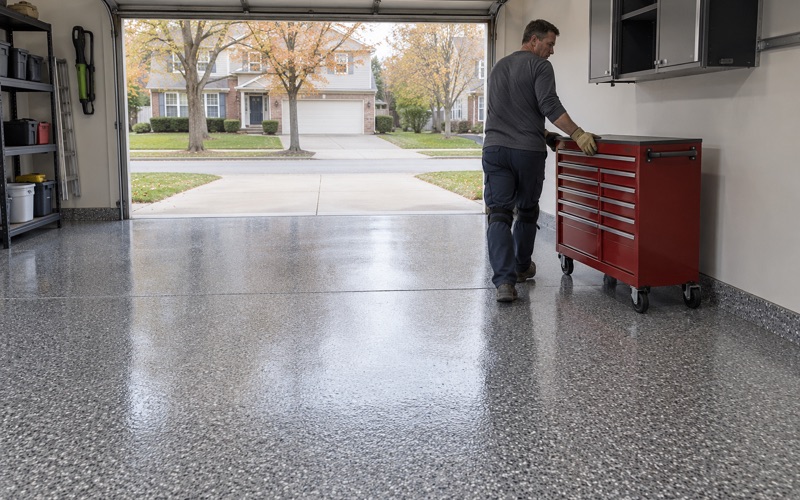
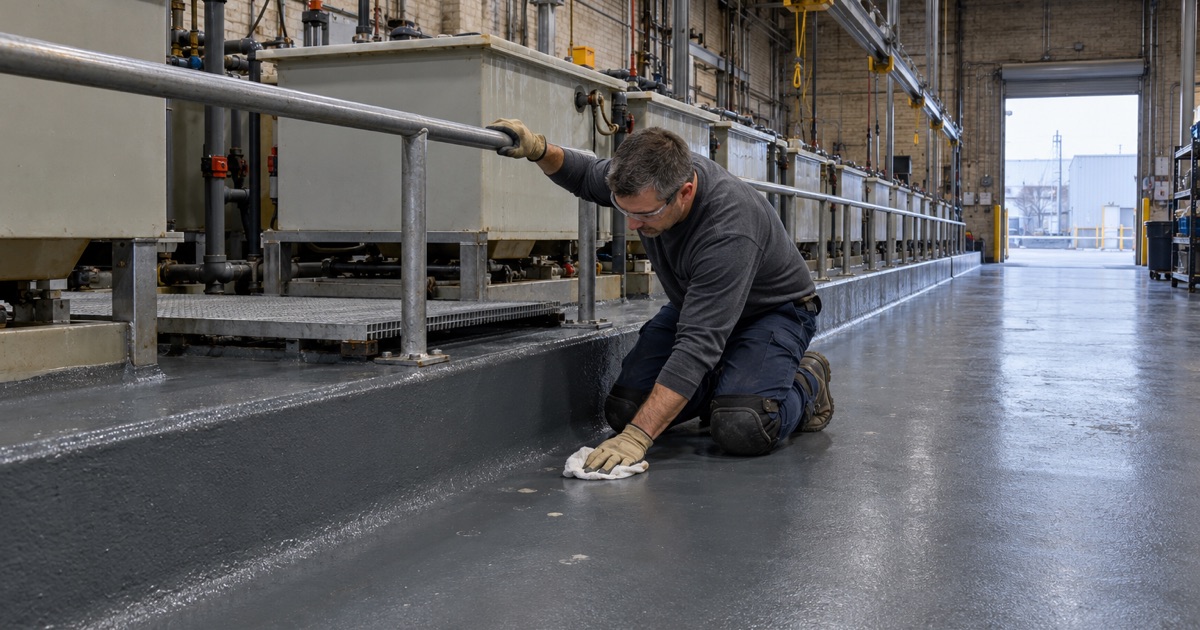
On a sealed, seamless floor the same drip stays on the surface. It can be seen, wiped up and collected instead of disappearing into the slab. That visibility is the real job of a coating here: it turns a hidden loss into a puddle someone can deal with during the shift.
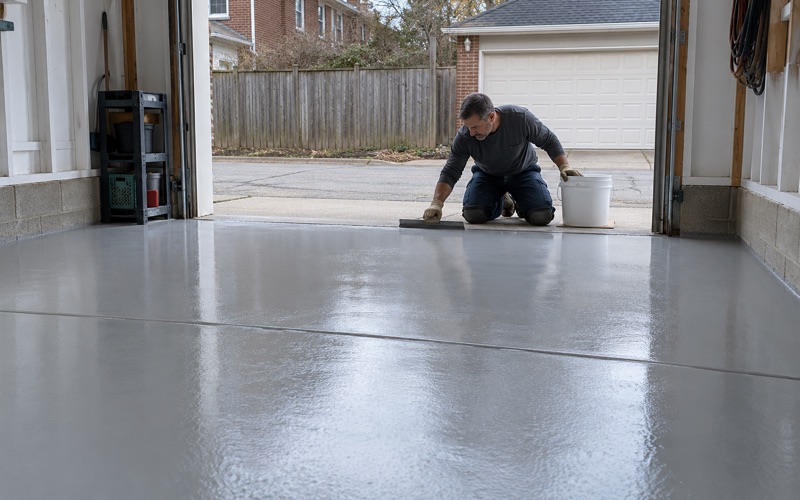
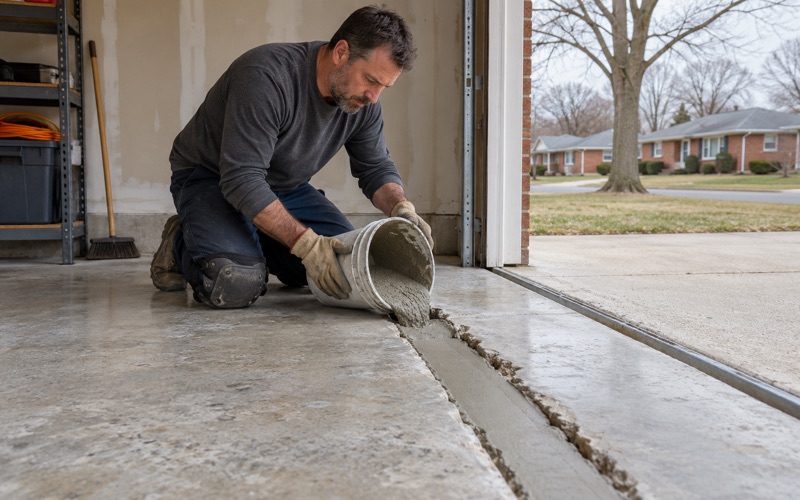
Seamless matters as much as sealed. Open joints, saw cuts and the edges of old patches are where liquid finds bare concrete again, so on a process aisle we fill and seal them as part of the floor system instead of coating around them. Slip resistance comes from the broadcast and topcoat we specify, and on a wet aisle we balance that texture against how easily the surface can be wiped clean.
Preparing a Slab That Has Taken Drips for Years
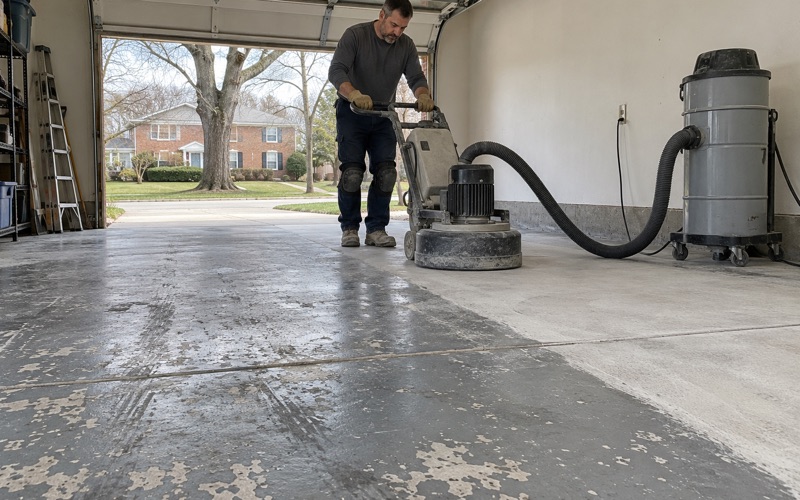
An existing plating aisle is rarely clean concrete. We start by mapping cracks, spalls, old coatings and stained areas, then open the surface with a diamond grinder or shot blaster to the ICRI concrete surface profile the system calls for, with the dust captured at the machine by vacuum rather than washed toward a floor drain or sump. Grinding removes the contaminated top layer where it can; where residue runs deeper, we say so, because that section needs repair or replacement before it is coated.
A moisture test is written into the scope before the price is final, using methods such as ASTM F2170 in-situ relative humidity probes or ASTM F1869 calcium chloride testing. A slab pushing moisture up from below can lift a coating however well its top was prepared.
Choosing a System for the Aisle
Plating aisles see acids, alkaline cleaners and metal-bearing solutions, and we do not treat any floor product as resistant to all of them. We check candidate systems, such as a 100% solids epoxy or a urethane cement, against the chemistry the line actually runs, using the manufacturer’s resistance data rather than a general promise. If a bath falls outside what a system is documented to handle, we tell the owner before anything is ordered.
Coves at Tank Bases, and Drips as a Maintenance Signal
Coving Where Tanks Meet the Floor
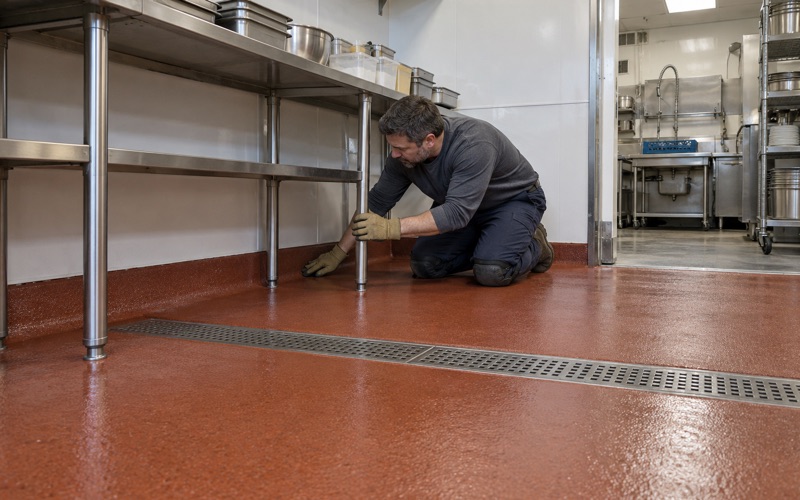
Tank bases are the corners a flat coating leaves open. A drip that runs down a tank wall meets a hard corner, finds the gap between coating and steel or between slab and wall, and gets under the system. A cove, the coating turned up in a smooth radius at the base of walls, curbs and tank stands, closes that corner so liquid stays on a surface that can be cleaned.
Coves take planning on a working line. Tank stands, pump skids and piping supports decide where a cove can run continuously and where it has to be detailed around a leg or anchor, and we settle those details on a site walk before any grinding is scheduled. Cure times are set by slab temperature and dew point, not by the calendar.
Reading Drips as Evidence
Once the floor is sealed and coved, the pattern of drips on it becomes information. Drips spread along the hoist path between tanks suggest a drip time that is too short or a drainage board that has shifted. A wet patch that keeps returning at the foot of one tank, away from the hoist path, points instead to a leaking tank, pump or valve.
Ohio EPA’s sheet covers that case too, under maintaining chemical baths: repair leaking tanks, pumps and valves, and remove dropped parts daily. It lists saving the time and expense of spills and cleanup among the benefits. On bare concrete these signs vanish into the slab; on a sealed floor they show up every shift.
What a Coating Is Not
A floor coating is a finish. It is not secondary containment, it does not treat wastewater, and it does not make a plating line compliant with anything; those obligations sit with the shop’s own containment, treatment and permits. What a well-built floor does is keep drag-out on a surface where it can be found, collected and traced back to its source.
Starting a Floor Job in Franklin Park
Work inside the village falls under the Village of Franklin Park Building Department at 9500 Belmont Avenue, which requires every contractor working there to be licensed, insured and bonded. Permit questions for a process aisle, including whether any slab is being replaced rather than coated, are worth settling with the department before a schedule is set. For a plating shop, the walk-through starts at the line: which tanks drip, where the boards sit, and how long the aisle can be out of service.
- 20+ Years on Concrete
- Moisture Testing in Every Scope
- Ground, Never Acid-Etched