
Elmhurst Epoxy Flooring provides concrete grinding in Elmhurst, IL, serving surrounding cities including Northlake, Bellwood, Bensenville, Franklin Park and Westchester. Grinding is the step that decides whether a coating, an overlay or a polished floor lasts, and in 20+ years of floor work we have seen more failures traced to poor surface preparation than to any product on the market.
We grind with diamond tooling or shot blast every slab we prepare, and we never rely on acid etching. The goal is a clean, sound surface with a measured profile that matches the system going on top, whether that is a thin sealer, a broadcast epoxy floor or a heavy urethane cement build.
That preparation is spelled out in the proposal along with the profile we are aiming for and how we will control dust, so you know what the slab will look like before the first coat is opened.
Diamond Grinding, Shot Blasting and Why We Skip the Acid
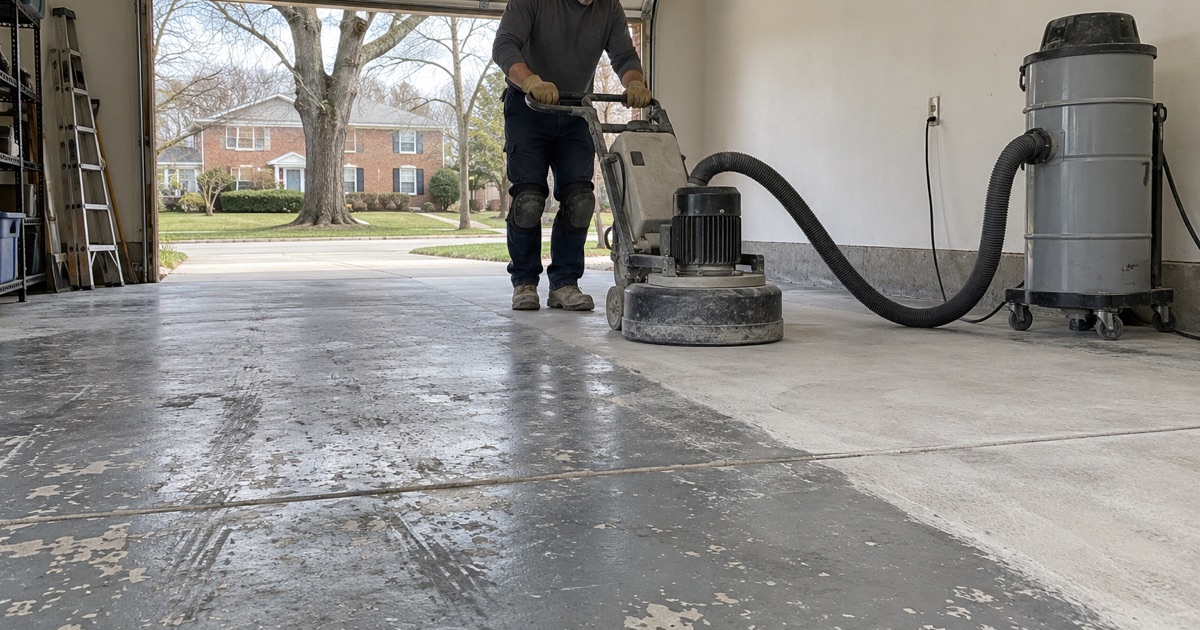
Diamond Grinding
Planetary and disc grinders fitted with metal-bonded diamond segments cut away the top layer of a slab, including laitance, sealers, light coatings and stains. Grinding can also flatten the surface, take down ridges and trowel marks and prepare a slab for polishing. It is our default method for garages, basements and most commercial interiors.
Different segment bonds suit different concrete. A hard, dense slab needs a softer bond that keeps exposing fresh diamond, while a soft or sandy slab wears through segments quickly and needs a harder bond. Reading the slab and choosing tooling to match is a large part of getting an even profile without gouging.
Shot Blasting
A shot blaster throws steel shot at the floor and vacuums it back up, leaving an even, textured profile across large areas. It is fast and efficient for warehouses, plant floors and commercial spaces getting thicker coating systems, though it does less to flatten a slab than grinding. Edges and corners are still finished with hand grinders.
Why We Never Acid Etch
Acid etching dissolves a thin layer of paste and leaves salts that must be neutralized and rinsed away, which pushes water into the slab right before coating. It cannot remove sealers, paint or oil, and it leaves no consistent profile. That is why so many store-bought kit floors peel, and why we do not use it.
Concrete Surface Profiles and Why They Matter
The ICRI CSP Scale
The International Concrete Repair Institute publishes concrete surface profile chips numbered CSP 1 through CSP 10, from nearly flat to very rough. Coating manufacturers specify which CSP range their products need, and we match our grinding or blasting to that range rather than guessing by feel.
Matching Profile to the System
Thin sealers and penetrating coatings need a light profile, while high-build epoxies, broadcast systems and urethane cement need a deeper one so they can lock into the concrete. Too smooth a surface leaves the coating without enough grip, while an overly rough one can telegraph through thin systems. Getting it right is what makes the product’s data sheet true.
We check the profile against the reference chips as we go, especially where the slab changes, such as at old patches, along walls and in areas that were once covered by tile or carpet.
Removing Old Coatings, Adhesives and Contaminants
Paint, Sealers and Failed Epoxy
Peeling paint, worn sealers and failed coatings are ground off down to sound concrete. Anything left behind becomes the weak point under the new floor. Removal is often the most time-consuming part of a job, which is why we measure and photograph existing coatings during the walk-through and price them in.
Tile Glue and Black Mastic
Carpet pad glue, vinyl tile adhesive and black mastic can be ground off with coarse diamonds. In buildings of uncertain age, some black mastics and old floor tiles contain asbestos, so we ask for testing before removal and follow the results, rather than grinding first and finding out later.
Oil and Chemical Contamination
Oil, grease, coolant and hydraulic fluid soak into concrete and prevent bonding. Light staining grinds out, while heavy saturation is degreased and sometimes cut out and patched. In garages and shops, we check drip zones again before priming, because that is where a new coating most often lets go.
Some contamination is invisible. Silicone from tire shine products, curing compounds and old wax can all leave a floor looking clean while still repelling a primer. A simple water-drop test and a small adhesion check tell us whether a surface is truly ready, and we regrind any area that fails rather than hoping the primer will cope.
Dust and Slurry Control
Dust Captured at the Machine
Every grinder and shot blaster we run is connected to an industrial vacuum at the cutting head, and edge work is done with shrouded hand tools on vacuums too. That keeps dust out of the house, out of neighboring suites and out of HVAC returns. In occupied buildings we also isolate the work area and schedule loud work around operating hours.
Nothing Rinsed Toward a Drain
Grinding dust and slurry are collected, never washed toward a floor drain, a sump pit or a storm inlet. Rinsing concrete fines into drains can clog plumbing and sends sediment into waterways. Collected material is bagged and removed with the rest of the job’s waste.
In a basement, that matters twice over. A floor drain or sump pit carries whatever reaches it into the sewer or the yard, and a slug of concrete fines can foul a pump or a check valve. We cover drains and pits during grinding and vacuum the floor clean before any coating goes down.
Grinding for Flatness and Safety
Lips, Joints and Trip Hazards
Where a slab has settled slightly at a joint or a crack, grinding can take down the lip and reduce trip hazards indoors. We measure the offset and let you know whether grinding will solve it or whether the slab is still moving and needs repair or replacement first.
Preparing for Polished Concrete
Grinding is also the first stage of polished concrete. The depth of the initial grind decides whether the finished floor shows cream, fine salt-and-pepper aggregate or larger stone. We start with a test area when the slab’s aggregate exposure is uncertain, so you can choose with your own concrete in front of you.
- 20+ Years on Concrete
- Moisture Testing in Every Scope
- Ground, Never Acid-Etched