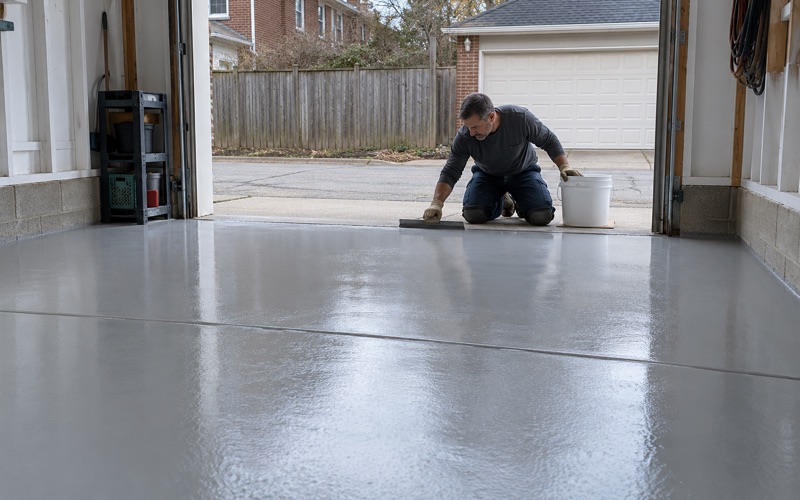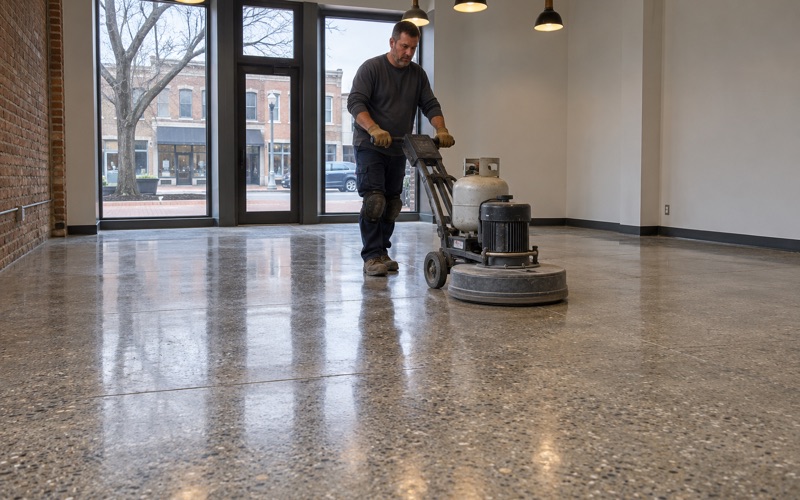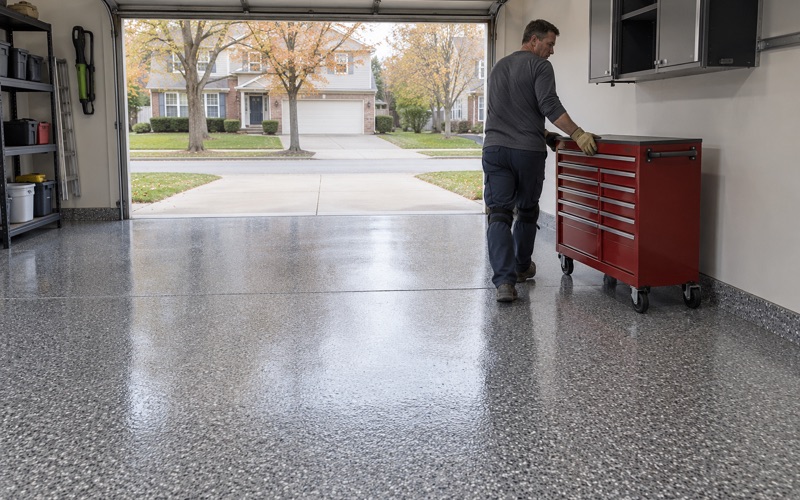
Elmhurst Epoxy Flooring brings more than 20 years of work to epoxy flooring in Burr Ridge, and the first question we ask about any floor is what will happen in the room once it is finished. A garage slab has to shrug off brine and hot tires. A floor in a building where people sleep has another job, and part of that job is how it sounds underfoot.
A coating is chosen for cleanability, chemical resistance and grip, and those strengths are real. What it does not do is soften a floor, so the scope we write starts from how the space is used rather than from a product catalog. Every slab we coat is opened with a diamond grinder or a shot blaster, moisture tested in writing before the price is final, and quoted with the product line, the coat count and the finished thickness named.
That matters most where a floor serves residents, patients or staff around the clock. It also matters at home, in a finished basement under a bedroom or a family room.
A Small Nursing Home on High Grove Boulevard
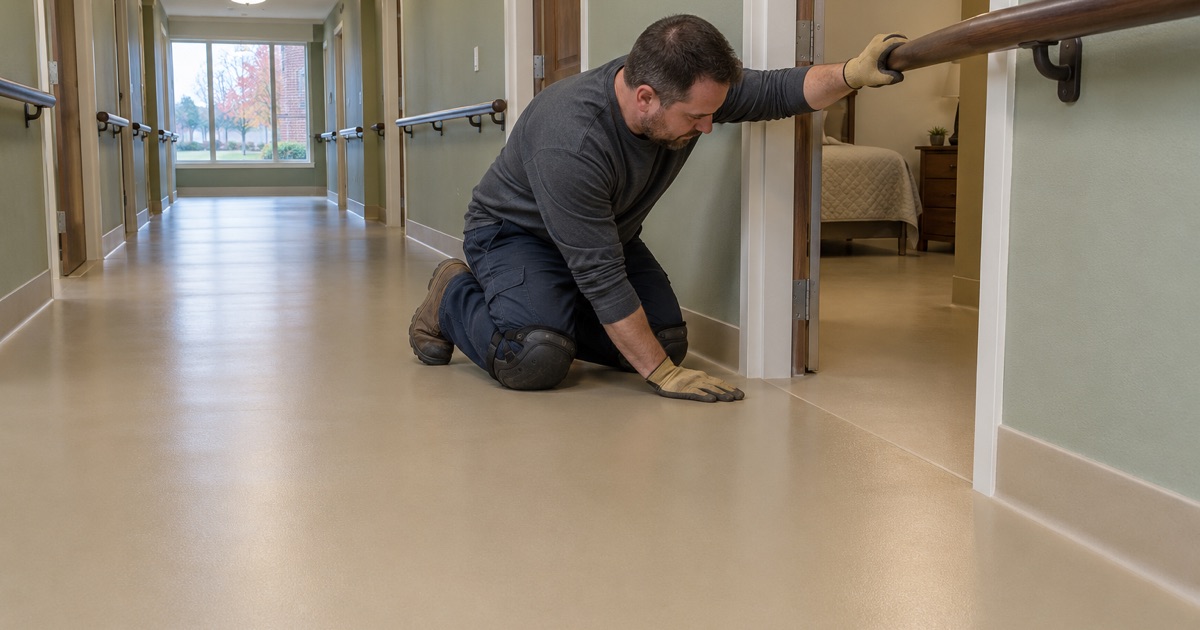
Eden Vista Burr Ridge sits at 6801 High Grove Boulevard, inside the village on its DuPage County side, in Downers Grove Township. The federal Medicare file processed on September 1, 2026 lists it with 29 certified beds and an average of 21.2 residents a day. It is the only Burr Ridge nursing home in that file.
The campus is also listed as offering assisted living, memory care and rehab, with skilled nursing plans built around a rehabilitation gym. We have not seen its floors, its carts or anything about noise there, and it is not a customer. We use it because it shows what a nursing home floor is asked to do in this village.
The Survey Question About Sound
Federal surveyors work through Form CMS-20061, the Environmental Observations worksheet for long-term care. One line on it reads, “Are comfortable sound levels maintained in all areas?” A no answer is cited under tag F584, and surveyors interview staff when residents or their own observation point to uncomfortable sound levels.
The same worksheet covers complaints about walls, floors and ceilings, and asks whether all areas and equipment are in good repair. A garage never faces that question about sound. A resident corridor faces it every shift.
For a floor, that turns the usual questions around. Instead of asking only whether a surface will stand up to traffic and cleaning, an administrator choosing a new corridor floor also has to ask what it will sound like with a cart on it.
Where the Noise Comes From
In a small nursing home the steady sounds are wheeled ones: med carts on their rounds, linen carts, lifts and housekeeping equipment, plus footfall from staff who walk the same corridor all night. Those sounds are made where the wheel or the heel meets the floor. What the floor is built from decides how loud that contact is.
A cart nobody notices at noon carries much farther at night, when the corridor is otherwise quiet and residents are trying to sleep. That is the hour a floor’s sound matters most, and the hour residents notice it.
Looking for epoxy-flooring closer to Winfield? See Epoxy-Flooring Services in Winfield.
Why a Coating Is a Hard Floor
A 100% solids epoxy or a polyaspartic topcoat is a thin film bonded to the concrete slab. It is tough, seamless and easy to disinfect, but it adds no cushion at all. Acoustically the floor still behaves like concrete, so a med cart rolling across a coated corridor is about as loud as it was on the bare slab or on old vinyl composition tile.
There is a good reason care buildings want resin anyway. A resin floor shrugs off repeated disinfection, and it can run as a cove up the wall so a mop reaches the corner. Those are cleanability gains, and they are why the decision is about placement rather than whether to use resin at all.
That is why we never describe a resin coating as quiet, and why we will not quote a decibel figure for one. We have not read a study that measures a resin coating’s sound directly. The honest description is a hard, cleanable floor with no cushion in it.
What the Research Does Say
The closest evidence we have comes from flooring with a soft layer in it. A University of Hartford corridor study, reported through a release by ECORE, the maker of the product tested, found a vinyl wear layer bonded to rubber backing about as quiet as commercial carpet under a rolling medical cart and footfall. The rubber backing cut rolling-cart sound by about 5 dBA.
That is a maker-linked result on one product, not a rating for any coating. A separate Healthcare Design post-occupancy study of two patient care units found staff still rating carts, beds and stretchers worse on a hard-surface floor than on carpet. Taken together, the lesson is about the cushion, not the resin.
None of this makes a coated floor wrong for a care building. It makes it wrong for the rooms where residents rest and the corridors outside them, unless the system is built to deal with sound.
Acoustic Resin Systems and Where Plain Coatings Fit
When a resident corridor or room really needs a seamless resin finish, the answer is an acoustic resin system rather than a plain coating. Flooring makers sell these as separate systems, with the resin laid over a resilient underlay instead of bonded straight to the slab. The other honest answer is a different floor altogether, such as a cushioned sheet product, and we will say so when that is the better fit.
Underlay Systems for Corridors and Rooms
An underlay system changes the prep as well as the finish. The slab still has to be sound, flat and dry, so we map cracks, spalls and old coatings first and tell the owner when repair or replacement has to come before anything is laid. Moisture comes next, measured with ASTM F2170 in-situ relative humidity probes or ASTM F1869 calcium chloride testing, because vapor trapped under a layered system is a failure waiting under the finish.
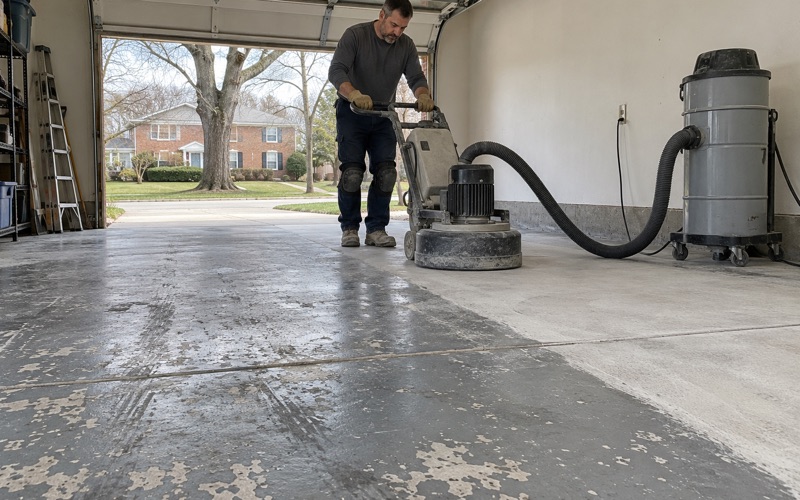
Whatever goes on top, the slab is ground to the ICRI concrete surface profile the system calls for. If readings come back high, a moisture-mitigation primer goes into the written scope, or we tell the owner the slab is not ready.
Occupied buildings also set the schedule. We phase health care work around operating hours, with overnight and weekend windows when a wing cannot close, and cure times follow slab temperature and dew point rather than the calendar.
Service Rooms Where Cleanability Wins
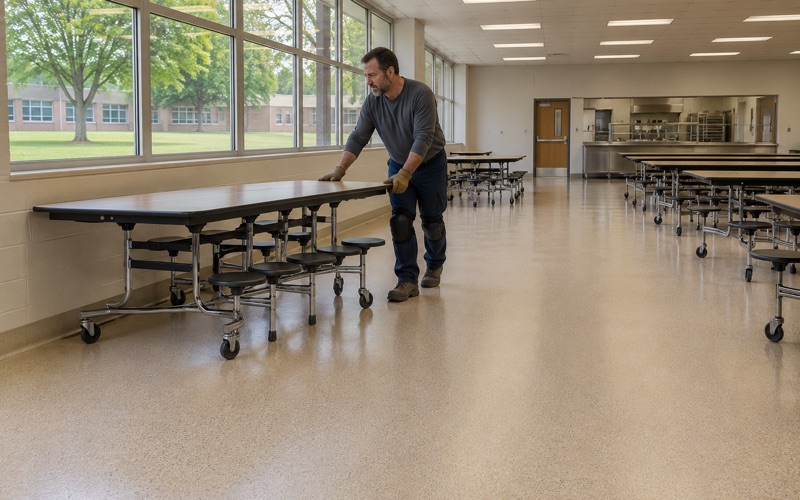
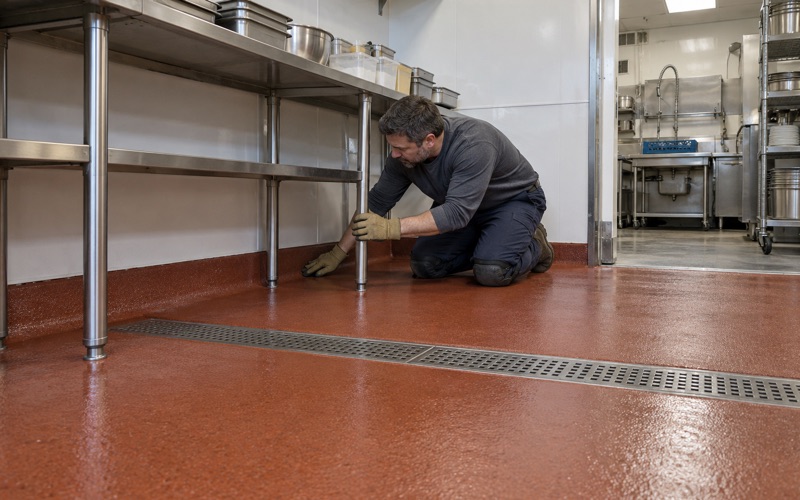
Plain coatings earn their place in the service rooms, where nobody sleeps and the floor is judged by how well it cleans. Soiled utility rooms, housekeeping closets, kitchen back rooms and the wet corner of a rehab gym all take spills, chemicals and constant mopping. A seamless resin floor leaves no grout lines to hold dirt, and the hard surface that was a drawback in a corridor is exactly what these rooms want.
In those rooms we specify slip resistance by the broadcast and topcoat used, typically a quartz aggregate broadcast under a urethane or polyaspartic topcoat, rather than promising it as a slogan. Where hot water and harsh cleaners are daily, urethane cement is often the better base than a thin film.
On a care building project, we sort the floor plan into two kinds of rooms before pricing anything: rooms where sound control decides the floor, and rooms where cleanability does. The proposal then names a different system for each zone, so an administrator can see exactly where resin is going and why.
Noise at Home and Doing the Work in Burr Ridge
A Coated Basement Under a Bedroom
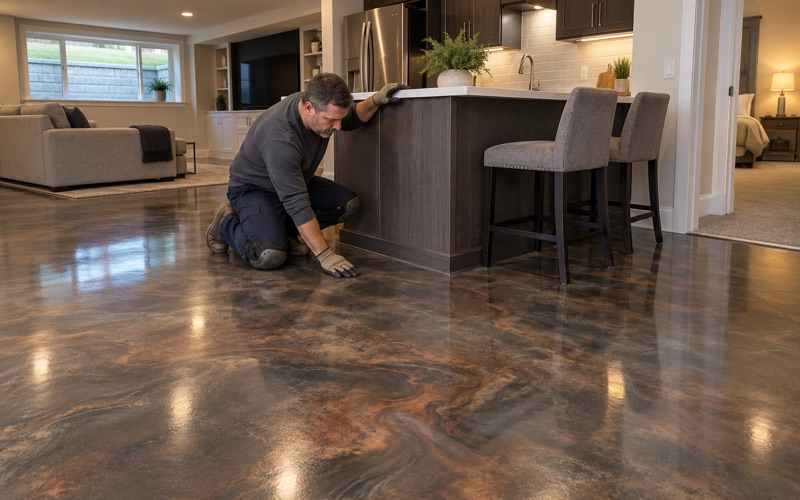
The same physics shows up at home. A coated basement floor is as hard as the slab beneath it, so footsteps, a treadmill or dropped weights sound much as they did on bare concrete, and that noise travels to a bedroom overhead. A coating is still a good basement floor; where a bedroom sits above, rugs or a cushioned mat in the gym or play zone do more for sound than any topcoat.
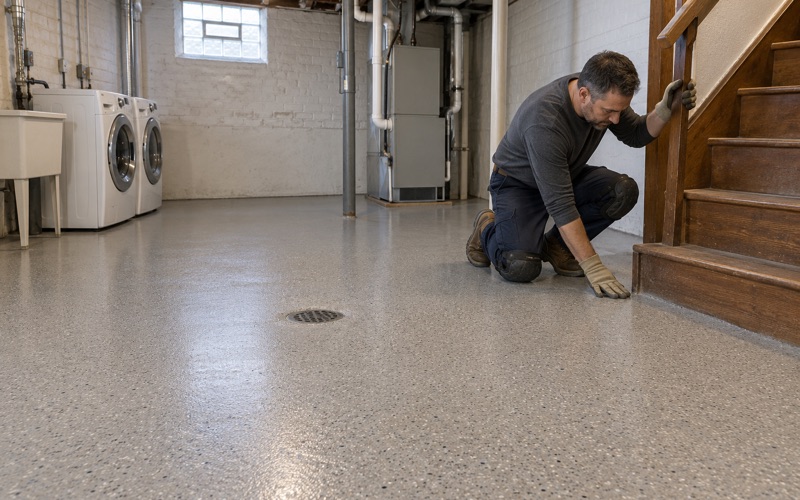
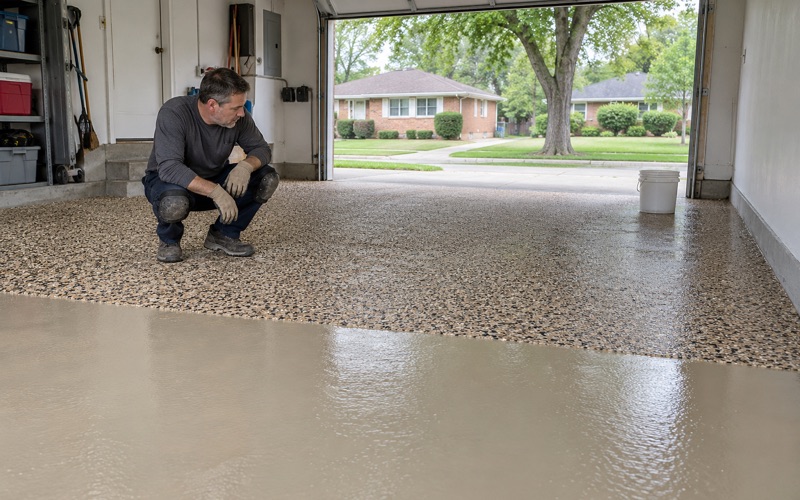
For a basement under living space, a common choice is an epoxy base with a vinyl flake broadcast and a polyaspartic topcoat, which hides dust and wipes clean. It makes a durable, bright floor; it does not make a quiet one, and we say that before anyone signs.
Before a basement is coated at all, we read it for past water, because a coating does not stop seepage, a sewer backup or a sump pump that cannot keep up. Moisture is also the first warranty exclusion we name, and we explain it before the job is sold. Most of the village’s housing dates from 1980 to 2009, and whether a slab of that era sits on a vapor retarder is something we test rather than assume.
Permits, Contractor Rules and Two Counties
Burr Ridge’s permit page lists finish work such as painting, hardwood refinishing, tile replacement and carpeting as needing no permit, while work that touches foundations, patios, driveways or garages does. On any permitted job, the Village of Burr Ridge Community Development department requires every contractor and subcontractor to hold a village contractor license, backed by a $10,000 surety bond naming the village and at least $1,000,000 in liability insurance listing it as additional insured.
We confirm permit questions with the village before a job is scheduled. The village straddles Cook and DuPage counties, so the fire district, sewer authority and county health department all depend on the address, which matters for a care facility’s kitchen and service rooms.
Dust from our grinders is captured at the machine with a vacuum, never rinsed toward a floor drain or sump, which keeps an occupied building or a finished basement livable while we work. When a home job crosses the state threshold, a written contract and the Illinois consumer-rights pamphlet come before any grinding starts. Products are picked inside the Illinois VOC limits for floor and industrial coatings, which matters in a building where residents stay put while work goes on nearby.
- 20+ Years on Concrete
- Moisture Testing in Every Scope
- Ground, Never Acid-Etched