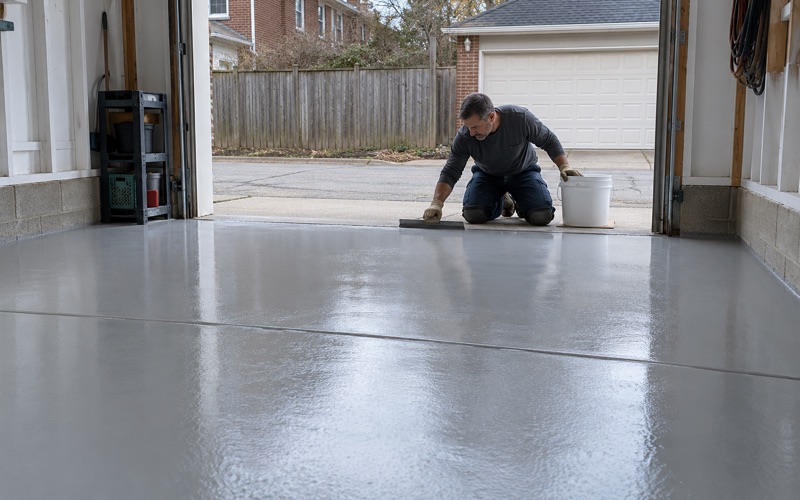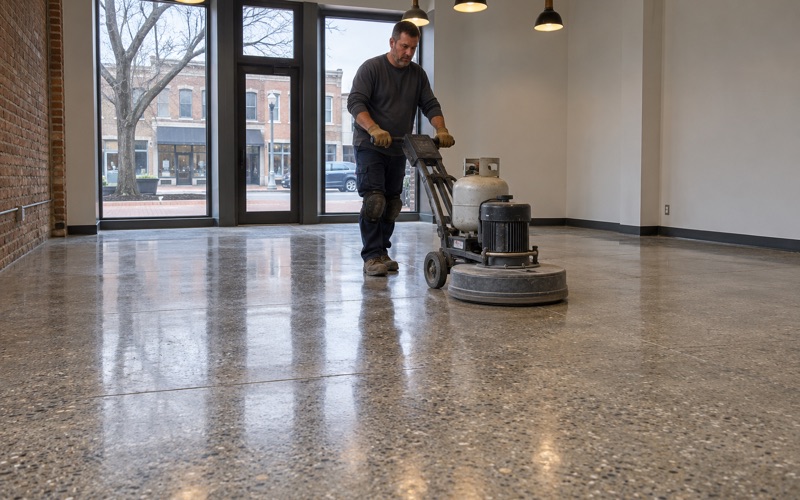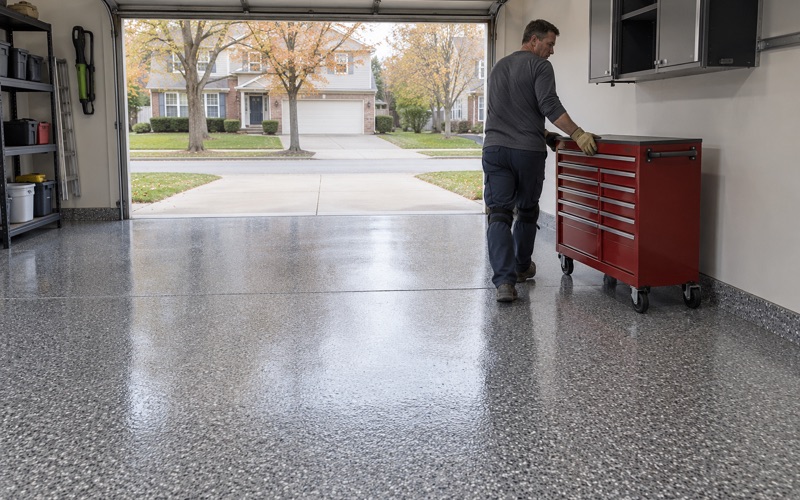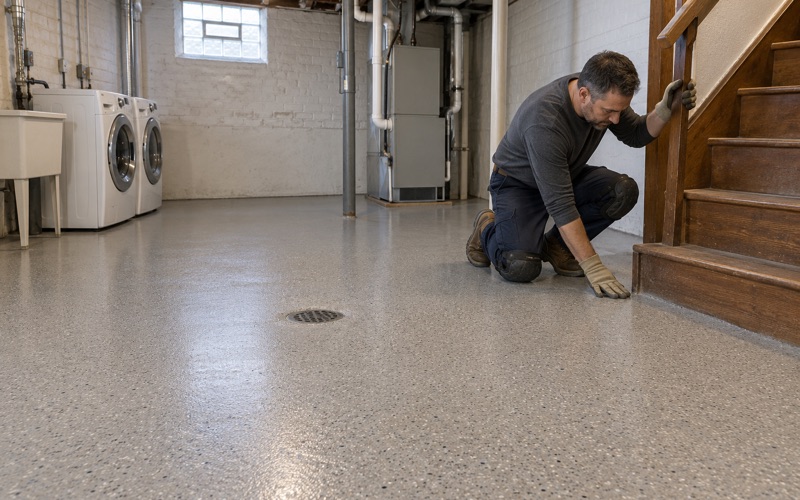
Elmhurst Epoxy Flooring brings more than 20 years of epoxy flooring work to Brookfield homes and businesses, from basement utility rooms to attached garages and shop floors. Every slab we coat is opened first with a diamond grinder or a shot blaster, never an acid etch, so the resin bonds to a real profile instead of a skin of dust. That first step matters most in an older basement, where the concrete has usually been patched, painted or cut before we ever arrive.
Before a price is final, a moisture test goes into the written scope and we walk the floor for past water, cracks, spalls and old coatings. If a slab should be repaired or replaced before it is coated, we tell you so rather than selling a finish that will not last. The proposal then names the product line, the number of coats and the finished thickness, which gives you something concrete to check the finished floor against.
On a Brookfield basement there is one more question we ask early. Has the water service at your meter already been replaced, and if not, is it on the schedule? The answer can change when we coat and which corner of the room waits.
Brookfield’s Lead Service Lines, From the Main to the Meter
How the village program works
Brookfield is a village in Cook County, 13 miles west of downtown Chicago, and it is working through its lead water services at a steady clip. The village’s own page says lead service lines are owned and replaced at the expense of the property owner, but the Village Board agreed to pay for both the public and private portions of replacements done under its Water Main Replacement Program. An owner replacing outside the program who meets the requirements and pays the private portion can have the village replace the entire service line from water main to meter at the same time.
The page cites the Illinois Lead Service Line Replacement and Notification Act and the federal Lead and Copper Rule. The Riverside-Brookfield Landmark reported in July 2024 that about 690 lead services were expected to be replaced that year, nearly 25 percent of the lines identified. At that pace, the paper noted, all of the lead lines could be replaced within five years.
Wall entry or floor entry
Where the new pipe goes depends on how the old one came into the house. A lead replacement FAQ from Blue Earth Light & Water, a Minnesota utility, describes services that either enter through the foundation wall or come up out of the floor, usually into an unfinished basement room or crawl space. A wall entry generally leaves the floor alone. When the service rises out of the slab, that program cuts an opening of roughly 3 by 3 feet to run the new pipe and restores it with concrete.
We have not read how Brookfield’s own contractor handles a floor-entry service or how large its openings run, so we will not quote you a size. What we can say is simple: if your water line comes up through the slab beside the meter, plan the coating as though that patch of floor may be opened.
Upsizing adds a second disturbance
In October 2025, Brookfield trustees approved a policy that lets residents upsize a scheduled replacement from a 1-inch to a 1.5-inch service, paying the cost difference. The village manager said upsizing means residents would have to change the water meter as well. For a coated basement, that means the meter corner may be worked twice, once for the line and once for the new meter.
Looking for epoxy-flooring closer to La Grange? See La Grange Epoxy-Flooring.
The Village Restores Concrete, Not Your Flooring
What interior restoration covers here
The same 2024 Landmark report quoted the assistant village manager on the inside of the house. If flooring or drywall has to be breached, the village would not pay for new drywall or flooring, because it does not reimburse interior restoration work. It also does not reimburse the installation of new water meters.
The Minnesota program draws the same line in its own terms. Where carpet or other flooring covers the spot, the opening is still restored with concrete, but the flooring over it is the owner’s to replace. Whatever finish sits on your slab at the meter, the cost of putting it back is yours, so the cheapest plan is the one that avoids coating a spot that is about to be cut.
A coating is a floor, not a plumbing fix
We want to be plain about our role. We are a floor-coating contractor: we hold no plumbing license, we do not replace service lines, and we have no arrangement with the village or its contractor. A floor coating does nothing about lead or water quality, and we will never present one as if it did.
Our part is narrower and practical. We learn where the utility work will land on your floor, and we plan the coating so it does not have to be torn out or patched twice. That is a scheduling problem more than a product problem, and it is cheaper to solve on paper than with a grinder.
Coat Before or After the Crew? Sequencing the Meter Corner
When the replacement is still scheduled
If the line has not been replaced yet, the simplest answer is to wait and coat after the crew is done. If the rest of the basement cannot wait, we can coat everything except the meter corner and leave that area for last. We finish the coated side on a clean, straight termination line that we can grind back and tie into later.
That way the cut, the patch and any new meter land on bare concrete rather than through a finished floor. If you are thinking about upsizing the service, tell us before we set that line. A corner that may be visited twice is better left uncoated until both visits are over.
When the floor is already coated
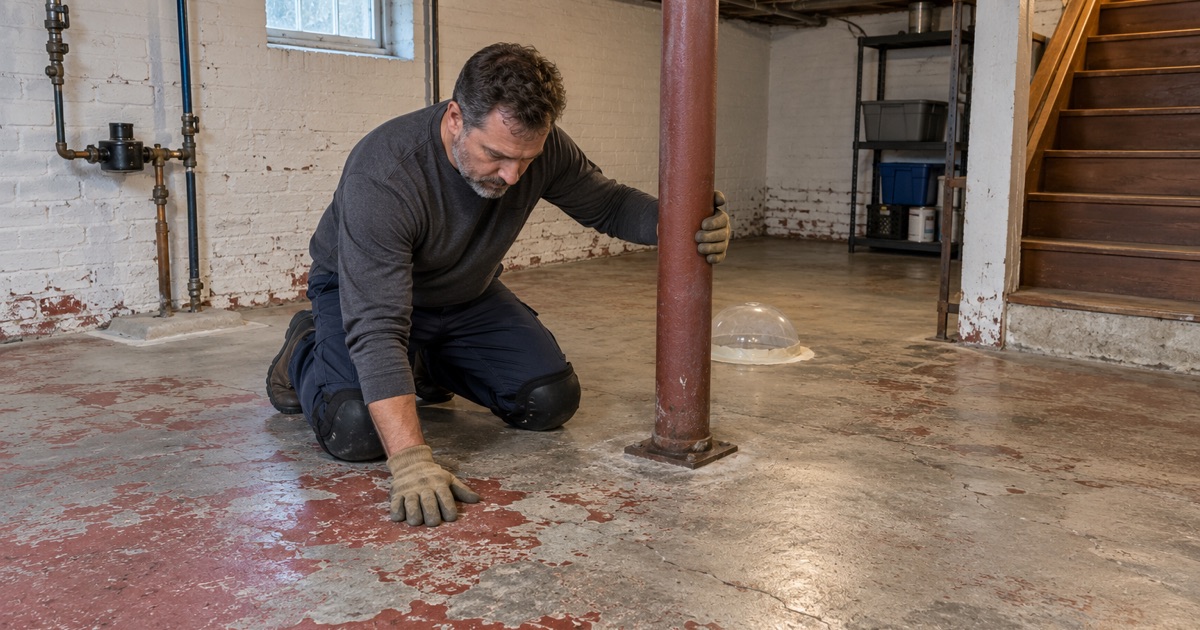
If your basement is coated and the replacement comes later, expect a saw-cut opening patched with plain concrete. That patch is not ready for resin the day the crew leaves. We treat it as new concrete, which means it has to cure, be checked for moisture and be profiled before the coating goes back over it.
It also helps to clear the meter corner before the crew arrives and to keep heavy shelving off the coated floor near the opening. Saw cutting and digging are hard on any finish nearby, and the edges of the cut are where chips start.
What to tell us when you call
A few details let us plan the corner before we ever see it. We ask where the meter sits, whether the water line comes through the wall or up through the floor, whether you have received notice of a scheduled replacement, and whether you plan to upsize. If you do not know some of these, we look during the site visit.
We also read the basement for past water before anything else, because a coating does not stop seepage or make up for a sump that cannot keep up. Those findings, and the moisture test, go into the written scope next to the meter-corner plan.
Tying a Coating Back Into a Fresh Concrete Patch
Test the patch, not just the slab
A new concrete patch and the old slab around it are two different surfaces, and we test them separately. Depending on the floor, that can mean ASTM F2170 in-situ relative humidity probes, ASTM F1869 calcium chloride testing or an ASTM D4263 plastic sheet test as a first read. If the patch is still giving off more moisture than the system allows, we wait or move to a moisture-mitigation primer rather than coating over it and hoping.
The patch cure is only part of the timing. Our cure schedules follow slab temperature and the dew point spread at the surface, not the calendar, and a cold basement corner can hold a coating back longer than the rest of the room. An unheated space in deep winter is told to wait, and a patch placed in cold weather can take longer to test dry.
Profile the patch and the overlap
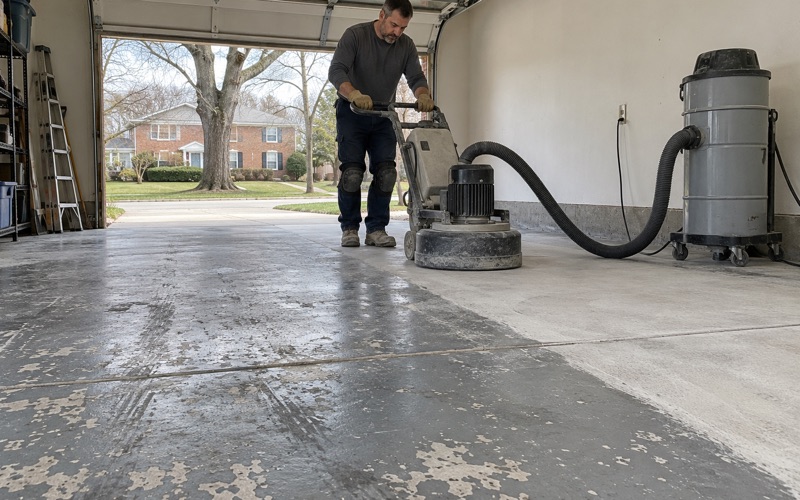
A troweled patch is usually smooth and dense on top, which is the wrong surface for resin. We grind the patch to the ICRI CSP profile the system calls for, then grind back a band of the existing coating around it so the new layers bond to opened material, not to a glossy edge. Grinding dust is captured at the machine with a vacuum rather than swept or rinsed toward a floor drain or a sump.
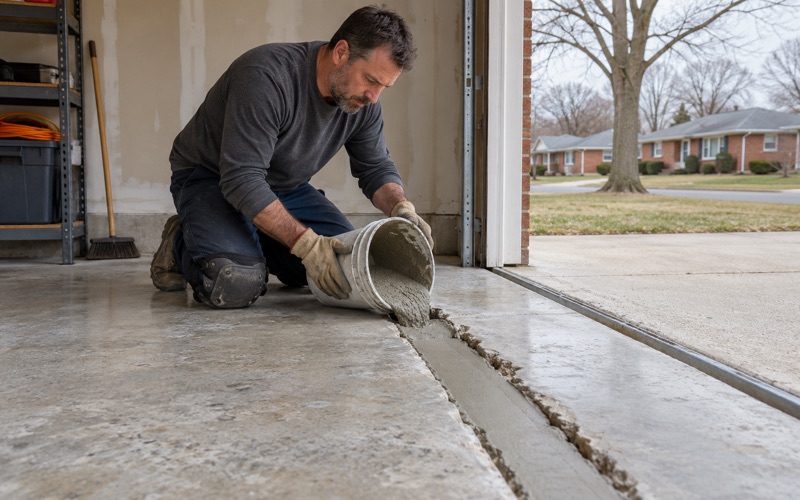
Where the patch meets the old slab there is a joint, and joints are where repairs crack or lift. We fill and level that line before the base coat goes down, so the coated surface reads as one floor rather than a square set into another.
Matching the finish you already have
A solid color with a vinyl flake broadcast or a quartz aggregate broadcast can usually be brought close to the original. A floor that has aged under years of use may still read slightly different at the repair, and we say so before the work starts. Sometimes the cleaner answer is a fresh topcoat over the whole room, such as a polyaspartic or polyurea, so the sheen matches wall to wall.
We also explain what the coating warranty leaves out before you agree to anything, and moisture is the first exclusion we name. A repair that bonds well, sits on a tested patch and is honest about its limits is the one that holds up the next time the meter corner needs attention.
- 20+ Years on Concrete
- Moisture Testing in Every Scope
- Ground, Never Acid-Etched