Elmhurst Epoxy Flooring has spent more than 20 years putting down epoxy flooring in Bellwood garages, basements and working shops, and most of what decides whether a coating stays bonded happens before any resin is mixed. The concrete underneath was finished by someone holding a trowel, and that finish sets how much work the slab needs before it will hold a primer.
We open every slab with a diamond grinder or a shot blaster and never rely on an acid wash, so the coating bonds to sound, textured concrete instead of a slick skin. A moisture test is written into the scope before the price is final. The proposal then names the product line, the number of coats and the finished thickness, which lets you hold the floor up against the paper.
This page covers the part of the job most homeowners never hear about: how the way a slab was troweled changes the prep, what a concrete surface profile actually is, why etching falls short, and what to ask a concrete contractor before pouring a garage floor you intend to coat.
Where Bellwood’s Slab Finishers Learn the Trade
A training floor on 25th Avenue
Cement Masons Local 502 keeps its union hall at 739 S. 25th Avenue, inside the village, and in fall 2017 it opened a 20,000-square-foot training center next door. Apprentices there learn pouring, finishing and removing concrete, and the building was set up so trucks can be brought indoors to pour. A labor-press photo caption from the center shows an instructor teaching the correct way to keep a trowel flat.
That makes Bellwood, a Proviso Township village about 13 miles west of the Loop, the place where many Chicago-area cement masons learn to finish a slab. It is a fitting spot to explain why the finish matters so much to whoever coats the floor later.
The local’s three-year apprenticeship meets at the facility for four weeks each year, or 160 hours a year. We have no connection to the local or its training center, and we have not read what its curriculum says about coatings. We mention it because the slab under a garage coating was shaped by that trade, with its own skills and its own goals.
What a finisher is aiming for
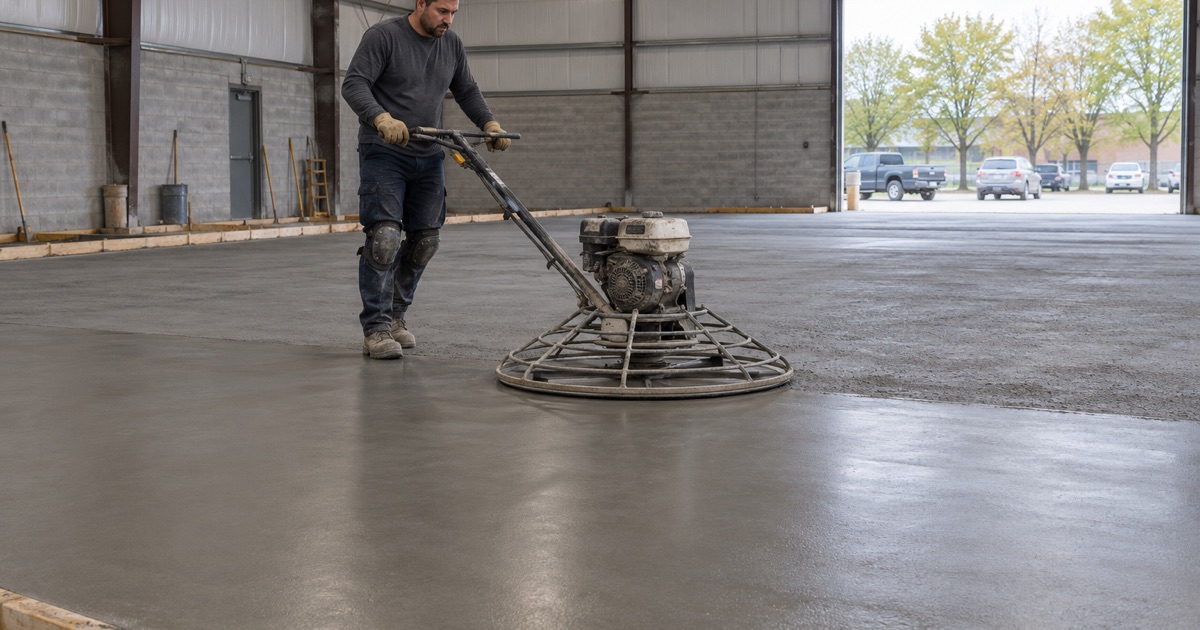
A concrete finisher working a garage or shop slab is usually after a surface that is flat, dense and easy to sweep. Repeated passes with a steel trowel close the surface pores and press the fine paste to the top, and a machine-burnished floor can come out almost glassy. For a bare floor that is a good result, because it sheds dirt and water and cleans with a mop.
Why a coating cannot grip it
The same qualities work against a coating. A dense steel-troweled finish sits at the smooth end of the profile scale, and resin has little to key into when the pores are closed. Rust-Oleum’s industrial epoxy guidance says concrete with a hard steel-troweled finish, or concrete cured with curing compounds, needs shot blasting, sandblasting or another mechanical method before coating.
A quick field check tells a lot. If water dropped on the slab beads up instead of darkening the concrete, the surface is not porous enough, and the same manufacturer’s guidance calls for shot blasting or abrading. Cracks, spalls and old coatings get mapped on the same walk-through, and we say plainly when a slab needs repair or replacement before it should be coated.
Looking for epoxy-flooring closer to Bensenville? See Bensenville Epoxy-Flooring.
Concrete Surface Profile: What CSP 2-3 Means and How We Get There
Concrete surface profile, or CSP, is the industry’s way of describing the texture that mechanical prep leaves behind. The International Concrete Repair Institute scale runs from CSP 1, nearly smooth, to CSP 10, very rough, and installers compare a prepared slab against the institute’s molded reference chips rather than guessing by eye or by feel.
What each resin system asks for
Different systems want different textures. One manufacturer’s technical sheet, Floorguard’s reference on profile by resin system, recommends CSP 2-3 for standard epoxy primers, polyurea basecoats and polyaspartic topcoats, CSP 2-4 for industrial epoxy buildcoats and broadcast flake or quartz systems, and CSP 3-5 for moisture-mitigation primers. Those are one maker’s figures, and the product data sheet for the system actually going down is what governs a given job.
The same sheet warns that the wrong profile often leads to delamination, fisheyes, pinholing and premature wear. Too smooth and the primer has nothing to lock into; too rough for a thin system and the peaks can telegraph through or leave the film starved over the high points.
Grinding or blasting
Two tools reach those numbers. Diamond grinding is the usual choice for CSP 1-3, and it handles edges, tight garages and slabs where an even, modest texture is the target. Shot blasting throws steel shot at the surface and recovers it in the same machine, and the Floorguard sheet points to it for CSP 3 and up, which suits a moisture-mitigation primer or a heavy broadcast system.
Rust-Oleum’s guidance makes the same call for laitance, the weak, powdery layer of fine paste that can form on top of fresh concrete: remove it by diamond grinding or shot blasting.
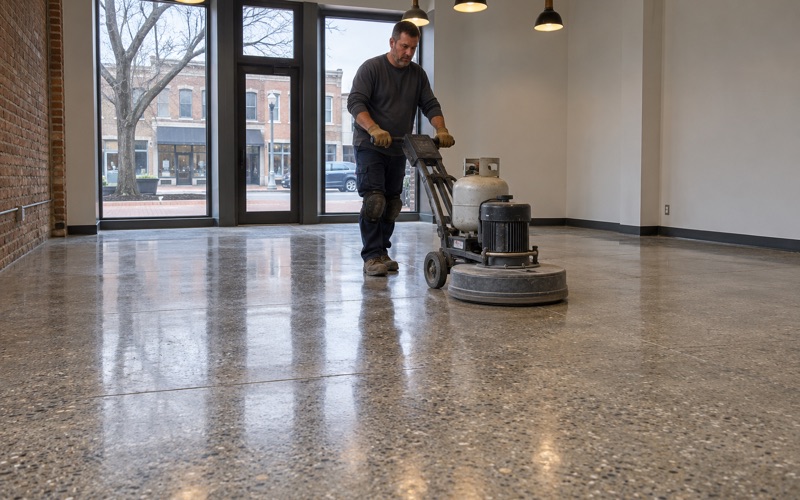
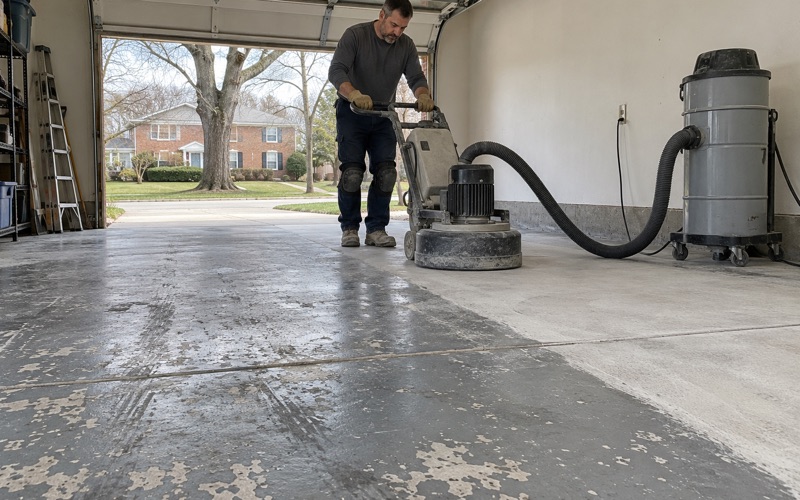
Either way, the dust is pulled into a vacuum at the machine rather than washed toward a floor drain, a sump pit or a storm inlet. On a hard-troweled Bellwood garage slab, the grinder is doing more than scuffing: it is removing the burnished top skin until open, sound concrete shows across the whole floor.
Checking the floor before primer
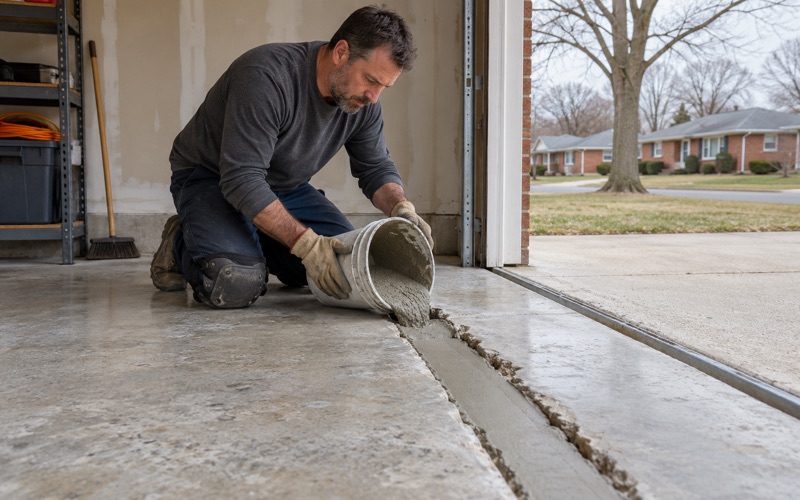
Before any primer goes down, the prepared floor should look evenly opened from wall to wall, including the strip along the garage door and the margins along each wall, where a large grinder cannot reach. We hand-grind those edges, then vacuum the whole slab so the primer lands on clean, open concrete rather than on prep dust.
Why Acid Etching Cleans a Slab but Doesn’t Profile It
Acid etching is still sold as garage-floor prep, mostly in retail kits. The acid reacts with the cement paste at the surface, fizzes, and gets rinsed away, and the slab looks cleaner and feels a little rougher afterward. That is why so many do-it-yourself coatings start with it.
What the acid leaves behind
The Floorguard reference is blunt about it: avoid acid etching, because it does not create adequate CSP. On a dense, steel-troweled slab the problem gets worse. A burnished surface resists the acid the same way it resists a primer, and a coating can end up bonded to a thin, weakened skin rather than to the concrete below, a bond that tends to let go under hot tires or dropped tools.
Etching also brings water into the job. The slab is flooded, scrubbed and rinsed, and the acid residue has to be neutralized and carried off somewhere. In a Bellwood basement or garage, that rinse water often heads straight for a floor drain, which is one more reason our prep stays dry.
Reading a quote that lists etching
If a quote for your floor lists acid etching as the prep step, ask what concrete surface profile the coating maker requires and how the installer will confirm it was reached. A clear answer names a CSP number and a way to check it; a vague one is worth noting before you sign.
What we do instead
Our answer is mechanical prep on every slab, matched to the profile the chosen system calls for and compared with reference chips before any primer is opened. Profile is only half of a bond, though, so the moisture result from the written scope decides whether a standard epoxy primer or a moisture-mitigation primer goes down first.
Pouring a New Garage Slab You Plan to Coat
The cheapest moment to make a slab easy to coat is before the concrete truck arrives. If you are replacing a garage floor or pouring a new shop slab in Bellwood and already know it will get epoxy, polyaspartic or a flake system, tell the concrete contractor that at the bid stage, not after the floor has been troweled.
Questions to settle before the pour
Ask what finish the contractor plans. A hard, burnished steel-trowel finish looks sharp on bare concrete, but it is the surface we will spend the most time grinding open later. Ask whether a lighter finish suits a slab that is getting a coating anyway, and listen to the reasons if the answer is no; the finisher knows the mix, the weather and the crew.
Ask how the slab will be cured. A cure-and-seal compound is a common choice, and on a floor that will be coated it is a film we would only have to grind off before priming. Agree on the curing method with the concrete contractor in writing, so nobody applies a product out of habit on the last day of the pour.
If the slab is already poured and burnished, nothing is lost. It just means more grinding time, which belongs in the quote rather than a surprise on the day.
Ask about what goes under the slab, too. A vapor retarder below a garage or basement floor changes how much moisture the finished coating will see, and it cannot be added once the concrete is placed. Permit questions for a new slab go to the Village of Bellwood Building Department, so confirm with the contractor who is handling them.
Scheduling the coating itself
Once the new slab is in place, our own schedule follows the slab, not the calendar. We read slab temperature and the dew point spread at the surface before a batch is opened, and an unheated Bellwood garage in deep winter is told to wait for warmer conditions rather than coated into a bad cure.
A garage system also has to stand up to the brine and rock salt that ride in on tires all winter, so the topcoat is chosen for that. And if a home job crosses the state threshold, you get a written contract and the Illinois Home Repair: Know Your Consumer Rights pamphlet before any grinding starts.
- 20+ Years on Concrete
- Moisture Testing in Every Scope
- Ground, Never Acid-Etched